Given that God belongs to all who seek, Given that re-fathering by God in Jesus is always on offer, Given that God reigns in the heavenly throne room In the vastness of the created universe, In the intimacy of the skies above and the air we breathe – His Name is hallowed — it could not be otherwise.
Yet the Incarnate Logos bids us be bolder: The creation and its creatures are not yet as they should be. The ironically named homo sapiens languishes in the ruins of its own priesthood.
The Incarnate Logos has taken those priestly ruins Into Himself. And knowing at last the darkness of the estranged priest, cries out: Eli, Eli lama sabach-thani? And like Gandalf with the Balrog, carries the poisoned priesthood into death.
But this is no wizard of epic tales, It is the Word behind all storytelling. Death is dead. The Word liberates its former prisoners, slaves of Mordor. And on the third day…
The Kingdom earlier proclaimed is coming into focus. The Kingdom prayer gains incarnate substance, And therefore greater urgency. Thy Kingdom come, he taught them, Thy will be done – where? In me, in her who shares her life with me, In us – an entity created by our vows in Him. In places like the community in which we live, And like the city where we served for fifteen years. In all those places – in all places – on earth as in heaven? Which heaven? For this is singular. Is it the Third – maybe from our perspective. Or from the King’s – the first.
And this we pray as He taught us.And this we pray so often. And this we pray sometimes carelessly. And this we pray sometimes desperately. And in praying this often or carelessly or desperately, We have volunteered to be part of the answer.
Advent, at least as far as the assigned Gospel readings were concerned, always felt backwards to me. We begin at the end, with signs of the end of the age and Jesus’ return, and we end at the beginning with either the Annunciation, Joseph’s dream, or the Visitation. In the prior lectionary (found in the 1928 Book of Common Prayer and going back to the 1662 Prayer Book from the Church of England), the annual Gospel reading for the First Sunday of Advent was Matthew’s version of the Triumphal Entry and the cleansing of the temple. But by the time I was confirmed, though the 1928 book was still in use, most Episcopal churches had adopted the three year cycle of readings which insisted on putting the end at the beginning, so that’s where I begin as well.
But why? Why begin the run up to the celebration of the coming of the Savior with such grim descriptions of the end times? I don’t know what prompted whatever committee was responsible for the lectionary revision, but my own take was that the readings and the prayer for the First Sunday of Advent was an assurance that the whole story we’d just rehearsed in the Christian Year just end was actually going somewhere. It would be both dramatic and traumatic, even for apprentices of Jesus and even more so for those who rejected the king and the kingdom. But in the end, justice would prevail and yet mercy would triumph over justice. And with that enigmatic word, the readings of the season move on to the forerunner, John the baptizer; and finally to the focus on Mary (and Joseph) in the months leading up to the birth of the Christ.
But that jarring beginning to Advent, while of relatively recent vintage, is essential as we start the observation of yet another Christian Year There will come a time when the upward spiral of the annual liturgical pilgrimage will reach its conclusion, the season of joyful anticipation will find its fulfillment, and the story will have finally – not concluded, but arrived. Even so, come Lord Jesus. And until You come, we’ll keep telling the story.
Our Father who art in heaven … and just where is that? And what has some heavenly Being – wherever He is have to do with me – earthbound and suffocating in my own technological waste products?
But the word in the prayer is NOT HEAVEN that’s only a lazy translation. It is HEAVENS – plural – and that means something, though timid teachers insist it does not.
But WARNING: here there be rabbit holes! And nary a white rabbit in sight. How many heavens? What is contained in earth? Are they related to the universe we study? More holes. Fewer rabbits. Maybe we should keep it simple.
“We” is the key word. Our construct. Our illustration. Our impressionistic representation. We’ll make it three in Trinitarian fashion, The third first, as the Apostle tells the story.
It is the throne room of the Creator, The control room according to an English prelate. The central core from which all creation And creativity flow.
The second heaven where the Nebulae In grave and violent delight Conduct their majestic reel, And nearer at hand the spheres dance To the music of their movement.
The first heaven is that In which we live and move and have our being… As the poet said of God. But the first heaven is also where God is, as close as the air we breathe. Soaring with eagles, riding on the clouds, Reigning on the throne.
Our Father in the Heavens, there is nowhere where you are not. Preserver of the memories of our earth fathers’ love, Healing the wounds of the wounded and wounding fathers You are Father to the fatherless.
You set us in the midst of uncomfortable company We share our lives with you in them. It is the Our of our Father And in that Our we give and receive instruction, wisdom and blessing.
But if “Our” is problematic, “Father” is a veritable minefield.
Did Jesus know what a can of worms he opened? Was Joseph so loving, so present, so formative that Father was a safe image?
Maybe Jesus’ experience of life was unlike ours, whose fathers were a mixture of iron and clay, like ours, whose fathers were present and loving though never perfect, like ours, whose fathers were angry, wounded, and wounding like ours, whose fathers were absent by death, like ours, whose fathers were absent by desertion.
Or maybe the Incarnation is true, deity embracing the fullness of humanity and Jesus had a normal home.
Maybe Joseph had that most Christian of virtues – humility.
Maybe Joseph could step back and give space for the HeavenFather to radiate blessing.
To pray “Father” means to give space for God; to recall the ways our fathers gave space to the HeavenFather.
To pray “Father” means to expose the deep wounds left by mortal fatherhood and allow ourselves to be re-fathered from on high.
This week’s post, updated from a few years back, is continuing the Glacial Transformation theme. I’ve also prepared a post on human priestliness, tentatively titled “The Priesthood We Cannot Escape.” It’s about 60% complete which means it could be posted by Friday, or maybe sometime in early November. Before the advent of smartphones and social media I was perfectly capable of distracting myself into immobility. I really didn’t need help. But on with Glacial Transformation:
In the previous post, I examined Simon the Magician (Acts 8) as an example of an inadequate concept of conversion. If what is often called conversion is simply the inauguration of the conversion process, then Simon’s conversion, as told in that story, was merely a small beginning. The text does not support the attempts of many commentators to cast doubt on the authenticity of that beginning. Those attempts only reveal an assumption that the beginning is supposed to be the end. It is not. It is just the beginning.
Yet the distance between our beginning and our end – to show, unsullied, the character and person of Jesus through the lens of our unique personalities – is a long journey in which no part of our lives can be left unexamined. If that is a challenge to an individual Christian, it is a much greater one to a Christian community. The challenge becomes even more daunting because our cultural bias in the West leads us to underestimate both the reality and the power of community. While an individual may have some influence on a community, a community has a personality and a life that is not only greater than the sum of its parts, but is more capable of influencing us than we it. James K.A. Smith makes a similar observation regarding a type of community, the cultural institution: “However, there is an important sense in which cultural institutions take on a life of their own; while they are ultimately human creations, once they’re up and running, they cannot be reduced to the particular whims and interests of particular human beings. They assume a kind of systemic power that gives them an influence independent of individual agents. The result is that while cultural institutions are essentially human creations, there is also an important sense in which humans are the products of the formation we receive through cultural institutions.[1]
We find a more whimsical version in John Gall’s last edition of his book, The Systems Bible (the third edition of his original work, Systemantics). “Systems are like babies: once you get one, you have it. They don’t go away. On the contrary, they display the most remarkable persistence. They not only persist, they grow.[2]
The New Testament recounts the formation of numerous new communities through St. Paul’s missionary work. One community that seems particularly to have struggled with the process of conversion is the Christian community in the city of Corinth. At the time of Paul’s writing, Corinth was a thriving and prosperous port city. Like many commercial centers in our times, it was an expensive place in which to live. Additionally, like many modern cities, there were significant disparities in wealth, status, and education. The first Christian communities were notable for the diversity of their members: Jews and Gentiles, women and men, the rich and the poor, slaves and citizens of Rome. And yet…
Despite having a robust spiritual life, the Corinthian church faced some significant problems. The culture of the city infiltrated the church through its members. Several issues that Paul addresses in his letters reflect the culture of the city. There are factions around leaders. The eloquent Apollos and the blunt Paul are sharp contrasts, and the congregation seems split between the educated, who appreciate the oratory of Apollos, and those who prefer the blunt directness of Paul. There is also religious division between those who are sophisticated enough to disregard the old gods and goddesses of the classic world and those who still find power, however sinister, in the old religion.
However, the most significant evidence of a not-quite-converted community is in their “love feast,” which is a common setting for observing the Eucharist, also known as the Lord’s Supper. The continuing separation based on wealth and privilege has some with nothing to eat at the feast and some who continue pagan patterns of overindulgence. Jew and Gentile sharing a meal would be a radical thing for the Jewish believers in this new community. But sharing a meal with the rich and the poor was equally radical – a sign of a new humanity in Christ. The separation experienced in the Corinthian meal (one cannot call it a common meal!) was a clear indicator that the life of Christ’s new community had not yet permeated the customs and expectations of the Corinthian church.
Although much of Paul’s first letter is devoted to corrections, this was not a failed community. It was simply a community in the early stages of conversion. There was sufficient awareness within the community that a delegation had come to Paul, expressing their distress and concern. In one important regard, the situation of the Corinthian church was much clearer than that of churches in the West, particularly in the US. The world of ancient Corinth was a pagan world, characterized by its values and expectations. There was a Jewish presence in the city, but the separation Jews maintained from the surrounding culture meant that the life of the Torah had little impact or influence. In our day, on the dying edge of Christendom, the distinctions are not quite as clear. The assumption that Christianity is “normal,” even though its normalcy is under siege, masks the need of a community to experience ongoing conversion. The problem with “normal” is the question of whose norm we apply. Perhaps the ending of our former normal is a God-given moment where we can test that passing normal against the norms that Jesus and Paul set forth for the church.
What can help us get our communal conversion back on track is to explore the New Testament’s description and expectation of what a church is supposed to look like. Once we discover the disconnect between that description and expectation and the characteristics of “norms” of church life, conversion can resume in earnest.
As there is (and always will be) a certain randomness in both the frequency and content of my writing, I think it best to let my small band of subscribers and followers know that there is a kind of method to this chaos. First, there’s ADHD. It’s become a popular diagnosis, or perhaps it’s just that that particular neuro configuration prompts people to write online. The good folks at Kaiser Permanente diagnosed me with ADHD in 2014, and it explained a great deal about my scholastic inconsistency throughout my schooling. Medications seemed to have no effect, so I’ve learned other ways of coping. However, I do warn people that although I’m rather good at improvising in a crisis, no one should ask me to plan anything important.
That demurrer given, here are the four areas in which I will be posting in the foreseeable future:
Being an Apprentice. This includes the currently interrupted series on “The Art of Paying Attention.” There will be future posts coming – but not just yet.
Spiritual Formation. I present this under the description of “Glacial Transformation.” I’ve posted twice under this title with two more to come – eventually.
Priesthood. Dallas Willard writes that human life “essentially involves meaning. Meaning is not a luxury for us. It is a kind of spiritual oxygen, we might say, that enables our souls to live.”[1] Priests are weavers of meaning, taking the ordinary things and experiences of life and giving them meaning beyond simple description. I identify four and a half types of priest in the Bible: 1) Adamic (universal humanity); 2) Aaronic (cultic); 3) Christ’s (uniquely restorative); 4) Christian (derivative); and the half priesthood, Presbyteral (exemplary). I have a few outlines, but nothing is ready for posting yet.
Random Shiny Objects. As ideas and encounters catch my attention, they may occasionally appear as unrelated posts. For example, the herd of elk that passed my study window when I was trying to start writing this post.
Once I’ve reviewed and posted this, I fully expect my consciousness to go into “white noise” mode for at least the next 24 hours. Peace and Good to all.
[1] Dallas Willard. The Divine Conspiracy. 1998 p. 386
It seemed an inauspicious beginning. Last November, in an effort to revive this long dormant blog, I offered a simple post on being an Apprentice of Jesus. That post did not contain a single reference to any spiritual disciplines. The omission was not intentional, but it wasn’t an oversight either. A vague sense of discomfort plagues me when I start to write or teach about spiritual disciplines, rules (or ways) of life, or any of the elements contained in an otherwise welcome renewal of interest in spiritual formation. At least it was vague until I remembered an article by James Bryan Smith written for the September 2022 issue of Christianity Today magazine.. Smith was Dallas Willard’s teaching assistant for his courses at Fuller seminary and worked with Willard and Richard Foster in launching the Renovaré ministry in the late 1980s. Smith’s article was “Dallas Willard’s 3 Fears About the Spiritual Formation Movement.”
According to Smith:
“[Dallas] worried that the focus would be on the practice of the spiritual disciplines themselves rather than on what they were intended to do. Dallas felt this would naturally degenerate into a focus on technique—on the how and not the why of the spiritual exercises. Dallas also feared that churches would co-opt interest in spiritual formation as a tool for church growth—and that, because it likely would not lead to numerical growth, leaders would then relegate formation to one of many departments in a church rather than viewing it as central to their mission. Finally, he was concerned that the growing number of formation ministries would compete with each other—rather than cooperate—in order to validate their work and ensure their survival.”
On the second and third of Dallas Willard’s fears, I may offer some thoughts in a later post. However, the first fear listed raises an important question: what exactly is the “why” of the spiritual exercises? To begin to answer that question, one can look at the consequences focusing primarily on the “how” of the disciplines. Fortunately, Smith address this in another Willard quote:
“In one of our last conversations together, I asked Dallas what would be at stake if his fears became reality. His answer: ‘A lack of transformation into Christlikeness.’”
But is it possible that such transformation is less the goal of the disciplines than it is the effect of seeking that goal? Another of Smith’s recollections give us a hint.
“Dallas taught that disciplines such as prayer, solitude, and Scripture memorization are only one part of the formation process. The second part is the work of the Holy Spirit, and the third is learning how to see life’s trials and events in light of God’s presence and power. One of Dallas’s fears—something he essentially predicted—was that interest in the practice of the disciplines, while essential, would eclipse the other two parts.”
These parts are not three unconnected activities, but three interconnected aspects of the work of apprenticeship. The work of the disciplines is something we do. The way we see our life “in the light of God’s presence and power” is something that grows in us as we become more aware of God’s involvement in our lives. However, the work of the Holy Spirit is God’s sovereign work – which is not to say that we have no part to play in that work. The work we do is in creating space in our lives for the Spirit of God to take up residence and produce the fruit of the Spirit: love, joy, peace, forbearance, kindness, goodness, faithfulness, gentleness, and self-control. Or in other words, the character of Christ.
The disciplines are the essential tool in creating this space. And, oddly enough, preparing to go to sleep is a good analogy for the process. Philosopher Jamie Smith addresses this in his book Imagining the Kingdom. Throughout the book Smith intersperses brief insets under the title of “To Think About.” Drawing on some writing by philosopher Maruice Merleau-Ponty, Smith writes:
I cannot “choose” to fall asleep. The best I can do is choose to put myself in a position that welcomes sleep. I want to go to sleep, and I’ve chosen to climb into bed – but in another sense sleep is not something under my control nor at my beck and call. “I call up the visitation of sleep by initiating the breathing and posture of the sleeper … There is a moment when sleep ‘comes,’ settling on this imitation of itself which I have been offering to it, and I succeed in becoming what I was trying to be.” (Phenomenology of Perception, Merleau-Ponty, P 189-90, emphasis added.) Sleep is a gift that requires a posture of reception – a kind of active welcome. What if being filled with the Spirit had the same dynamic? What if Christian practices are what Craig Dykstra calls “habitations of the Spirit” precisely because they posture us to be filled and sanctified? What if we need to first adopt a bodily posture in order to become what we are trying to be? (James K.A. Smith. Imagining the Kingdom (Grand Rapids, MI, Baker Academic, 2013), p. 65)
This is an idea and image worth exploring and it raises both further questions and further concerns. The concern that is foremost in my own thinking is the communal context of the Christlike life. Throughout the New Testament the primary context of Jesus’ teaching, and that of Paul and the other New Testament writers, is the corporate nature of discipleship. The “lone ranger” kind of discipleship/apprenticeship is a figment of our western imagination, it cannot be found in the Scriptures.
From that New Testament perspective I can only be a disciple in the context of a community of disciples. I can only be an apprentice in the context of a community of apprentices. This brings to my mind a book by the Rev. Dr. Alison Morgan, Following Jesus. While the book is a valuable tool for any group of apprentices, it is the secondary title that caught my imagination: The Plural of Disciple is Church. If that’s true, and I believe it is, then I come back at last to my revisionist version of Inigo Montoya: “Church! You keep saying that word. I do not think it means what you think it means!”
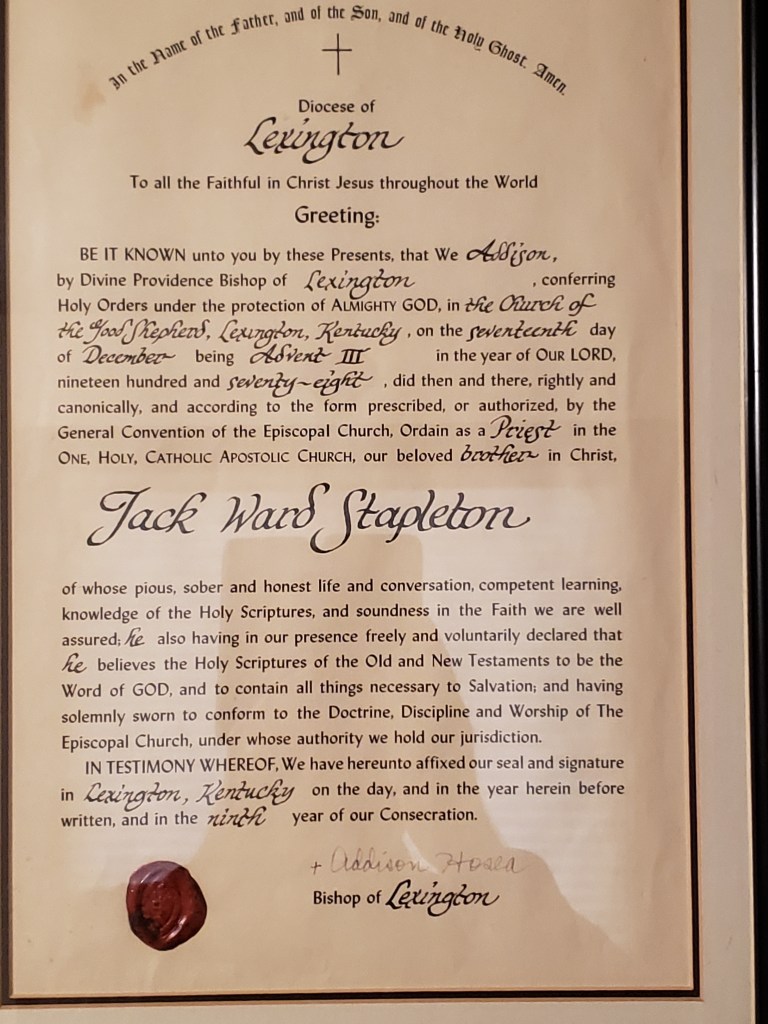
It isn’t my age. In fact, I can barely remember being 46. But it was on this day 46 years ago, in 1978, that I was ordained a priest in the “One, Holy, Catholic, Apostolic Church.” At least that’s what the ordination certificate says.
Although Evergreen, Colorado, has a number of excellent coffee shops and some remarkable brew pubs, I’m not expecting any anniversary discounts today. Being an Episcopal priest is not a particularly notable status in our culture – and it never was as important as we thought it was back in more religious times. That is NOT to say that being a priest is insignificant, only that its significance is not in the arena of national cultural life.
A person ordained a priest maintains two statuses. First is in the Holy Order of priesthood. That status is reflected in three functions: presiding at the Eucharist in the gathered Christian community, pronouncing blessings, and declaring absolution from sin. The second status is the ministry in which the ordained person participates. That can be in parish ministry, institutional chaplaincy, education, or any number of ministries that we can exercise over the years.
The arena in which I exercised Holy Orders has been exclusively the local congregation until I retired at the end of 2018. It was only in the last years of parish ministry that I finally stumbled on a connection between Orders and Ministry that changed the way in which I exercised ministry in the parish. (I have no doubt that many Episcopal priests have been aware of and functioning in that connection for most of their ordained life. I’ve always been a bit slow to catch on.)
The connection is the role of the parish priest in modeling the priesthood that the church members possess in Christ. In short, to teach others to bless, to teach others to pronounce forgiveness of sins, and to teach others to make common things holy (as in Holy Communion) by offering them to the God who transforms and transfigures. That is why this blog is called “The Apprentice Priest.” And that’s what I hope to explore in greater detail in the coming months and (maybe) years.
I would love a day to come when this article, first written eight years ago, would be irrelevant to our times. Unfortunately, that day is not today. The following article was written for the parish newsletter of Trinity Episcopal Church, Greeley, Colorado in 2016. I posted it again in 2020. I thought about updating it then and now, but aside from references to my former parish and the “Trinity Way of Life” it is unfortunately as relevant in 2024 as it was in 2020, and 2016, and every year in between.
So who in the world is Fursey? He’s a rather obscure Irishman who gets a mention in Bede’s History of the English Church and People. I read that book in seminary and for something written in 731 AD it’s quite readable. Bede mentions quite a few Irishmen for a book devoted to the development of Anglo-Saxon England. Each year I get a reminder of Fursey for a week during the second week of Advent in the prayers Dorie Ann and I use at the lighting of our Advent wreath at home. One section of the devotional tells of a vision of “four fires through which unclean spirits threatened to destroy the earth.” They are listed as the destroying fire of falseness, the destroying fire of greed, the destroying fire of disunity and the destroying fire of manipulation. And each year, but particularly this one, we comment on how contemporary this feels.
Fortunately, the devotional doesn’t end there. It continues: But Fursey urged everyone he met to do as the angels told him: to fight against all evils. He encouraged them with these words he had heard: “The saints shall advance from one virtue to another;” and, “The God of gods shall be seen in our midst.”
At first the encouragement Fursey offers seems pretty pale against a set of destroying fires. In a world that seems beset by falseness, greed, disunity and manipulation we might be excused for wanting stronger stuff that what is on offer. Yet implied in these messages from the angels is a charge to follow the Jesus path as the means by which God overcomes the destroying fires.
The first charge is to fight against all evils. The first all too human reaction is to take up arms, whether political, economic or military, meeting might with might to set things right. This is not the Jesus path. If we fight fire with fire, fire always wins. There are other ways to fight against evil than to use the tools of evil. Paul enjoins the Roman Christians to follow the Jesus path in these words: “Do not be overcome by evil but overcome evil with good” (Romans 12:21) To confront evil with good seems anti-intuitive to us, but only because the Jesus path is not the path that we were taught either by the world around us or even, sadly, by the church much of the time.
To fight against all evils means that wherever we find cursing in word or action we respond by blessing in word and action not only the victim but even the perpetrator. In the orbit of our reach, no evil done to others is irrelevant to us. We are God’s agent of blessing and that is our first duty.
The next word to Fursey from the angels is that “the saints will advance from one virtue to another.” We dare not turn this into an inward concern about building our own character. Virtue has substance only in so far as it is demonstrated by word and action in our relations with others. Advancing from one virtue to another means that our growth in Christ and therefore in virtue is a continuous journey. The primary function of a spiritual discipline, whether the Trinity Way of Life* or any other set of disciplines is to keep and guide us on that journey. Therefore, it is never enough to simply come to worship, listen to teaching, receive nourishment in the Sacrament and then drop back to spiritual passivity for the remains of the week. What we receive we are to apply through the tools of our spiritual disciplines until we rejoin the worshiping community the following Sunday to build one another up, to share the stories of what God has done, accept the divine strength given in Holy Communion and return to the fray growing in the good works God is preparing for us.
The final word from the angels is that the God of gods shall be seen in our midst. In late November we began a preparation for Christmas in Advent and we are just now completing the 12 days of Christmastide. The birth of Jesus is the story of the God of Israel joining Israel in the midst of Israel. The God of gods is seen in their midst even though many do not recognize him. John’s Gospel notes that “He came to that which was his own, but his own did not receive him. Yet to all who did receive him, to those who believed in his name, he gave the right to become children of God– children born not of natural descent, nor of human decision or a husband’s will, but born of God.” (John 1:11-13) This adoption by God in Jesus is done through our baptism and its significance extends far beyond our personal salvation.
It cannot be said often enough that Christmas is not the end of the story of God’s redeeming work but its beginning. Jesus’ life, works and words covered a period of 33 years. The culmination of those years was traumatic and dramatic. But even that was not the end of the story. In fact, the Jesus story is still going on, acted out by generation of generation of apprentices of Jesus. The God of Israel entered Israel but now moves beyond the community of Israel into the gentile world. Wherever we are faithful, the God of gods is seen in our midst.
This past year has been a difficult and painful year all over the world and also in our local community. There seems to be an encroaching darkness that fills millions and even billions of people with anxiety and fear. But as John the evangelist also notes: “In him was life, and that life was the light of all mankind. The light shines in the darkness, and the darkness has not overcome it.” (John 1:4-5) In 2017 the challenge to the community at Trinity (and to Christian communities everywhere) is to be bearers of that light. In times of anxiety and fear we have a mission to carry out. If we take that mission seriously and execute it prayerfully and faithfully the destroying fires of falseness, greed, disunity and manipulation will never have their way.
*As of 2018 the Trinity Way of Life included Pay Attention (prayer), Show Up (community), Serve Others (service), Learn the Story (study), Give as you receive (generosity), Check In (accountability), Practice Gratitude (thankfulness), and Tell the story (witness).


 The Apprentice Priest