

Life at 46

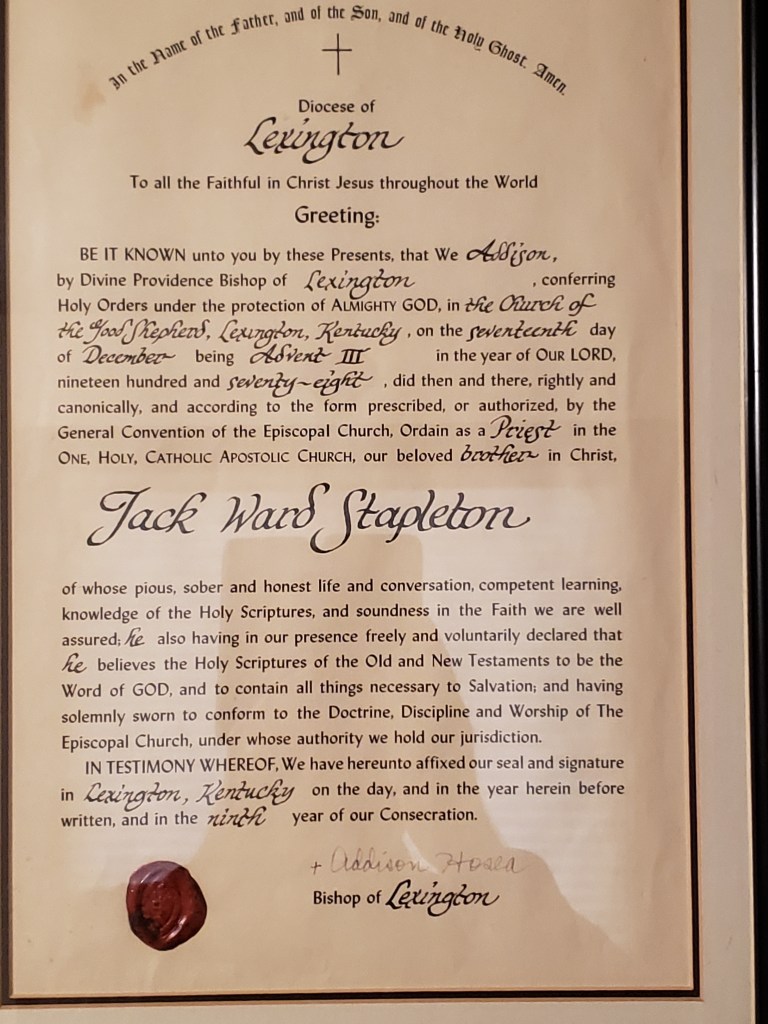
It isn’t my age. In fact, I can barely remember being 46. But it was on this day 46 years ago, in 1978, that I was ordained a priest in the “One, Holy, Catholic, Apostolic Church.” At least that’s what the ordination certificate says.

Although Evergreen, Colorado, has a number of excellent coffee shops and some remarkable brew pubs, I’m not expecting any anniversary discounts today. Being an Episcopal priest is not a particularly notable status in our culture – and it never was as important as we thought it was back in more religious times. That is NOT to say that being a priest is insignificant, only that its significance is not in the arena of national cultural life.

A person ordained a priest maintains two statuses. First is in the Holy Order of priesthood. That status is reflected in three functions: presiding at the Eucharist in the gathered Christian community, pronouncing blessings, and declaring absolution from sin. The second status is the ministry in which the ordained person participates. That can be in parish ministry, institutional chaplaincy, education, or any number of ministries that we can exercise over the years.

The arena in which I exercised Holy Orders has been exclusively the local congregation until I retired at the end of 2018. It was only in the last years of parish ministry that I finally stumbled on a connection between Orders and Ministry that changed the way in which I exercised ministry in the parish. (I have no doubt that many Episcopal priests have been aware of and functioning in that connection for most of their ordained life. I’ve always been a bit slow to catch on.)

The connection is the role of the parish priest in modeling the priesthood that the church members possess in Christ. In short, to teach others to bless, to teach others to pronounce forgiveness of sins, and to teach others to make common things holy (as in Holy Communion) by offering them to the God who transforms and transfigures. That is why this blog is called “The Apprentice Priest.” And that’s what I hope to explore in greater detail in the coming months and (maybe) years.

Reconnecting: The Apprentice Part

In an ongoing effort to render this old blog site habitable, a few items of furniture need to be brought into the sunlight again for a thorough cleaning. The first piece of furniture relates to the choice of its name: The Apprentice Priest.

Why Apprentice?

Today apprentice is not a synonym for disciple – but that’s because being an apprentice isn’t what it used to be. Unlike the reality show version of apprentice, modern apprenticeship is a step towards professional status in a trade. It does not involve living with one’s instructor or observing their lifestyle and character. 

I picked up the practice describing myself as an apprentice from Dallas Willard. He well may be the source of the current adoption of apprentice as an alternative to disciple. But apprentice is probably popular because it is new. Human culture will undoubtedly be able to drain it of substantial meaning as we did with Christian and disciple. Christian and Christianity are terms that come loaded with a great deal of baggage that has little to do with what we read in the New Testament. While I am happy to be known as a follower of Jesus or an apprentice of Jesus, I prefer not to accept the term Christian until I understand what associations it has for the person with whom I am speaking.

Disciple has its own problems. Alison Morgan reports: “In 2011 the Anglican Diocese of Gloucester conducted a survey among its clergy, asking what they regarded as the most important elements of discipleship. The survey reported widespread agreement across the diocese: clergy from all contexts and traditions selected ‘Bible study’ as the foremost activity of a Christian disciple, followed by ‘prayer.’ There was no suggestion that discipleship should involve any element either of ministry or lifestyle; indeed, ‘personal morality’ was rated bottom of the seventeen options offered, along with ‘witness’ and ‘faith at work.’”[1]  

Morgan later observes: “Jesus wasn’t training theologians; he was training practitioners, and the primary context of training was not the classroom but the community.’[2] This is consistent with Dallas Willard’s contention that “The term ‘discipleship’ has currently been ruined so far as any solid psychological and biblical content is concerned.”[3]

On the other hand, apprentice has an advantage over the other terms. Christian is rarely used to imply any relationship except that between Christ and the individual believer. However, to be an apprentice, you usually have to be apprenticed to someone. One can be a disciple of anyone, living or dead. But one can only apprentice oneself to a living person. Therefore, to be an apprentice of Jesus means a) that He is alive, b) He is accessible in relationship, and c) that relationship is capable of growing, evolving, and deepening.

Being an apprentice of Jesus the Christ is where I want to be. Sharing some of that journey’s failures and successes is one reason I’m resurrecting The Apprentice Priest. And the “priest” part of this? Maybe in a couple of weeks, I’ll have more to say.


[1] Alison Morgan, Following Jesus: The Plural of Disciple is Church, ReSource, c. 2015, p. 44

[2] Ibid, p. 48

[3] Dallas Willard, The Great Omission p. 53