Published on Substack 30 July 2025

Published on Substack 30 July 2025
Part 1
The new post on Substack: https://apprenticepriest.substack.com/p/the-art-of-paying-attention-314
Read it on the Apprentice Priest Substack
https://apprenticepriest.substack.com/p/the-art-of-paying-attention
It started with me a long time ago and it’s still going on.
https://apprenticepriest.substack.com/p/the-priesthood-of-adam-and-the-shape
Follow this link for a new post on Substack: https://open.substack.com/pub/apprenticepriest/p/the-priest-part?r=5axlfw&utm_campaign=post&utm_medium=web&showWelcomeOnShare=true
Being retired, one has enough time to get into mischief, or in my case, into Substack. This is something thrown together quickly after reading too many Substack posts on the decline of the churches. It’s not that churches aren’t declining. It’s more that the struggles of the institutional church distract us from the deeper reality of Church. (Click below)
It seemed an inauspicious beginning. Last November, in an effort to revive this long dormant blog, I offered a simple post on being an Apprentice of Jesus. That post did not contain a single reference to any spiritual disciplines. The omission was not intentional, but it wasn’t an oversight either. A vague sense of discomfort plagues me when I start to write or teach about spiritual disciplines, rules (or ways) of life, or any of the elements contained in an otherwise welcome renewal of interest in spiritual formation. At least it was vague until I remembered an article by James Bryan Smith written for the September 2022 issue of Christianity Today magazine.. Smith was Dallas Willard’s teaching assistant for his courses at Fuller seminary and worked with Willard and Richard Foster in launching the Renovaré ministry in the late 1980s. Smith’s article was “Dallas Willard’s 3 Fears About the Spiritual Formation Movement.”
According to Smith:
“[Dallas] worried that the focus would be on the practice of the spiritual disciplines themselves rather than on what they were intended to do. Dallas felt this would naturally degenerate into a focus on technique—on the how and not the why of the spiritual exercises. Dallas also feared that churches would co-opt interest in spiritual formation as a tool for church growth—and that, because it likely would not lead to numerical growth, leaders would then relegate formation to one of many departments in a church rather than viewing it as central to their mission. Finally, he was concerned that the growing number of formation ministries would compete with each other—rather than cooperate—in order to validate their work and ensure their survival.”
On the second and third of Dallas Willard’s fears, I may offer some thoughts in a later post. However, the first fear listed raises an important question: what exactly is the “why” of the spiritual exercises? To begin to answer that question, one can look at the consequences focusing primarily on the “how” of the disciplines. Fortunately, Smith address this in another Willard quote:
“In one of our last conversations together, I asked Dallas what would be at stake if his fears became reality. His answer: ‘A lack of transformation into Christlikeness.’”
But is it possible that such transformation is less the goal of the disciplines than it is the effect of seeking that goal? Another of Smith’s recollections give us a hint.
“Dallas taught that disciplines such as prayer, solitude, and Scripture memorization are only one part of the formation process. The second part is the work of the Holy Spirit, and the third is learning how to see life’s trials and events in light of God’s presence and power. One of Dallas’s fears—something he essentially predicted—was that interest in the practice of the disciplines, while essential, would eclipse the other two parts.”
These parts are not three unconnected activities, but three interconnected aspects of the work of apprenticeship. The work of the disciplines is something we do. The way we see our life “in the light of God’s presence and power” is something that grows in us as we become more aware of God’s involvement in our lives. However, the work of the Holy Spirit is God’s sovereign work – which is not to say that we have no part to play in that work. The work we do is in creating space in our lives for the Spirit of God to take up residence and produce the fruit of the Spirit: love, joy, peace, forbearance, kindness, goodness, faithfulness, gentleness, and self-control. Or in other words, the character of Christ.
The disciplines are the essential tool in creating this space. And, oddly enough, preparing to go to sleep is a good analogy for the process. Philosopher Jamie Smith addresses this in his book Imagining the Kingdom. Throughout the book Smith intersperses brief insets under the title of “To Think About.” Drawing on some writing by philosopher Maruice Merleau-Ponty, Smith writes:
I cannot “choose” to fall asleep. The best I can do is choose to put myself in a position that welcomes sleep. I want to go to sleep, and I’ve chosen to climb into bed – but in another sense sleep is not something under my control nor at my beck and call. “I call up the visitation of sleep by initiating the breathing and posture of the sleeper … There is a moment when sleep ‘comes,’ settling on this imitation of itself which I have been offering to it, and I succeed in becoming what I was trying to be.” (Phenomenology of Perception, Merleau-Ponty, P 189-90, emphasis added.) Sleep is a gift that requires a posture of reception – a kind of active welcome. What if being filled with the Spirit had the same dynamic? What if Christian practices are what Craig Dykstra calls “habitations of the Spirit” precisely because they posture us to be filled and sanctified? What if we need to first adopt a bodily posture in order to become what we are trying to be? (James K.A. Smith. Imagining the Kingdom (Grand Rapids, MI, Baker Academic, 2013), p. 65)
This is an idea and image worth exploring and it raises both further questions and further concerns. The concern that is foremost in my own thinking is the communal context of the Christlike life. Throughout the New Testament the primary context of Jesus’ teaching, and that of Paul and the other New Testament writers, is the corporate nature of discipleship. The “lone ranger” kind of discipleship/apprenticeship is a figment of our western imagination, it cannot be found in the Scriptures.
From that New Testament perspective I can only be a disciple in the context of a community of disciples. I can only be an apprentice in the context of a community of apprentices. This brings to my mind a book by the Rev. Dr. Alison Morgan, Following Jesus. While the book is a valuable tool for any group of apprentices, it is the secondary title that caught my imagination: The Plural of Disciple is Church. If that’s true, and I believe it is, then I come back at last to my revisionist version of Inigo Montoya: “Church! You keep saying that word. I do not think it means what you think it means!”
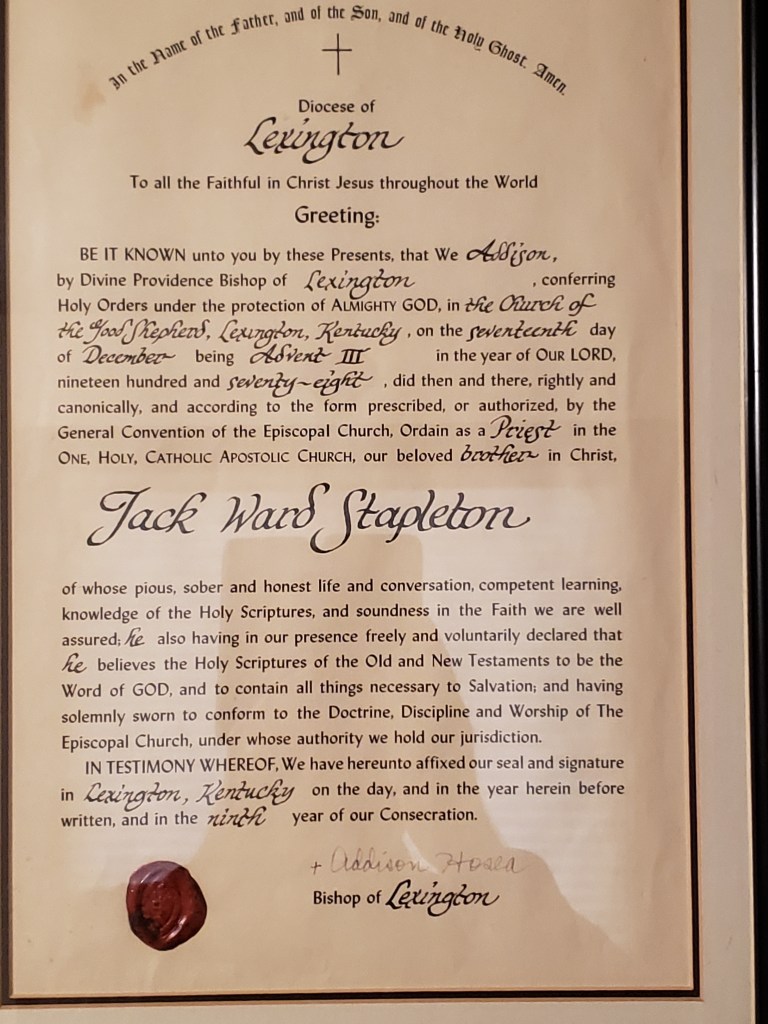
It isn’t my age. In fact, I can barely remember being 46. But it was on this day 46 years ago, in 1978, that I was ordained a priest in the “One, Holy, Catholic, Apostolic Church.” At least that’s what the ordination certificate says.
Although Evergreen, Colorado, has a number of excellent coffee shops and some remarkable brew pubs, I’m not expecting any anniversary discounts today. Being an Episcopal priest is not a particularly notable status in our culture – and it never was as important as we thought it was back in more religious times. That is NOT to say that being a priest is insignificant, only that its significance is not in the arena of national cultural life.
A person ordained a priest maintains two statuses. First is in the Holy Order of priesthood. That status is reflected in three functions: presiding at the Eucharist in the gathered Christian community, pronouncing blessings, and declaring absolution from sin. The second status is the ministry in which the ordained person participates. That can be in parish ministry, institutional chaplaincy, education, or any number of ministries that we can exercise over the years.
The arena in which I exercised Holy Orders has been exclusively the local congregation until I retired at the end of 2018. It was only in the last years of parish ministry that I finally stumbled on a connection between Orders and Ministry that changed the way in which I exercised ministry in the parish. (I have no doubt that many Episcopal priests have been aware of and functioning in that connection for most of their ordained life. I’ve always been a bit slow to catch on.)
The connection is the role of the parish priest in modeling the priesthood that the church members possess in Christ. In short, to teach others to bless, to teach others to pronounce forgiveness of sins, and to teach others to make common things holy (as in Holy Communion) by offering them to the God who transforms and transfigures. That is why this blog is called “The Apprentice Priest.” And that’s what I hope to explore in greater detail in the coming months and (maybe) years.