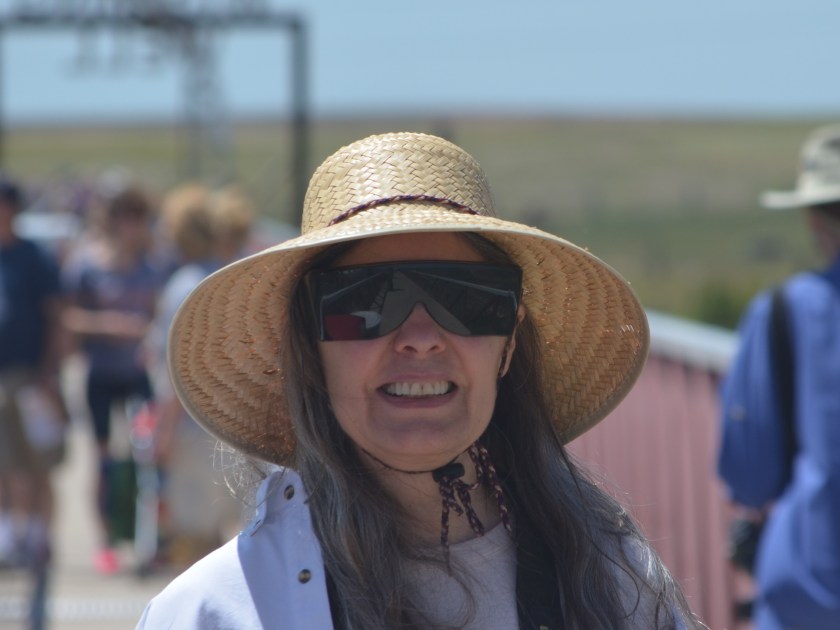
And Now a Word From Dorie Ann

Dorie AnnJack asked if I would write something for his sabbatical blog so here goes.

I spent the early days while Jack was getting the basement set up for his study and prayer area working in my sewing room upstairs. It hasn’t functioned as a sewing room for many years now. In December 2007 when a burst pipe in the basement caused a flood 2 large bookcases and an armoire full of assorted papers and things were lugged upstairs to “my domain” where they sat practically undisturbed until last week. I had a lot of time for reflection as I began sorting through things from the past.

We bought this house 28 years ago in 1989. And 14 years ago this week we moved to Greeley. That was a revelation – that half of our Colorado lives have been spent in Greeley. Some of the things I found in the armoire were things that had disappeared from my life. There was a sketchbook that I had purchased shortly after Jack and I were married in 1979. I found a detailed drawing of the living room in the vicarage in Morehead, Kentucky, that included the living room window showing the large tree that dominated the front yard. (And I drew that? Hmmm.) I saw a drawing of the small cabin where we occasionally went on retreat. And lots of sketches of Jack (sitting in his lounge chair smoking a pipe; sprawling on the sofa with a cat on his lap; sitting at his desk, writing; lots of attempts just to capture the expression of his eyes.) And lots of attempts to depict Frisbee and Squeak, my 2 cats. Some weren’t bad at all and I wondered why I had left that behind. (There are lots of pages left so who knows.)

Another thing I had left behind was my sewing machine but I do have plans for that item. For some months now I’ve had the idea for a Christmas banner to go along with the other 6 banners that we hang from the choir loft at Trinity. I’d never made one for Christmas because the season is so short and we usually hang wreaths. Still it has been on my mind for quite a while. I’ve known what the message will be since last Spring but it was only this week that I saw the design and the colors in my mind. Thursday we drove down to Lakewood and I purchased the fabric. Yesterday I began cutting out the letters.

So there is a snapshot for you. And blessings from Evergreen.

Dorie Ann

Xcellent Interruption

Taking a break from reading may not have been God’s plan today. I was loading some recycling in the car for a community recycling event in Evergreen tomorrow when I was suddenly plunged into darkness. Turns out that a major power station on the north end of the town had blown a fuse (or something like that) and plunged over 2500 households into dimness — it was, after all, mid-afternoon. Dorie Ann was working on an entry that will be posted here in the next day or so. Thank God for battery backups. We got the file saved and the computer shut down before her work was lost.

The outage lasted a bit under two hours and with little else to accomplish we retired to the upstairs where we had plenty of light. I picked up the second book in my studies, Ian Bradley’s Colonies of Heaven, and went back to work. Dorie Ann went to the dining room to work on a Christmas present she’s making for the parish. When the power returned, Dorie Ann decided that her writing muse had taken the rest of the day off and continued on her project and I came down to type more nearly illegible notes into more coherent form.

[Warning: in addition to the book listed above I also spent some time brushing up my biblical Greek, so there will be no respite from the “present active subjunctive” and other delights of New Testament mysteries when I return.]

I did not finish the book I’d been working on first as it was only really the first section that had provided the early inspiration for exploring parish-wide spiritual formation. Martin Thornton, the author of that work, was a fairly intense Anglo-Catholic who spent a good portion of his early ordained life in a religious community. We might find some of his ideas a bit rigid today, but along the line of “not reading naively” it’s not that difficult to sort out those ideas which can be applied to a 21st century congregation.

There was, however, one sentence that stood out, particularly coming from an Anglo-Catholic priest of his vintage. I will end today’s entry with that quote, but without further comment on it. I leave it for you few, brave readers of these entries to sort out what it might mean for us in being a parish church. Your comments would be welcome. And now, here it is:

“…Anglican theology insists that the creative channel of Grace in the world is not the priesthood but the church…”

The New Routine

It really began yesterday . Well, sort of. I managed to plow (slowly) through five more chapters of Pastoral Theology and actually made some useful notes. Since my handwriting (or printing for that matter) is pretty awful, I spent some part of the afternoon typing the notes in while I could still remember what those squiggles on the yellow notepad represented.

It was an interesting beginning to this journey as thoughts I encountered over 40 years ago leapt out in one “aha” moment after another. It is, at this stage, primarily a theological underpinning to why the Trinity Way of Life should exist at all and what I hope it will enable us to accomplish as a parish. (More on that later on in the sabbatical.) What I’m experiencing now is a renewed understanding of where the Way was coming from, and more excitingly, where it could go.

What is coming clear at this early stage is that our identity as Trinity Parish may be far more important than I’d hitherto understood. For the moment I will note that human history comes down to Jesus and from Jesus flows out in redemption and healing and justice for our world. I’m not saying that being Trinity Parish is the cornerstone of God’s great redemptive purpose! We are but one of thousands of Christian communities across the globe. But perhaps in discovering what it means to be Trinity Parish we may have positive impact on the community in which we live and may also encourage other Christian communities, even beyond the Episcopal Church, to find their own parish identity and thus become channels of God’s grace in a grace-starved world.

Avoiding Naive Reading

N. T. Wright had been recommending reading the works of Josephus, a first century Jewish scholar, to get a feel for the Jewish world which was the stage for Jesus and the early church. A person in the audience challenged Wright by pointing out Josephus’ penchant for self-promotion. Wright countered with some self-deprecating comment about his own works and then concluded with the statement: “I hope none of us reads naively.”

That comment stuck with me in the four years since I heard it. I’ve done a fair amount of naive reading over my lifetime, mostly in books about how to grow a church. I became aware of that problem some years before hearing N. T. Wright when Rick Warren’s book, The Purpose Driven Church, made waves across denominational lines and had clergy flocking to satellite conferences to learn how to replicate his phenomenal results at Saddleback Church. That wave petered out for most all mainline clergy who tried Warren’s methods. In retrospect we forgot in our enthusiasm that Warren was a Southern Baptist, and Southern Baptist is a very different church culture than our own.

The problem of reading naively is that when the latest magic bullet fails to produce the expected results we find a thousand different reasons to dismiss the whole book itself. In fact, about 25% of Warren’s book can be relevant to churches like ours. We have to read with discernment, the opposite of reading naively.

This lesson learned comes back to me now as I re-read Martin Thornton’s Pastoral Theology: A Reorientation. It was the book that gave birth to a vision of a community in common spiritual formation and thus set me on a path that has led to, among other things, the Trinity Way of Life. Now the great challenge is to reread it with discernment. That takes time and patience.

A Preparation Nearly Complete

It doesn’t feel like a sabbatical — yet. It’s not the daily labor making the house livable, creating the work space (nearly there) and the prayer and study place (complete!!). It’s more that this feels like one of the extended stays we take up here after Christmas and Easter and maybe a week in the summer. The older cat is pretty skittish, waiting to be bunged up in the cat carrier for the trip home. I sympathize.

I did no reading today, spending time in sorting out the 14 years of neglected mess and throwing a lot of things out, setting much aside for recycling and going through old cassette teaching tapes trying to determine if I would ever listen to any of them again. A few made the cut, but only a few. There was one interesting treasure among the detritus, a packet from the cruise ship we took on our honeymoon in 1979. Included in the packet were the menus from the various meals. I know we were only in our 20s but I’m amazed we didn’t need an angioplasty by the time the cruise ended.

Tomorrow is my first Sunday away from Trinity. Even on short vacations it seems odd not to be preparing for the liturgies. So the oddness today is nothing unusual. We’ll see how odd it will feel to get back into that routine come November. Tomorrow evening I’ll be moving the computer down into the work space we created this week and then Monday begins the attempt to establish a pattern of prayerful reading, prayerful reflecting, prayerful note taking and maybe even some prayerful writing. I already miss the folks in our parish and hope and pray that will discover this time apart is a wonderful opportunity exercise their spiritual authority in ministry that comes from their connection with Jesus, not their connection with a priest.

The Sabbatical Journey Begins

Instead of starting on sabbatical reflections I spent most of Friday afternoon locking our credit with the big three (Equifax, Experian and Transunion). Thank you Equifax. (That was sarcasm.)

However, as this time away began just this past Monday, I didn’t have much to write about. According to our diocesan sabbatical policy this is to be a “time for rest, renewal and inspiration.” I hope these seven weeks will encompass all three, but the first few days have not reflected that hope. Much of that has to do with the peculiar setting for this sabbatical. We lived in Evergreen, Colorado full time from 1989 until 2003. In 2003 God took us on what we thought was a temporary sojourn to Greeley, Colorado to work with Trinity Episcopal Church. Things did not go as planned, and thanks be to God for that. Because of the peculiar path we ended up with two homes, visiting our Evergreen residence for an overnight every other week. Most of our furniture moved with us to Greeley, so we’ve been “camping out” in the mountains when we visit.

This sabbatical is intended to be a time of revisiting many of the books that have shaped my approach to parish ministry, a time of collecting disparate writings and reflections on that journey and seeking to put all this material together in a way that can be shared by others. This is all being done back in Evergreen, but we’ve had to create a space for prayer, study and writing and that has been our work for the past week. We’re almost there and we’ve been able to walk through our neighborhood daily, listening to the elk bugling and occasional running across our local herd while keeping a safe distance.

Today we took an early break to visit the Evergreen Rotary Club where Greg Dobbs, a new inductee into the Denver Press Club hall of fame, was the speaker. I also signed up to help with their annual recycling event on the 23rd. And this afternoon I finally opened the first book I needed to revisit, Martin Thornton’s Pastoral Theology. The real work of the sabbatical starts this coming Monday.

Fursey’s Four Fires

So who in the world is Fursey? He’s a rather obscure Irishman who gets a mention in Bede’s History of the English Church and People. I read that book in seminary and for something written in 731 AD it’s quite readable. Bede mentions quite a few Irishmen for a book devoted to the development of Anglo-Saxon England. Each year I get a reminder of Fursey for a week during the second week of Advent in the prayers Dorie Ann and I use at the lighting of our Advent wreath at home. One section of the devotional tells of a vision of “four fires through which unclean spirits threatened to destroy the earth.” They are listed as the destroying fire of falseness, the destroying fire of greed, the destroying fire of disunity and the destroying fire of manipulation. And each year, but particularly this one, we comment on how contemporary this feels.

Fortunately, the devotional doesn’t end there. It continues: But Fursey urged everyone he met to do as the angels told him:  to fight against all evils.  He encouraged them with these words he had heard:  “The saints shall advance from one virtue to another;” and, “The God of gods shall be seen in our midst.”

At first the encouragement Fursey offers seems pretty pale against a set of destroying fires. In a world that seems beset by falseness, greed, disunity and manipulation we might be excused for wanting stronger stuff that what is on offer. Yet implied in these messages from the angels is a charge to follow the Jesus path as the means by which God overcomes the destroying fires.

The first charge is to fight against all evils. The first all too human reaction is to take up arms, whether political, economic or military, meeting might with might to set things right. This is not the Jesus path. If we fight fire with fire, fire always wins. There are other ways to fight against evil than to use the tools of evil. Paul enjoins the Roman Christians to follow the Jesus path in these words: “Do not be overcome by evil but overcome evil with good” (Romans 12:21) To confront evil with good seems anti-intuitive to us, but only because the Jesus path is not the path that we were taught either by the world around us or even, sadly, by the church much of the time.

To fight against all evils means that wherever we find cursing in word or action we respond by blessing in word and action not only the victim but even the perpetrator. In the orbit of our reach, no evil done to others is irrelevant to us. We are God’s agent of blessing and that is our first duty.

The next word to Fursey from the angels is that “the saints will advance from one virtue to another.” We dare not turn this into an inward concern about building our own character. Virtue has substance only in so far as it is demonstrated by word and action in our relations with others. Advancing from one virtue to another means that our growth in Christ and therefore in virtue is a continuous journey. The primary function of a spiritual discipline, whether the Trinity Way of Life or any other set of disciplines is to keep and guide us on that journey. Therefore, it is never enough to simply come to worship, listen to teaching, receive nourishment in the Sacrament and then drop back to spiritual passivity for the remains of the week. What we receive we are to apply through the tools of our spiritual disciplines until we rejoin the worshiping community the following Sunday to build one another up, to share the stories of what God has done, accept the divine strength given in Holy Communion and return to the fray growing in the good works God is preparing for us.

The final word from the angels is that the God of gods shall be seen in our midst. In late November we began a preparation for Christmas in Advent and we are just now completing the 12 days of Christmastide. The birth of Jesus is the story of the God of Israel joining Israel in the midst of Israel. The God of gods is seen in their midst even though many do not recognize him. John’s Gospel notes that “He came to that which was his own, but his own did not receive him. Yet to all who did receive him, to those who believed in his name, he gave the right to become children of God– children born not of natural descent, nor of human decision or a husband’s will, but born of God.” (John 1:11-13) This adoption by God in Jesus is done through our baptism and its significance extends far beyond our personal salvation.

It cannot be said often enough that Christmas is not the end of the story of God’s redeeming work but its beginning. Jesus’ life, works and words covered a period of 33 years. The culmination of those years was traumatic and dramatic. But even that was not the end of the story. In fact, the Jesus story is still going on, acted out by generation of generation of apprentices of Jesus. The God of Israel entered Israel but now moves beyond the community of Israel into the gentile world. Wherever we are faithful, the God of gods is seen in our midst.

This past year has been a difficult and painful year all over the world and also in our local community. There seems to be an encroaching darkness that fills millions and even billions of people with anxiety and fear. But as John the evangelist also notes: “In him was life, and that life was the light of all mankind. The light shines in the darkness, and the darkness has not overcome it.” (John 1:4-5) In 2017 the challenge to the community at Trinity (and to Christian communities everywhere) is to be bearers of that light. In times of anxiety and fear we have a mission to carry out. If we take that mission seriously and execute it prayerfully and faithfully the destroying fires of falseness, greed, disunity and manipulation will never have their way.

The Common Path

My last posting described in a small part the Jesus path, the counter-intuitive path Jesus choses to fulfill a vision in which one “like a son of man” is given authority, glory and sovereign power. The Jesus path didn’t make sense to his contemporaries and it doesn’t make sense to us; even to those of us who claim the identity of Christian. We, and the rest of our species, regardless of history, culture or geography have chosen a path by which we hope to bring our world to order and to some sense of justice and fairness. That this path has never fulfilled its promise has never deterred us. Maybe one of the reasons we don’t seem to “get it” is that we’ve rarely been aware of just what the path we’ve chosen entails. Fortunately, one episode in the Jesus story from John can help us find some clarity.

Pilate entered the praetorium again and called Jesus, and said to him, “Are you the King of the Jews?” Jesus answered, “Do you say this of your own accord, or did others say it to you about me?” Pilate answered, “Am I a Jew? Your own nation and the chief priests have handed you over to me; what have you done?” Jesus answered, “My kingship is not of this world; if my kingship were of this world, my servants would fight, that I might not be handed over to the Jews; but my kingship is not from the world.” Pilate said to him, “So you are a king?” Jesus answered, “You say that I am a king. For this I was born, and for this I have come into the world, to bear witness to the truth. Every one who is of the truth hears my voice.” Pilate said to him, “What is truth?” (John 18:33-38)

In this exchange there are three words in English, “of this world” translating four words in the Greek language in which John recorded the dialogue between Jesus and Pilate

My kingdom, says Jesus, is not of this world. Those are the three words: of this world. All too often Christians have read this as if what God is offering is an escape from this benighted planet into some ethereal realm of non-material bliss. With that interpretation Christians have either disengaged from dealing with the evil in this world, or tried to reform this world often using the same political and military means that others have used to destroy or exploit it. I think we can make a good argument that Christians have read Jesus wrong on this and that brings me to the four words that are behind the three words “of this world.”

ek tou kosmou toutou
Let’s break this down using the definitions from Strong’s dictionary:
Ek: according to Strong’s dictionary it is a primary preposition denoting origin, and can be translated “of” or “from”
Kosmou – orderly arrangement, that is, decoration; by implication the world (in a wide or narrow sense, including its inhabitants, literally or figuratively [morally]): – adorning, world.
tou… toutou – of (from or concerning) this (person or thing), the repetition tou…toutou is an emphasis: this world – meaning there are other arrangements, other systems and values

This is actually made clearer in the paraphrased Complete Jewish Bible: “Yeshua answered, “My kingship does not derive its authority from this world’s order of things. If it did, my men would have fought to keep me from being arrested by the Judeans. But my kingship does not come from here.” (John 18:36)

The exchange between Jesus and Pilate is a study in non-communication and the reason for that lies in the meaning of Jesus words: my kingdom does not draw its authority from the values of your world. Jesus knows Pilate’s world all too well. He has seen it since his childhood in the Roman occupation of his homeland, in the crucified bodies of his fellow Jews.

The impossibility of reasoning with those who seek to force the end of the world, who regard life as nothing and their own deaths as martyrdom warns us that creating heaven on earth is not within the reach of human effort. It is not, however, outside of the reach of Jesus. Throughout the Gospels you will find no command to take over Pilate’s world with Pilate’s tools. If we try that, we are on our own – Jesus will not help us establish such a kingdom even when we try it in Jesus’ name. Instead, in the Kingdom of God we are to be salt, leaven and light within the area of our reach. And though tyranny and insanity and cynical exploitation seem to overwhelm our consciousness, the greatest danger these things pose to us is to inhibit us from doing those things within our reach.

So here’s what we do in the face of insane fanaticism and the reaction of anger and fear: do not despise the little things within our reach. We are assured that every small act of feeding the hungry or offering kindness and blessing to the alien and the refugee, providing shelter for the homeless or giving hope and opportunity to the hopeless – every act and word of blessing will be taken up into the world God is building even as this world is tearing itself apart.

So to cobble together a few lines of Scripture:
Be not afraid little flock
In the [Pilate’s] world we will indeed have tribulation
But Jesus has overcome that world
Alleluia! Christ is Risen!
And all things done in Christ are never done in vain.


And on another subject

I’ve been idle on this page for over a year, in spite of many good intentions to update the last posting on topic. But it’s our vacation that prompts this offering. For the first time in more than two decades we’re on the rails again. From Denver to Sacramento and from Sacramento to Portland (OR) we’re renewing an old relationship with Amtrak.

19 June 2015

One of the realities of train travel in the US is the role Amtrak plays as a “guest” on other company’s tracks. Other than the Northeast Corridor (Washington, DC to Boston) Amtrak pays a fee to run trains on the tracks of private freight companies. There are two side-effects to this situation that affect our travel plans. The first is the priorities of the hosting railroad. Each company has a dispatcher that determines who can use the track when and how fast. It is not true that Amtrak trains have to pull over on sidings for every freight train they encounter. On the other hand wherever terrain creates a bottleneck passenger traffic most always gives way to freight.

On the matter of speed, that is a matter of safety. some of the regulations are no-brainers. After all, there is a reason why Independence Pass has a much lower speed limit than I-76 to the Nebraska border. Beyond grades and curves, there is another limiter of train speed: track condition. while freight companies do try to keep their tracks in safe condition, “safe” for railworkers and the freight they manage rarely equals “comfortable” for a passenger ride. The steel unitized track with concrete ties rarely appears beyond major metropolitan areas.

That is why train travel (outside those major metropolitan areas) is not for those who desire efficiency and timeliness in their arrangements.

Or, to put it more succinctly, our train was 2 1/2 hours late this morning and continues to lose time as we head west.

the renewed Union Station in Denver


Thanksgiving

I started a new entry on priesthood in August, got sidetracked and yesterday couldn’t remember where it was supposed to go. So, in the immortal words of the Cybermen: “Delete! Delete!”

This Thanksgiving morning we’ve got a turkey brining in the basement and a good deal of the prep already done. There’s no football on tv as we’re in a cable free environment with no local channels and slow speed internet. Thus I had some quiet this morning while offering Morning Prayer to reflect once again on the General Thanksgiving in the Daily Offices of the Book of Common Prayer:

“We bless you for our creation, preservation, and all the blessings of this life;” which covers what the US Thanksgiving Day is supposed to be about. But it doesn’t stop there. “…but above all in the redemption of the world by our Lord Jesus Christ;”

In there is a reminder that God’s intent is not to destroy the world (acc. to NT Wright a late misreading of Revelation to John and Jesus words about a time of tribulation) but to redeem it, to rescue it from it’s captivity to futility (cf Romans 8). So the world has been redeemed however little it may look like it and the thanksgiving of God’s people are one of the means by which redemption becomes visible. After all, according to the General Thanksgiving the act of thanksgiving is more than just a “thank you” to the Almighty.

“And, we pray, give us such an awareness of your mercies, that with truly thankful hearts we may show forth your praise, not only with our lips, but in our lives, by giving up our selves to your service, and by walking before you in holiness and righteousness all our days:”

All of which means that after the soporific properties of the turkey have worn off, thanksgiving continues in attention to our inner wholeness and integrity and our energy devoted to reconciliation and justice.

Happy Thanksgiving to all.