


Fursey’s Four Fires (redux +1)

I would love a day to come when this article, first written eight years ago, would be irrelevant to our times. Unfortunately, that day is not today. The following article was written for the parish newsletter of Trinity Episcopal Church, Greeley, Colorado in 2016. I posted it again in 2020. I thought about updating it then and now, but aside from references to my former parish and the “Trinity Way of Life” it is unfortunately as relevant in 2024 as it was in 2020, and 2016, and every year in between.

So who in the world is Fursey? He’s a rather obscure Irishman who gets a mention in Bede’s History of the English Church and People. I read that book in seminary and for something written in 731 AD it’s quite readable. Bede mentions quite a few Irishmen for a book devoted to the development of Anglo-Saxon England. Each year I get a reminder of Fursey for a week during the second week of Advent in the prayers Dorie Ann and I use at the lighting of our Advent wreath at home. One section of the devotional tells of a vision of “four fires through which unclean spirits threatened to destroy the earth.” They are listed as the destroying fire of falseness, the destroying fire of greed, the destroying fire of disunity and the destroying fire of manipulation. And each year, but particularly this one, we comment on how contemporary this feels.

Fortunately, the devotional doesn’t end there. It continues: But Fursey urged everyone he met to do as the angels told him:  to fight against all evils.  He encouraged them with these words he had heard:  “The saints shall advance from one virtue to another;” and, “The God of gods shall be seen in our midst.”

At first the encouragement Fursey offers seems pretty pale against a set of destroying fires. In a world that seems beset by falseness, greed, disunity and manipulation we might be excused for wanting stronger stuff that what is on offer. Yet implied in these messages from the angels is a charge to follow the Jesus path as the means by which God overcomes the destroying fires.

The first charge is to fight against all evils. The first all too human reaction is to take up arms, whether political, economic or military, meeting might with might to set things right. This is not the Jesus path. If we fight fire with fire, fire always wins. There are other ways to fight against evil than to use the tools of evil. Paul enjoins the Roman Christians to follow the Jesus path in these words: “Do not be overcome by evil but overcome evil with good” (Romans 12:21) To confront evil with good seems anti-intuitive to us, but only because the Jesus path is not the path that we were taught either by the world around us or even, sadly, by the church much of the time.

To fight against all evils means that wherever we find cursing in word or action we respond by blessing in word and action not only the victim but even the perpetrator. In the orbit of our reach, no evil done to others is irrelevant to us. We are God’s agent of blessing and that is our first duty.

The next word to Fursey from the angels is that “the saints will advance from one virtue to another.” We dare not turn this into an inward concern about building our own character. Virtue has substance only in so far as it is demonstrated by word and action in our relations with others. Advancing from one virtue to another means that our growth in Christ and therefore in virtue is a continuous journey. The primary function of a spiritual discipline, whether the Trinity Way of Life* or any other set of disciplines is to keep and guide us on that journey. Therefore, it is never enough to simply come to worship, listen to teaching, receive nourishment in the Sacrament and then drop back to spiritual passivity for the remains of the week. What we receive we are to apply through the tools of our spiritual disciplines until we rejoin the worshiping community the following Sunday to build one another up, to share the stories of what God has done, accept the divine strength given in Holy Communion and return to the fray growing in the good works God is preparing for us.

The final word from the angels is that the God of gods shall be seen in our midst. In late November we began a preparation for Christmas in Advent and we are just now completing the 12 days of Christmastide. The birth of Jesus is the story of the God of Israel joining Israel in the midst of Israel. The God of gods is seen in their midst even though many do not recognize him. John’s Gospel notes that “He came to that which was his own, but his own did not receive him. Yet to all who did receive him, to those who believed in his name, he gave the right to become children of God– children born not of natural descent, nor of human decision or a husband’s will, but born of God.” (John 1:11-13) This adoption by God in Jesus is done through our baptism and its significance extends far beyond our personal salvation.

It cannot be said often enough that Christmas is not the end of the story of God’s redeeming work but its beginning. Jesus’ life, works and words covered a period of 33 years. The culmination of those years was traumatic and dramatic. But even that was not the end of the story. In fact, the Jesus story is still going on, acted out by generation of generation of apprentices of Jesus. The God of Israel entered Israel but now moves beyond the community of Israel into the gentile world. Wherever we are faithful, the God of gods is seen in our midst.

This past year has been a difficult and painful year all over the world and also in our local community. There seems to be an encroaching darkness that fills millions and even billions of people with anxiety and fear. But as John the evangelist also notes: “In him was life, and that life was the light of all mankind. The light shines in the darkness, and the darkness has not overcome it.” (John 1:4-5) In 2017 the challenge to the community at Trinity (and to Christian communities everywhere) is to be bearers of that light. In times of anxiety and fear we have a mission to carry out. If we take that mission seriously and execute it prayerfully and faithfully the destroying fires of falseness, greed, disunity and manipulation will never have their way.

*As of 2018 the Trinity Way of Life included Pay Attention (prayer), Show Up (community), Serve Others (service), Learn the Story (study), Give as you receive (generosity), Check In (accountability), Practice Gratitude (thankfulness), and Tell the story (witness).

Reconnecting: The Apprentice Part

In an ongoing effort to render this old blog site habitable, a few items of furniture need to be brought into the sunlight again for a thorough cleaning. The first piece of furniture relates to the choice of its name: The Apprentice Priest.

Why Apprentice?

Today apprentice is not a synonym for disciple – but that’s because being an apprentice isn’t what it used to be. Unlike the reality show version of apprentice, modern apprenticeship is a step towards professional status in a trade. It does not involve living with one’s instructor or observing their lifestyle and character. 

I picked up the practice describing myself as an apprentice from Dallas Willard. He well may be the source of the current adoption of apprentice as an alternative to disciple. But apprentice is probably popular because it is new. Human culture will undoubtedly be able to drain it of substantial meaning as we did with Christian and disciple. Christian and Christianity are terms that come loaded with a great deal of baggage that has little to do with what we read in the New Testament. While I am happy to be known as a follower of Jesus or an apprentice of Jesus, I prefer not to accept the term Christian until I understand what associations it has for the person with whom I am speaking.

Disciple has its own problems. Alison Morgan reports: “In 2011 the Anglican Diocese of Gloucester conducted a survey among its clergy, asking what they regarded as the most important elements of discipleship. The survey reported widespread agreement across the diocese: clergy from all contexts and traditions selected ‘Bible study’ as the foremost activity of a Christian disciple, followed by ‘prayer.’ There was no suggestion that discipleship should involve any element either of ministry or lifestyle; indeed, ‘personal morality’ was rated bottom of the seventeen options offered, along with ‘witness’ and ‘faith at work.’”[1]  

Morgan later observes: “Jesus wasn’t training theologians; he was training practitioners, and the primary context of training was not the classroom but the community.’[2] This is consistent with Dallas Willard’s contention that “The term ‘discipleship’ has currently been ruined so far as any solid psychological and biblical content is concerned.”[3]

On the other hand, apprentice has an advantage over the other terms. Christian is rarely used to imply any relationship except that between Christ and the individual believer. However, to be an apprentice, you usually have to be apprenticed to someone. One can be a disciple of anyone, living or dead. But one can only apprentice oneself to a living person. Therefore, to be an apprentice of Jesus means a) that He is alive, b) He is accessible in relationship, and c) that relationship is capable of growing, evolving, and deepening.

Being an apprentice of Jesus the Christ is where I want to be. Sharing some of that journey’s failures and successes is one reason I’m resurrecting The Apprentice Priest. And the “priest” part of this? Maybe in a couple of weeks, I’ll have more to say.


[1] Alison Morgan, Following Jesus: The Plural of Disciple is Church, ReSource, c. 2015, p. 44

[2] Ibid, p. 48

[3] Dallas Willard, The Great Omission p. 53

After a long absence…

Typically, I did this backward. I wanted to restart The Apprentice Priest after leaving it dormant for over two years. Of course, I wanted to restart with a bang. And, of course, have several engaging and thoughtful posts backed up ready to launch to keep things busy. Instead I’m in the position of inviting old friends (and maybe some new ones) to dinner in a house that been shut up for 2+ years before I’ve cleaned the cobwebs, aired the rooms or even reconnected the utilities.

But the reality is even worse. Based on a few comments by Russell Moore (@drmoore.bsky.social) I went out to check the (relatively) new Bluesky app and then – Kyrie Eleison – signed up myself. If you are interested in exploring that community, you can find me @apprenticepriest.bsky.social. And yes, I have lost my mind. But once the rooms are dusted and the heat is back on, I hope and pray to visit with folks more regularly.

Rock ‘n Roll

My vote for the most profound theologian of the past 50 years goes to an anonymous London taxi driver. N.T. Wright told his story back in 2010 when Wright served as the Anglican bishop of Durham. The story inspired Wright’s Easter sermon that year, and it is best to let the bishop tell it in his own words:

The taxi driver looked back at me in his mirror. His face was a mixture of amusement and sympathy. We were stuck in traffic and he’d asked me, as they do, what I did for a living.

‘Ah,’ he said, ‘you Church of England people’ (having told me he was a Roman Catholic himself). ‘You’re still having all that trouble about women bishops, aren’t you?’

I had to admit that that was indeed the case.

‘The way I look at it,’ he said, ‘is this: if God raised Jesus Christ from the dead, all the rest is basically rock’n’roll.’

https://ntwrightpage.com/2016/03/30/resurrection-and-rocknroll/

Rock ‘n roll indeed. Yes, that probably is an over-simplification, but the hard truth behind it is that if God did not raise Jesus Christ from the dead, then as Paul told the Corinthians: “Your faith is futile.” Most of the things that self-identified Christians squabble about are of debateable importance. But if Jesus is not raised, then they are of no importance at all.

May I suggest that we take the Resurrection of Jesus as a pair of glasses, corrective lenses through which we look at Scripture, theology, history, the physical and social sciences, and, in fact, every human endeavor? Let us remember that resurrection is not resuscitation. The description of the risen Jesus’ physical actions in the Gospels indicate much more than restoration to the life Jesus lived before his crucifixion. This is something new.

To look at our lives through those Resurrection glasses is to invite ourselves to assess and reassess all else that we believe. Maybe how we see our world is more a product of the culture in which we were raised and less the product of Jesus’ Kingdom.


Thanksgiving

On this Thanksgiving Day, I’m thankful that I’ve learned the absolute necessity of giving thanks. I’m thankful for many people and many circumstances and many things that God has put into my life. But all these people and circumstances and things are all gifts of God. Yes, I’ve worked hard most of my life. Yes, we’ve invested wisely. Yes, we’ve lived within our means. But without intelligence, opportunity, education, loving parents, and wise mentors my life would have been very different.

Some years ago, a US president set off a firestorm of fury when he suggested that our interdependence was an essential element of our prosperity. “You,” he said, “didn’t do all that.” That was deeply offensive to our cultural belief in our own self-sufficiency. The howls of protest against his statement laid bare our pride in that avowed self-sufficiency. But not only was he right, he was biblical.

In Moses’ extended farewell address to the people of Israel (a.k.a., the Book of Deuteronomy), he issues this warning:

When you have eaten your fill and have built fine houses and live in them, and when your herds and flocks have multiplied, and your silver and gold is multiplied, and all that you have is multiplied, then do not exalt yourself, forgetting the LORD your God, who brought you out of the land of Egypt, out of the house of slavery, who led you through the great and terrible wilderness, an arid wasteland with poisonous snakes and scorpions. He made water flow for you from flint rock, and fed you in the wilderness with manna that your ancestors did not know, to humble you and to test you, and in the end to do you good. Do not say to yourself, “My power and the might of my own hand have gotten me this wealth.” But remember the LORD your God, for it is he who gives you power to get wealth, so that he may confirm his covenant that he swore to your ancestors, as he is doing today. If you do forget the LORD your God and follow other gods to serve and worship them, I solemnly warn you today that you shall surely perish. Like the nations that the LORD is destroying before you, so shall you perish, because you would not obey the voice of the LORD your God.

(Deuteronomy 8:12-20)

Yet even if we accept our utter dependence on God’s gracious gifts, we dare not let it rest at that. What of those who are not so blessed, whose needs are not met, whose lives seem filled with sorrow and want? There is a theme shot through the Tanach and the New Testament that speaks to their needs. That theme is our responsibility for each other. Our abundance is not solely for ourselves. We dare not hoard what God has freely given.

Our response to God’s graciousness is to be our own acts of generosity and care. When we share our substance, our time, our caring, we are exercising thanksgiving to God for our ability to share these things. Generosity is built into God’s creation. So be thankful and act thankfully for in so doing we reveal the glory of God through His children.

After a long silence…

An announcement! Writing 12 posts in 12 days for the 12 Days of Christmas obviously melted a number of neurons in my aging brain. But I’ve not been idle. In fact, in case anyone doubted my weakened grasp on sanity, I’ve begun a Podcast. Right now it is available on Anchor FM, Spotify, Google Podcasts, Breaker, Pocket Casts and RadioPublic. Just search for The Apprentice Priest and you’ll see my smiling face!

I’m not done with the blog, but when it comes to writing, I’m still in recovery.

42

It’s neither my age nor my IQ. In fact it used to be a fairly insignificant number until the late Douglas Adams selected it for the answer to the ultimate question of “life, the universe, and everything.” The conundrum in his series, The Hitchhikers Guide to the Galaxy, was that 42 made no sense until one understood what the actual question was regarding life, the universe and everything.

I post this brief reflection on Adam’s ongoing joke because today is the 42nd anniversary of my ordination to the priesthood in the Episcopal Church. No celebrations, other than a nice dinner planned.

On explanation of 42 that’s been going around for a while is that in the ASCII table the character assigned to 42 is the asterisk, and the asterisk is a wildcard in searching for items on your computer. In other words, 42 means whatever you want it to mean. So much for philosophy and metaphysics.

Of course, I don’t buy that theory, or at least not entirely. It may or may not be what Douglas Adams meant in his story, but there is meaning and purpose in the universe way beyond our limited and transient self-definitions. On the other hand, 42 years of being a priest and most of the functioning in a parish have helped shape an understanding of priesthood that has moved beyond the limits of ecclesiastical definition. This understanding does base itself on both historical and denominational definitions of Christian priesthood, but it now encompasses much more. Some of that “much more” has been addressed in earlier postings. More may appear here from time to time.

In the meantime, today is 42 in terms of Holy Orders and though I haven’t yet found the question to the answer proposed by Adams whether in regard to the universe or in regard to Holy Orders, I’m enjoying the journey.

Fursey’s Four Fires (redux)

The following article was written for our parish newsletter in 2016. I thought about updating it but aside from references to my former parish and the “Trinity Way of Life” it is unfortunately as relevant in 2020 as it was in 2016:

So who in the world is Fursey? He’s a rather obscure Irishman who gets a mention in Bede’s History of the English Church and People. I read that book in seminary and for something written in 731 AD it’s quite readable. Bede mentions quite a few Irishmen for a book devoted to the development of Anglo-Saxon England. Each year I get a reminder of Fursey for a week during the second week of Advent in the prayers Dorie Ann and I use at the lighting of our Advent wreath at home. One section of the devotional tells of a vision of “four fires through which unclean spirits threatened to destroy the earth.” They are listed as the destroying fire of falseness, the destroying fire of greed, the destroying fire of disunity and the destroying fire of manipulation. And each year, but particularly this one, we comment on how contemporary this feels.

Fortunately, the devotional doesn’t end there. It continues: But Fursey urged everyone he met to do as the angels told him:  to fight against all evils.  He encouraged them with these words he had heard:  “The saints shall advance from one virtue to another;” and, “The God of gods shall be seen in our midst.”

At first the encouragement Fursey offers seems pretty pale against a set of destroying fires. In a world that seems beset by falseness, greed, disunity and manipulation we might be excused for wanting stronger stuff that what is on offer. Yet implied in these messages from the angels is a charge to follow the Jesus path as the means by which God overcomes the destroying fires.

The first charge is to fight against all evils. The first all too human reaction is to take up arms, whether political, economic or military, meeting might with might to set things right. This is not the Jesus path. If we fight fire with fire, fire always wins. There are other ways to fight against evil than to use the tools of evil. Paul enjoins the Roman Christians to follow the Jesus path in these words: “Do not be overcome by evil but overcome evil with good” (Romans 12:21) To confront evil with good seems anti-intuitive to us, but only because the Jesus path is not the path that we were taught either by the world around us or even, sadly, by the church much of the time.

To fight against all evils means that wherever we find cursing in word or action we respond by blessing in word and action not only the victim but even the perpetrator. In the orbit of our reach, no evil done to others is irrelevant to us. We are God’s agent of blessing and that is our first duty.

The next word to Fursey from the angels is that “the saints will advance from one virtue to another.” We dare not turn this into an inward concern about building our own character. Virtue has substance only in so far as it is demonstrated by word and action in our relations with others. Advancing from one virtue to another means that our growth in Christ and therefore in virtue is a continuous journey. The primary function of a spiritual discipline, whether the Trinity Way of Life* or any other set of disciplines is to keep and guide us on that journey. Therefore, it is never enough to simply come to worship, listen to teaching, receive nourishment in the Sacrament and then drop back to spiritual passivity for the remains of the week. What we receive we are to apply through the tools of our spiritual disciplines until we rejoin the worshiping community the following Sunday to build one another up, to share the stories of what God has done, accept the divine strength given in Holy Communion and return to the fray growing in the good works God is preparing for us.

The final word from the angels is that the God of gods shall be seen in our midst. In late November we began a preparation for Christmas in Advent and we are just now completing the 12 days of Christmastide. The birth of Jesus is the story of the God of Israel joining Israel in the midst of Israel. The God of gods is seen in their midst even though many do not recognize him. John’s Gospel notes that “He came to that which was his own, but his own did not receive him. Yet to all who did receive him, to those who believed in his name, he gave the right to become children of God– children born not of natural descent, nor of human decision or a husband’s will, but born of God.” (John 1:11-13) This adoption by God in Jesus is done through our baptism and its significance extends far beyond our personal salvation.

It cannot be said often enough that Christmas is not the end of the story of God’s redeeming work but its beginning. Jesus’ life, works and words covered a period of 33 years. The culmination of those years was traumatic and dramatic. But even that was not the end of the story. In fact, the Jesus story is still going on, acted out by generation of generation of apprentices of Jesus. The God of Israel entered Israel but now moves beyond the community of Israel into the gentile world. Wherever we are faithful, the God of gods is seen in our midst.

This past year has been a difficult and painful year all over the world and also in our local community. There seems to be an encroaching darkness that fills millions and even billions of people with anxiety and fear. But as John the evangelist also notes: “In him was life, and that life was the light of all mankind. The light shines in the darkness, and the darkness has not overcome it.” (John 1:4-5) In 2017 the challenge to the community at Trinity (and to Christian communities everywhere) is to be bearers of that light. In times of anxiety and fear we have a mission to carry out. If we take that mission seriously and execute it prayerfully and faithfully the destroying fires of falseness, greed, disunity and manipulation will never have their way.

*As of 2018 the Trinity Way of Life included Pay Attention (prayer), Show Up (community), Serve Others (service), Learn the Story (study), Give as you receive (generosity), Check In (accountability), Practice Gratitude (thankfulness), and Tell the story (witness).

Conversion Unstuck

In previous postings (May 12, June 6, July 3) I looked at the problem of conversion when it is considered a singular event rather than an extended journey.  I considered the problem in three contexts; first of an individual coming to faith from outside the covenant tradition of Israel: Simon the magician (Acts 8:9-24). Second, problem of conversion in a community, many of whom also came from outside the covenant tradition. In that case it was the church in Corinth, primarily looking at Paul’s First Letter to the Corinthians. In the third case it was the apostles themselves who served as an example of the problem of conversion; a problem even among those steeped in both the covenant tradition and the teaching of Jesus. Perhaps all these stories connected with our experience of people of faith or communities of faith. But whether we found a connection or not, all three of those postings only described situations. There was no mention of a way forward, of getting the process of conversion unstuck.

It reminds me of one of my mother’s favorite jokes (she was a medical secretary). A man visits his doctor and describes a whole host of symptoms. The doctor listens carefully and then he asks: “Have you had this condition before?” The man answers in the affirmative and the doctor then says: “Well, you’ve got it again. That will be fifty dollars. Next patient.” Fortunately, my postings are free of charge, but it’s still not helpful to leave us with a description we may already recognize.

Of course, the first step is to recognize that conversion is a journey and if we’re not making progress, we need to get unstuck. There are several tools available to us in getting moving on our journey. These tools, often called spiritual disciplines, are, or should be, quite familiar to us. Most Christian traditions include prayer, Bible study, and service. There are several other disciplines including fasting, giving, worship, penance, devotional reading and more. And these are not new. Their pedigree is older than the Church, for we learned them from the Jews.

These disciplines have indeed been around for centuries, but by themselves are not sufficient to start our journey into a fuller conversion. If they were, Christian history would read rather differently. At their best, they might awaken a hunger for closer connection with Jesus. At their worst they create a complacency that can produce legalistic self-righteousness. It is not that these disciplines are faulty. They are all good and several of them necessary to the journey of conversion. It is that there are two critical elements missing: understanding the context of the disciplines and understanding their purpose.

Most of what Jesus teaches about the values and priorities of the Jesus path assume it is lived in community. The late Canon David Watson once observed that “the meeting place is the learning place for the marketplace.” Many times, when I’ve quoted that in sermons and teachings, the only response I get is a blank look. Part of the problem is that Watson was speaking in British idiom and I’ve only ministered in the US. But the main problem is that we fail, on the whole, to appreciate the essential nature of community in following the Jesus path.

The meeting place, in Watson’s observation, is the regular gathering of Christ’s people in worship and fellowship. Yet even that can be misleading. Worship is an action directed God-ward. The community’s attention is directed towards those who are leading the worship. It is not a place of conversation or relation-building among those gathered. Worship, whether liturgical or non-liturgical, is not designed to create or build relationships. Those relationships are formed in smaller configurations where there is time to share and reflect and experiment with the Spirit filled life in Christ.

It is in these smaller groups, as well as in corporate worship, that the meeting place becomes the learning place. The learning can be factual – as in getting insight to Scripture through sharing understanding. It can be behavioral – as in sharing struggles and practices in prayer. It can be relational – as in dealing faithfully with others whose style of communication, values, and personalities are quite different than our own. When what we are learning becomes part of our own behavior, we carry that into the world outside our group and our congregation. And the meeting place has become the learning place for engaging in the marketplace – a Britishism that refers not to the large halls of commerce but to the town market where, in the midst of our personal commerce we connect with our local community.

That now leaves us with the final piece of the puzzle of getting conversion unstuck – the purpose. And that purpose is not what we often think it is. But that must wait for the next post.

The Not Quite Converted Disciples

In the case of Simon the Magician, we have a story of a new convert who has just begun the journey of conversion. Unless, of course, conversion is a complete event rather than the beginning of a process. In which case the story of Simon is that of a false conversion. Conversion as a complete event, however, raises troubling questions about the disconnect between how Christians live and how they are expected to live according to the Scriptures. It also raises troubling questions about the behavior of Christian congregations particularly in light of those who have suffered abuse in churches. The example of the Corinthian church used in the previous post can be either a sign of the falsity of Christian claims or, if conversion is treated as an inauguration, a warning that the conversion journey is long and difficult.

But there is another Scriptural example of incomplete conversion that does not involve a person outside the covenant community like Simon, or a congregation like the Corinthians who bring a great deal of pagan baggage into their new life. Instead this is a group that has been on the “inside” of the Jesus Movement and whose lives, prior to connecting with Jesus were steeped in the Torah, the prophets, and the writings. This group is known to us as the Apostles.

The four Gospels offer us several incidents where they just didn’t seem to be able to hear Jesus. There are two in the Gospels and one at the opening of the Acts of the Apostles that illustrate the problem. In Matthew’s version of the confession of Peter we have the intense moment of Peter’s response to Jesus’ question: “Who do you say that I am?” is “You are the Christ, the Son of the living God.” Jesus in turn blesses Peter and declares him to be the Rock, and gives the keys to the kingdom of Heaven. But then Jesus goes on to teach them about his fate: betrayal, suffering and death. Peter takes Jesus aside and rebukes him for such an expectation insists that such a thing could never happen. To this, Jesus responds: “Get behind me, Satan! You are a hindrance to me; for you are not on the side of God, but of men.” (Mathew 16:23) From hero to zero in two paragraphs is a pretty spectacular fall.

The second incident is in two parts in Mark’s Gospel. Jesus is heading towards Jerusalem for his final confrontation. The first is an awkward moment when they reach Capernaum: And they came to Capernaum; and when he was in the house he asked them, “What were you discussing on the way?” But they were silent; for on the way they had discussed with one another who was the greatest. And he sat down and called the twelve; and he said to them, “If any one would be first, he must be last of all and servant of all.” And he took a child, and put him in the midst of them; and taking him in his arms, he said to them, “Whoever receives one such child in my name receives me; and whoever receives me, receives not me but him who sent me.” (Mark 9:33-37)

Jesus’ use of a child to illustrate doesn’t seem to make much of an impact as shortly thereafter he has to rebuke his disciples for trying to send children away (Mark 10:13-16). But the real problem occurs later in the chapter when James and John ask Jesus to grant them the chief positions in his glory. The other disciples are indignant, perhaps because the Zebedee brothers beat them to the mark. Jesus again tries to teach them that his kingdom operates by different rules: And Jesus called them to him and said to them, “You know that those who are supposed to rule over the Gentiles lord it over them, and their great men exercise authority over them. But it shall not be so among you; but whoever would be great among you must be your servant, and whoever would be first among you must be slave of all. For the Son of man also came not to be served but to serve, and to give his life as a ransom for many.” (Mark 10:42-45)

It is easy to portray Jesus’ disciples as hopeless clods who (in the wonderful phrase of Dorothy Sayers) “couldn’t find a herd of black elephants on a snowbound field in broad noonday.” That is not only untrue and unfair, it misses a critical point about both the disciples and about conversion. While the beliefs and expectations about the messiah were not uniform among the Jews of that time, there was a popular hope for one who would deliver them from Roman bondage, purify the Temple and reestablish the Davidic kingdom. Behind these hopes was a set of unspoken assumptions that this deliverance would come about through the military overthrow of Rome and the normal uses of political power energized by powerful acts of Israel’s God.

The acts of power performed through Jesus were signs of hope as was his preaching on the kingdom, on integrity in observing the Torah and his rebukes of the Temple authorities and the religious establishment. When Jesus starts teaching that he will be betrayed and executed, there is no conceptual box in the disciples’ minds to place such a thought. The jockeying for positions in Jesus’ coming kingdom is normal operating procedure and, again, his insistence that the path to leadership in his kingdom is through humility and service finds no place in the disciples’ world view.

And therein lies the problem. We are rarely conscious that we even have a “world view” much less aware that there are other alternatives. This is why the incomplete conversion of disciples is sometimes the most difficult to discern. We may be raised in church community and even in a family that seeks to apply their faith to their daily life, work, and relationships. But we are also raised in a cultural locality, region, and nation. Whether we are raised in America or Armenia or Austria or Australia, whether in Germany or Ghana or Guyana we have a view of the world that is both pervasive and yet, for the most part, invisible to ourselves.

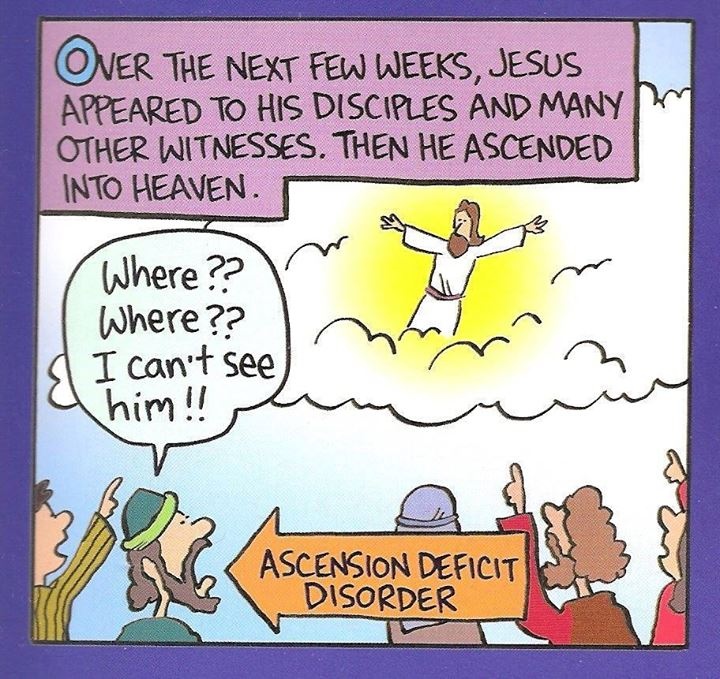
The disciples, bound by their world view, simply could not register what Jesus was telling them. They went through the trauma of Jesus’ betrayal both by Judas and by the Temple authorities. They saw him arrested, tortured, and crucified. And then they experienced the wonder of his Resurrection. And still, as Acts records, when they accompany him to the place of his Ascension, the question foremost in their minds is “Lord, will you at this time restore the kingdom to Israel?” (Acts 1:6)

They weren’t dumb. Yet they were blind. And their conversion needed to go on. As does ours.