
The Not Quite Converted Disciples

In the case of Simon the Magician, we have a story of a new convert who has just begun the journey of conversion. Unless, of course, conversion is a complete event rather than the beginning of a process. In which case the story of Simon is that of a false conversion. Conversion as a complete event, however, raises troubling questions about the disconnect between how Christians live and how they are expected to live according to the Scriptures. It also raises troubling questions about the behavior of Christian congregations particularly in light of those who have suffered abuse in churches. The example of the Corinthian church used in the previous post can be either a sign of the falsity of Christian claims or, if conversion is treated as an inauguration, a warning that the conversion journey is long and difficult.

But there is another Scriptural example of incomplete conversion that does not involve a person outside the covenant community like Simon, or a congregation like the Corinthians who bring a great deal of pagan baggage into their new life. Instead this is a group that has been on the “inside” of the Jesus Movement and whose lives, prior to connecting with Jesus were steeped in the Torah, the prophets, and the writings. This group is known to us as the Apostles.

The four Gospels offer us several incidents where they just didn’t seem to be able to hear Jesus. There are two in the Gospels and one at the opening of the Acts of the Apostles that illustrate the problem. In Matthew’s version of the confession of Peter we have the intense moment of Peter’s response to Jesus’ question: “Who do you say that I am?” is “You are the Christ, the Son of the living God.” Jesus in turn blesses Peter and declares him to be the Rock, and gives the keys to the kingdom of Heaven. But then Jesus goes on to teach them about his fate: betrayal, suffering and death. Peter takes Jesus aside and rebukes him for such an expectation insists that such a thing could never happen. To this, Jesus responds: “Get behind me, Satan! You are a hindrance to me; for you are not on the side of God, but of men.” (Mathew 16:23) From hero to zero in two paragraphs is a pretty spectacular fall.

The second incident is in two parts in Mark’s Gospel. Jesus is heading towards Jerusalem for his final confrontation. The first is an awkward moment when they reach Capernaum: And they came to Capernaum; and when he was in the house he asked them, “What were you discussing on the way?” But they were silent; for on the way they had discussed with one another who was the greatest. And he sat down and called the twelve; and he said to them, “If any one would be first, he must be last of all and servant of all.” And he took a child, and put him in the midst of them; and taking him in his arms, he said to them, “Whoever receives one such child in my name receives me; and whoever receives me, receives not me but him who sent me.” (Mark 9:33-37)

Jesus’ use of a child to illustrate doesn’t seem to make much of an impact as shortly thereafter he has to rebuke his disciples for trying to send children away (Mark 10:13-16). But the real problem occurs later in the chapter when James and John ask Jesus to grant them the chief positions in his glory. The other disciples are indignant, perhaps because the Zebedee brothers beat them to the mark. Jesus again tries to teach them that his kingdom operates by different rules: And Jesus called them to him and said to them, “You know that those who are supposed to rule over the Gentiles lord it over them, and their great men exercise authority over them. But it shall not be so among you; but whoever would be great among you must be your servant, and whoever would be first among you must be slave of all. For the Son of man also came not to be served but to serve, and to give his life as a ransom for many.” (Mark 10:42-45)

It is easy to portray Jesus’ disciples as hopeless clods who (in the wonderful phrase of Dorothy Sayers) “couldn’t find a herd of black elephants on a snowbound field in broad noonday.” That is not only untrue and unfair, it misses a critical point about both the disciples and about conversion. While the beliefs and expectations about the messiah were not uniform among the Jews of that time, there was a popular hope for one who would deliver them from Roman bondage, purify the Temple and reestablish the Davidic kingdom. Behind these hopes was a set of unspoken assumptions that this deliverance would come about through the military overthrow of Rome and the normal uses of political power energized by powerful acts of Israel’s God.

The acts of power performed through Jesus were signs of hope as was his preaching on the kingdom, on integrity in observing the Torah and his rebukes of the Temple authorities and the religious establishment. When Jesus starts teaching that he will be betrayed and executed, there is no conceptual box in the disciples’ minds to place such a thought. The jockeying for positions in Jesus’ coming kingdom is normal operating procedure and, again, his insistence that the path to leadership in his kingdom is through humility and service finds no place in the disciples’ world view.

And therein lies the problem. We are rarely conscious that we even have a “world view” much less aware that there are other alternatives. This is why the incomplete conversion of disciples is sometimes the most difficult to discern. We may be raised in church community and even in a family that seeks to apply their faith to their daily life, work, and relationships. But we are also raised in a cultural locality, region, and nation. Whether we are raised in America or Armenia or Austria or Australia, whether in Germany or Ghana or Guyana we have a view of the world that is both pervasive and yet, for the most part, invisible to ourselves.
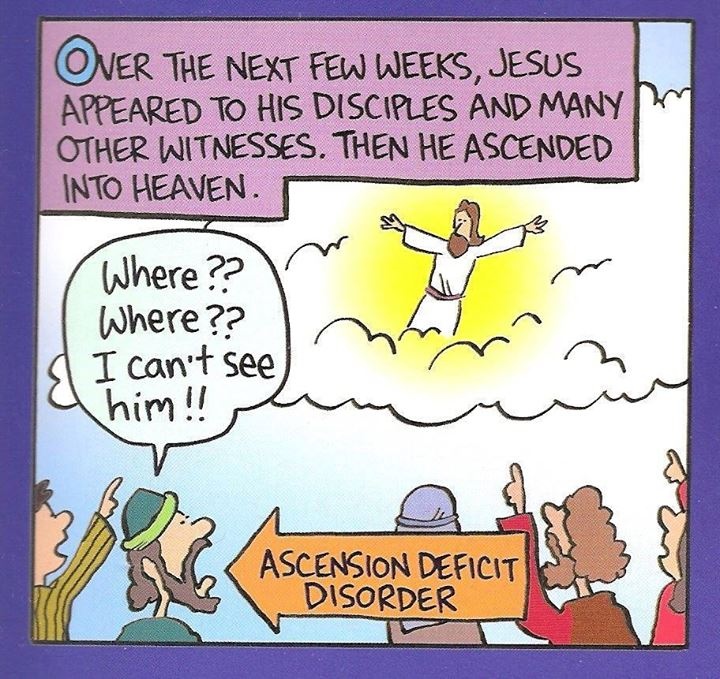
The disciples, bound by their world view, simply could not register what Jesus was telling them. They went through the trauma of Jesus’ betrayal both by Judas and by the Temple authorities. They saw him arrested, tortured, and crucified. And then they experienced the wonder of his Resurrection. And still, as Acts records, when they accompany him to the place of his Ascension, the question foremost in their minds is “Lord, will you at this time restore the kingdom to Israel?” (Acts 1:6)

They weren’t dumb. Yet they were blind. And their conversion needed to go on. As does ours.

The Not Quite Converted Community

The beginning of a problematic relationship with the Body of Christ

The previous post I looked at Simon the Magician (Acts 8) as an example of an inadequate concept of conversion. If what is often called conversion is simply the inauguration of the conversion process, then Simon’s conversion told in that story was simply a small beginning. The attempts of many commentators to cast doubt on the authenticity of that beginning is not supported by the text and only reveals an assumption that the beginning is supposed to be the end. It is not. It is just the beginning.

Yet the distance between our beginning and our end – to show, unsullied, the character and person of Jesus through the lens of our unique personalities – is a long journey in which no part of our lives can be left unexamined. If that is a challenge to an individual Christian, it is a much greater one to a Christian community. The challenge becomes even more daunting because our cultural bias in the west leads us to grossly underestimate both the reality and the power of community.

There is much to say on that subject, but it will have to wait for another occasion. The short version is that while an individual may have some influence on a community, a community has a personality and a life that is not only greater than the sum of its parts, but is more capable of influencing us than we it.

From that assertion we move on to a community that struggled with conversion, the Christian community in the city of Corinth. At the time of Paul’s writing, Corinth was a thriving and prosperous port city. Like many commercial centers in our times it was an expensive place in which to live. Also, like many modern cities, there were wide disparities of wealth, status, and education. The first Christian communities were notable for the diversity of their members: Jews and gentiles, women and men, rich and poor, slaves and citizens of Rome. And yet…

In spite of a robust spiritual life, the Corinthian church had some significant problems. The culture of the city came into the church with its members. The city culture crops up in a number of issues that Paul addresses in his letters. There are factions around leaders. The eloquent Apollos and the blunt Paul are sharp contrasts and the congregation seems split between the educated who appreciates the oratory of Apollos and those who prefer the blunt directness of Paul. There is also religious division between those who are sophisticated enough to disregard the old gods and goddesses of the classic world and those who still find power, however sinister, in the old religion.

But the greatest evidence of a not quite converted community is in their “love feast” which is a common setting for observing the Eucharist, the Lord’s Supper. The continuing separation based on wealth and privilege has some with nothing to eat at the feast and some who continue pagan patterns of overindulgence. Jew and gentile sharing a meal would be a radical thing for the Jewish believers in this new community. But rich and poor sharing a meal was equally radical – a sign of a new humanity in Christ. The separation experienced in the Corinthian meal (one cannot call it a common meal!) was a clear indicator that the life of Christ’s new community had not yet permeated the customs and expectations of the Corinthian church.

In spite of the fact that much of Paul’s first letter is devoted to corrections, this was not a failed community. It was simply a community in the early stages of conversion. There was enough awareness within that community that a delegation had come to Paul expressing their distress and concern. In one important regard, the situation of the Corinthian church was much more clear cut than that of churches in the West, and particularly in the US. The world of ancient Corinth was a pagan world with the values and expectations of that world. There was a Jewish presence in the city but the separation Jews maintained from the surrounding culture meant that the life of the Torah had little impact or influence. In our day, on the dying edge of Christendom, the distinctions are not quite as clear. The need of a community to experience ongoing conversion is masked by the assumption that Christianity is “normal,” even though its normalcy is under siege. The problem with “normal” is the question of whose norm we apply. Perhaps the ending of our former normal is a God-given moment where we can test that passing normal against the norms that Jesus and Paul set forth for the church.

What can help us get our communal conversion back on track is to explore the New Testament’s description and expectation of what a church is supposed to look like. Once we discover the disconnect between that description and expectation and the characteristics of “normal” church life, conversion can resume in earnest.

The Not Quite Converted Life

I am constantly amazed, irritated, confounded, and frustrated by the distance between the noisy professions of faith in, loyalty to, and promotion of Jesus Christ and the values and lifestyle he propounds in the Gospels. There is enough of that noise going on in our culture that it happily prevents me from contemplating that similar distance in my own life. In spite of a conscious acknowledgment that conversion is a process rather than an event, at a deeper level I still operate on the unbiblical myth of instant conversion.

It is true that a moment of conversion can be dramatic, even life-changing. Yet the change is not a complete transformation but the inauguration of a long journey. A dramatic “conversion experience” can act as a powerful boost along that path. It can also create an illusion that the beginning is actually the destination. While those observations may be accurate, they are hardly helpful as a map to the road of conversion. But before addressing that question, I want to examine three incomplete conversions found in the stories of the New Testament.

Probably nothing like Simon Magus, but you get the idea.

The first story is that of Simon the Magician found in Chapter 8:9-25 of the Acts of the Apostles. In this story the deacon Philip, fleeing the persecution in Jerusalem, ends up in Samaria and preaches there, with accompanying acts of power. In that town is a local wonder-worker, Simon, who had quite a following. However, Simon also becomes a believer and is baptized. When the leaders in Jerusalem hear what is happening, Peter and John are sent to follow up. They start praying for people to receive the Holy Spirit. Obviously something dramatic happened when they did that because when Simon saw it he offered to pay to learn how to do it himself. Peter’s reaction was sharp: “But Peter said to him, ‘May your silver perish with you, because you thought you could obtain God’s gift with money!’” The Complete Jewish Bible (paraphrase) gives it more literally: “But Kefa said to him, ‘Your silver go to ruin — and you with it, for thinking the free gift of God can be bought!’” My preference is from another paraphrase, The Message: “Peter said, ‘To hell with your money! And you along with it. Why, that’s unthinkable–trying to buy God’s gift!’”

Peter’s harsh words have left many readers and commentators on the text perplexed. The most common response that I’ve read has been that Simon’s conversion was false, a sort of “jumping on the bandwagon” response to the local positive response to Philip’s preaching. He couldn’t have been truly converted and still offered money for access to the power of God. Now I’ve come to believe that the problem isn’t so much Simon as it is our inadequate understanding of conversion.

Simon didn’t just get up one morning, decided to be a thaumaturge and start practicing on the streets of Samaria. He found a teacher or teachers, bought books, and paid for it all. That was normal life. That was standard operating procedure. Simon’s conversion did not erase all that he had learned, all that he had expected from life. His response to Philip’s preaching was an inauguration and perhaps, like many others, it might have gotten stuck there. Peter’s reaction probably came as quite a shock. It might also have helped him realize that maybe all he had assumed about the way life worked was dead wrong.

That, of course, is pure speculation on my part. However, so is the common belief that Simon’s conversion wasn’t real. Though I have too often failed to keep on track with my own conversion, Simon’s story mostly isn’t mine. I was taken to church (often kicking and screaming) as a child. I went through years of Sunday school and managed to absorb a great deal of Scripture before my mother finally surrendered and stopped dragging me along. Most of the “formation” of my life in terms of expectations of how the world worked did not come through that early church experience but through peers, through observing the adults in my life and most of all, through television and books. When I began my real conversion journey it was that formation and not the Scriptures that I brought to that new beginning. In the next posting, I’ll look at an implicit story from the New Testament. The story of a church found in Paul’s letters to the Corinthian community. Until then, let’s keep on the journey.

The Lentiest Lent We’ve Ever Lented

That comment is showing up regularly throughout the world of social media. It could also be the longest. Our isolation is likely to continue through Easter Day and well beyond. Yet even in the midst of our current chaos, the Christian year moves through its own rhythms, whether we are allowed to gather or not. Each Sunday and major feast has its own prayer, its collect[1]. For many Episcopalians, Sunday will be the only time they hear or read the collect of the day. Those who follow the discipline of daily Morning and/or Evening Prayer may offer that collect each day throughout the week. Yet even then, the calendar moves on and we don’t use the collect until next year.

And then there’s the reality that very few Christians attend churches that use these particular collects, and fewer pause to reflect on what has just been prayed. Then there’s the new, current reality that we cannot, for the immediate future, gather for worship. Even those who join their congregations online seem to be about half of what we used to have when we could meet in a common place.

Because of this I suggest we might look back a couple of weeks and reflect on the collect for the Third Sunday of Lent:

Almighty God, you know that we have no power in ourselves to help ourselves: Keep us both outwardly in our bodies and inwardly in our souls, that we may be defended from all adversities which may happen to the body, and from all evil thoughts which may assault and hurt the soul; through Jesus Christ our Lord, who lives and reigns with you and the Holy Spirit, one God, for ever and ever. Amen.

Book of Common Prayer

That first declaration may seem inaccurate to us. After all, we are doing quite a lot to help ourselves. Whether it is increasing our capacity for testing or working on a vaccine for the COVID19 virus or issuing stay at home orders or practicing social distancing or thoroughly and regularly washing our hands or turning our manufacturing from normal consumer items to masks and PPE and ventilators, we seem to be charging through to a solution even in the face of political maneuvering, finger pointing, wishful thinking and short-sightedness. And yet. Our failure to comprehend the fundamental connectedness of creation led us to this point. Whatever we can accomplish to ameliorate the pandemic will not change that self-sabotaging flaw in human nature that prefers to narrow our vision to what results in our own benefit. Our inventiveness has changed a lot of things in this world and not all of them for the worse. And yet, we can’t seem to change our behavior even when our circumstances demand it. We have no power in ourselves to help ourselves.

So the prayer begins with an honest evaluation of human limits. From there the prayer moves on to our need from our Creator, “keep us both outwardly in our bodies and inwardly in our souls.” That distinction has echoes of a very unbiblical Platonism. In the Scriptures the body/soul distinction is very fuzzy. The Gospels tell the story of Incarnation, that God who is Spirit willingly embraces matter. Having already declared the material world “good” in Genesis 1, God now makes it holy in John 1:14: “and the Word became flesh and dwelt among us.” Because of that fundamental unity of soul and body that makes us human, things which cause harm to the body also assault and hurt the soul and those things which assault and hurt the soul affect the body adversely. Perhaps that is why the prayer uses “and” rather than “or.” The two conditions are inextricably interrelated.

The prayer then concludes with the common doxology: “through Jesus Christ our Lord, who lives and reigns with you and the Holy Spirit, one God, for ever and ever. Amen” It is through Jesus the Messiah that connection has been restored between creation and the Creator and so our prayers find their natural path through him. We are also reminded that this Jesus both lives and reigns. The unity described in the doxology is the model for the unity for which Jesus prayed we might be one as he and the Father are one. If a collect is a summary prayer, it certainly seems that the Collect for the Third Sunday in Lent summarizes our situation accurately. It might be worth our while to offer that prayer daily through this season of pandemic.


[1] A collect is a prayer that isused in “collecting” the community for worship and also several elements of prayer and praise into one.

Doing Nothing Gallantly

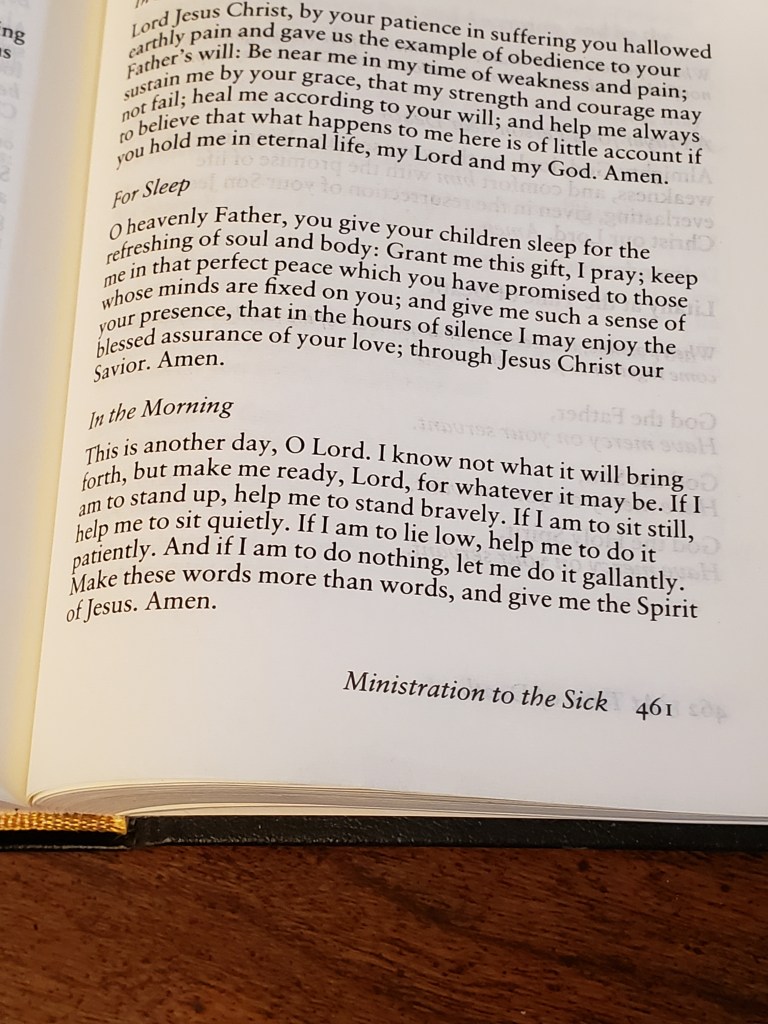
We called it “the Groundhog Book” to the probable consternation of the Standing Liturgical Commission. They had published The Draft Proposed Book of Common Prayer on February 2, 1976, the Feast of the Presentation. But that is also Groundhog Day and this was the 1970s so it became the Groundhog Book whether the powers that be liked it or not. Nonetheless, Episcopalians (particularly clergy and seminarians) pored over the 1,001 pages to see what glorious renewal of worship or what hideous manual of modern heresy we had been handed. Reviewing the pages with one of my mentors we discovered a new treasure deep inside the book, the last prayer in the section on Ministration to the Sick.

This is another day, O Lord. I know not what it will bring forth, but make me ready, Lord, for whatever it may be. If I am to stand up, help me to stand bravely. If I am to sit still, help me to sit quietly. If I am to lie low, help me to do it patiently. And if I am to do nothing, let me do it gallantly. Make these words more than words, and give me the Spirit of Jesus. Amen.

I’ve already seen this prayer posted in social media in relation to the current COVID19 crisis. With the increasing number of “stay in place” orders, the cancellations of events with over 50 in attendance (in some places over 10), many of us are experiencing the isolation of a recovering person regardless of our health. For those of us who tend towards introversion, this is not a great sacrifice. But for those who those who have lost their jobs, those who are more extroverted and have been told to work from home and struggle with the lack of human gatherings this is a dark and painful time.

How can those living with enforced cabin fever “do nothing gallantly?” I’d love to offer some “3 simple steps” or “four rules for prospering in crisis” but they would be as bogus as anything one might find on social media. There is, of course, one thing that all apprentices of Jesus can do no matter what their situation: pray.

OK, that’s neither original nor exciting. Most of those who read this are already praying. We may be praying for a number of things or a number of persons. But there are two things to keep in mind if we want our prayers to be more than just good thoughts. The first thing is to remember that when we pray we are also volunteering to be part of God’s answer to our prayers or to the prayers of others. Second, and related to that, the prayer of an apprentice also involves listening. In my former parish we called that “Paying Attention.” When we pay attention as an element of our praying we become open to God’s direction in both further prayer and continuing action.

Some nudge to call someone, to send a text or email or some other means of electronic communication or to follow the quiet prod to buy a gift card or take home a meal from a local eatery may be God’s timing to bring hope and courage to others trapped in fear. Doing nothing gallantly is to be content with the limitations imposed upon us in these days and turn our apparent helplessness into means by which others may be blessed, others may be encouraged, others may find hope rekindled, others find healing. To be able to do nothing (at least as our busy-ness loving world defines nothing) is not necessarily to be powerless – if we do nothing gallantly.

What quarantine can tell us about church

From Jack, a retired Episcopal priest and over 60 years of age (but in good health) in unofficial ecclesiastical quarantine because so many churches are in lockdown; to my beloved apprentices of Jesus in all the places where I’ve served (and a few that I haven’t): Grace and Peace to you from God our Father and the Lord Jesus Christ.

It feels odd not being able to “go to church” when we are in good health and we’re not on the road and the weather is clear. But “going to church” is a troublesome phrase because it can be read as going to a place or going to an event in which we are spectator/participants. A congregation in Brooklyn had t-shirts printed for their members. On the front it read “I don’t go to church.” On the back, “I AM the church!” It was clever and mostly true. I say “mostly” because to be completely true they’d have to change the “I am” to “We are.”

In the New Testament the English word church translates a Greek word ekklesia. Ekklesia (literally “called out”) had an important meaning in the ancient world before the New Testament was written. In the Greek city state of Athens, the ekklesia was the assembly of citizens that formed the first recorded attempt at democratic rule. Although citizens at that time only consisted of free males of 18 years old and above, they were called out on a regular basis to make significant decisions for the city of Athens.

Ekklesia is a gathering of a specific body, whether the body of the “citizens” of Athens or the Body of Christ. But what happens when the Body cannot gather? We’re facing that problem in many places both in the US and across the globe this weekend and probably longer. If church means an assembly then are we still church when we can’t assemble? The answer is certainly yes, but that yes has something to say about how we see ourselves as members of a church.

The citizens of Athens were part of the ekklesia whether the ekklesia was meeting or not. Indeed, members of the ekklesia could be fined for not attending the gathering (how’s that for a fund raising device for churches?). But the point is that the ekklesia existed even when it was not gathered. And if the existence of the church is not dependent on the gathering of the church, then how are we to model the interdependent life of the that Paul describes in 1 Corinthians 12?

For just as the body is one and has many members, and all the members of the body, though many, are one body, so it is with Christ. For in one Spirit we were all baptized into one body—Jews or Greeks, slaves or free—and all were made to drink of one Spirit. For the body does not consist of one member but of many. If the foot should say, “Because I am not a hand, I do not belong to the body,” that would not make it any less a part of the body. And if the ear should say, “Because I am not an eye, I do not belong to the body,” that would not make it any less a part of the body. If the whole body were an eye, where would be the sense of hearing? If the whole body were an ear, where would be the sense of smell? But as it is, God arranged the members in the body, each one of them, as he chose. If all were a single member, where would the body be? As it is, there are many parts, yet one body. The eye cannot say to the hand, “I have no need of you,” nor again the head to the feet, “I have no need of you.” On the contrary, the parts of the body that seem to be weaker are indispensable, and on those parts of the body that we think less honorable we bestow the greater honor, and our unpresentable parts are treated with greater modesty, which our more presentable parts do not require. But God has so composed the body, giving greater honor to the part that lacked it, that there may be no division in the body, but that the members may have the same care for one another. If one member suffers, all suffer together; if one member is honored, all rejoice together. Now you are the body of Christ and individually members of it. (1Cor 12:12-27)

Certainly we should pray for one another, for the members of our particular local Body and especially those of that Body who are most at risk in this crisis. At the same time we are the Body of a Christ who was himself Incarnate. As George Mcleod put it, “matter matters.” Thus, prayer in our isolation is vital, but it is not everything. Watching some form of worship via live streaming is helpful in maintaining a sense of connection, but it is not incarnational connection. And since we cannot gather in the same place at the same time during this time, how can we incarnate our community?

I’ve often taught that worship of an Incarnate Christ must be sensual worship, that is it should be engaging all the senses through which we interact with God’s creation. Vision and hearing may be engaged through live streaming, but that is not enough for it does nothing to establish the physical togetherness of the Body. Still, there are ways.

Calling one another to check in and encourage is far more valuable than we might believe. And though sending physical notes through the mail may not be wise (I’ll leave that one to the medical experts), an email that can be printed out and held in one’s hand is a physical representation of our connection in the Body of Christ.

This may seem rather trivial, but, to misquote Scripture, do not despise small things. The COVID19 virus has, for this time, apparently “dismembered” the Body of Christ. We can give lie to that appearance by using every appropriate resource of our sense to “re-member” who we are until that day when we can regather and receive that which we were given in re-membrance of Jesus. Maybe when we regather we will greet one another with gratitude and wonder, giving thanks for one another’s presence in one Body.