But if “Our” is problematic, “Father” is a veritable minefield.
Did Jesus know what a can of worms he opened? Was Joseph so loving, so present, so formative that Father was a safe image?
Maybe Jesus’ experience of life was unlike ours, whose fathers were a mixture of iron and clay, like ours, whose fathers were present and loving though never perfect, like ours, whose fathers were angry, wounded, and wounding like ours, whose fathers were absent by death, like ours, whose fathers were absent by desertion.
Or maybe the Incarnation is true, deity embracing the fullness of humanity and Jesus had a normal home.
Maybe Joseph had that most Christian of virtues – humility.
Maybe Joseph could step back and give space for the HeavenFather to radiate blessing.
To pray “Father” means to give space for God; to recall the ways our fathers gave space to the HeavenFather.
To pray “Father” means to expose the deep wounds left by mortal fatherhood and allow ourselves to be re-fathered from on high.
As there is (and always will be) a certain randomness in both the frequency and content of my writing, I think it best to let my small band of subscribers and followers know that there is a kind of method to this chaos. First, there’s ADHD. It’s become a popular diagnosis, or perhaps it’s just that that particular neuro configuration prompts people to write online. The good folks at Kaiser Permanente diagnosed me with ADHD in 2014, and it explained a great deal about my scholastic inconsistency throughout my schooling. Medications seemed to have no effect, so I’ve learned other ways of coping. However, I do warn people that although I’m rather good at improvising in a crisis, no one should ask me to plan anything important.
That demurrer given, here are the four areas in which I will be posting in the foreseeable future:
Being an Apprentice. This includes the currently interrupted series on “The Art of Paying Attention.” There will be future posts coming – but not just yet.
Spiritual Formation. I present this under the description of “Glacial Transformation.” I’ve posted twice under this title with two more to come – eventually.
Priesthood. Dallas Willard writes that human life “essentially involves meaning. Meaning is not a luxury for us. It is a kind of spiritual oxygen, we might say, that enables our souls to live.”[1] Priests are weavers of meaning, taking the ordinary things and experiences of life and giving them meaning beyond simple description. I identify four and a half types of priest in the Bible: 1) Adamic (universal humanity); 2) Aaronic (cultic); 3) Christ’s (uniquely restorative); 4) Christian (derivative); and the half priesthood, Presbyteral (exemplary). I have a few outlines, but nothing is ready for posting yet.
Random Shiny Objects. As ideas and encounters catch my attention, they may occasionally appear as unrelated posts. For example, the herd of elk that passed my study window when I was trying to start writing this post.
Once I’ve reviewed and posted this, I fully expect my consciousness to go into “white noise” mode for at least the next 24 hours. Peace and Good to all.
[1] Dallas Willard. The Divine Conspiracy. 1998 p. 386
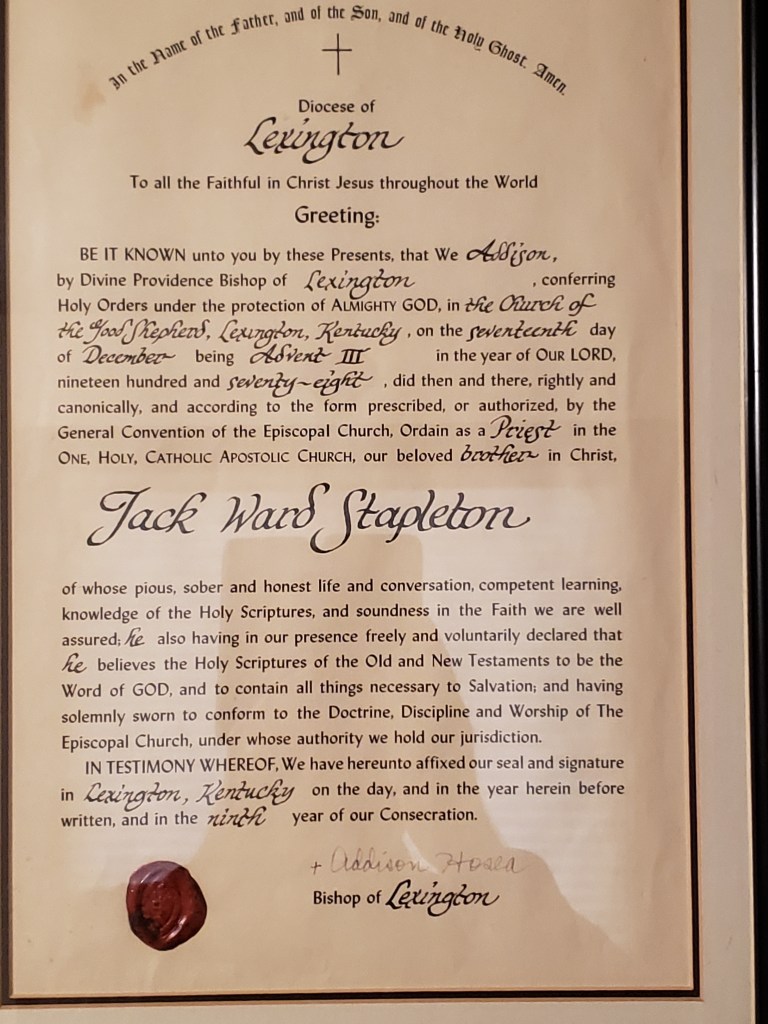
It isn’t my age. In fact, I can barely remember being 46. But it was on this day 46 years ago, in 1978, that I was ordained a priest in the “One, Holy, Catholic, Apostolic Church.” At least that’s what the ordination certificate says.
Although Evergreen, Colorado, has a number of excellent coffee shops and some remarkable brew pubs, I’m not expecting any anniversary discounts today. Being an Episcopal priest is not a particularly notable status in our culture – and it never was as important as we thought it was back in more religious times. That is NOT to say that being a priest is insignificant, only that its significance is not in the arena of national cultural life.
A person ordained a priest maintains two statuses. First is in the Holy Order of priesthood. That status is reflected in three functions: presiding at the Eucharist in the gathered Christian community, pronouncing blessings, and declaring absolution from sin. The second status is the ministry in which the ordained person participates. That can be in parish ministry, institutional chaplaincy, education, or any number of ministries that we can exercise over the years.
The arena in which I exercised Holy Orders has been exclusively the local congregation until I retired at the end of 2018. It was only in the last years of parish ministry that I finally stumbled on a connection between Orders and Ministry that changed the way in which I exercised ministry in the parish. (I have no doubt that many Episcopal priests have been aware of and functioning in that connection for most of their ordained life. I’ve always been a bit slow to catch on.)
The connection is the role of the parish priest in modeling the priesthood that the church members possess in Christ. In short, to teach others to bless, to teach others to pronounce forgiveness of sins, and to teach others to make common things holy (as in Holy Communion) by offering them to the God who transforms and transfigures. That is why this blog is called “The Apprentice Priest.” And that’s what I hope to explore in greater detail in the coming months and (maybe) years.
It’s neither my age nor my IQ. In fact it used to be a fairly insignificant number until the late Douglas Adams selected it for the answer to the ultimate question of “life, the universe, and everything.” The conundrum in his series, The Hitchhikers Guide to the Galaxy, was that 42 made no sense until one understood what the actual question was regarding life, the universe and everything.
I post this brief reflection on Adam’s ongoing joke because today is the 42nd anniversary of my ordination to the priesthood in the Episcopal Church. No celebrations, other than a nice dinner planned.
On explanation of 42 that’s been going around for a while is that in the ASCII table the character assigned to 42 is the asterisk, and the asterisk is a wildcard in searching for items on your computer. In other words, 42 means whatever you want it to mean. So much for philosophy and metaphysics.
Of course, I don’t buy that theory, or at least not entirely. It may or may not be what Douglas Adams meant in his story, but there is meaning and purpose in the universe way beyond our limited and transient self-definitions. On the other hand, 42 years of being a priest and most of the functioning in a parish have helped shape an understanding of priesthood that has moved beyond the limits of ecclesiastical definition. This understanding does base itself on both historical and denominational definitions of Christian priesthood, but it now encompasses much more. Some of that “much more” has been addressed in earlier postings. More may appear here from time to time.
In the meantime, today is 42 in terms of Holy Orders and though I haven’t yet found the question to the answer proposed by Adams whether in regard to the universe or in regard to Holy Orders, I’m enjoying the journey.
When I posted my entry on Practicing Blessing in the local church last Monday (12/23) I got one thing wrong. I mentioned a “conversation that was not caught on video.” In fact, it was. The incident involved a pastor who questioned whether he had authority to bless.
Although the questions about the pastor’s authority to bless seem to come mostly from churches in the evangelical tradition, when one casts a net over the question of whether ordinary Christians have that authority, then the doubt extends across most Christian traditions. Russ’s response to an earlier question on the content of blessing speaks to the doubts found about the authority of Christians to bless in our religious culture. The following excerpt (a bit more than 2 minutes) is worth the listen:
An example of blessing
The full videos of Russ’s four talks blessing run around an hour each. I know that few of us are so burdened with free time that watching an hour long video is a challenge. Nonetheless, I encourage all of you to find time to view – you won’t regret it. Again, you can find them here: https://www.trinitygreeley.org/russ-parker-videos/.
Of course, the practice of blessing by all Christians is nothing new, though it has certainly been lost for quite a while. Ian Bradley, in his book Celtic Christian Communities, makes note of the common practice in the Christian communities in Ireland, Scotland, Wales and other regions where “Celtic” Christianity thrived in the 4th – 9th centuries.
With this understanding of the power of the spoken word, pronouncing a blessing or benediction was no mere pleasantry or routine greeting to pass the time of day. Nor did it simply involve, as its Latin root benedicere suggests, speaking well of someone or something. Rather it conveyed to the recipient in an almost physical sense a portion of God’s goodness and grace… Although those delivered by saints and holy men [and women] were regarded as having a special force and efficacy, blessings were certainly not regarded as the exclusive province of priests and monks, and could come from the lips of any Christian. They were emphatically not confined to liturgical use but had a prominent place in the every day lives and conversation of laity and clergy alike, both inside and beyond the monastic vallum.
Ian Bradley, Celtic Christian Communities: Live the Tradition (Kelowna, BC, Canada: Northstone Publishing, 2000), 61
So if all Christians have the ministry of blessing, what is it that we should be teaching them to bless? Given the state of our society, it would seem obvious that we should teach husbands to bless their wives and wives their husbands. In fact, this would be a good discipline for couples preparing for Christian marriage. When the couple is together, their time should begin, or at least end, with blessing. When they are apart, they can bless one another, even from a distance, each night before sleep.
Parents need to be blessing their children, at night as they go to bed and in the morning before they leave for school. Both parents need to participate as a mother’s blessing is not the father’s, nor the father’s the mother’s. Children can be taught to bless their parents and one another.
These blessings can extend beyond the family and even beyond the life of the congregation. But wherever and to whomever the blessings are given, how do we bless. Again, I point you to Russ Parker’s video talks.
There is one other blessing I’ll close with, taken from Russ’s book, Rediscovering the Ministry of Blessing. It is a blessing for the communities in which we live.
Blessing for a town
We stand in the mighty name of Jesus and bless you [name of town], that you might prosper under the mighty hand of God.
We bless you that justice and righteousness might take their proper place within your boundaries. We bless you that the favour of the Lord might rest upon you and give you peace.
We bless you that the Father’s compassion might fall upon your people. We bless your poor that they might be lifted up.
We bless you that the knowledge of Jesus might come in among you like a flood.
We bless the people of God in [name of town] that they might rise up with servant authority and become a people of blessing.
We bless you that the joy of the Lord might be your strength. Amen. (Worldwide Mission Fellowship)
Parker, Russ. Rediscovering the Ministry of Blessing (pp. 125-126). SPCK. Kindle Edition.
In 2017 our parish brought in Rev. Dr. Russ Parker to lead a parish weekend. While the weekend and the teaching were wonderful and blessed us all, it was the preliminary to the weekend that was my own motive for bringing Russ over from the UK. Russ has written many books and one of them Healing Wounded History had been an essential element in moving the congregation in healing, renewal and growth. But it was one of his more recent books, Rediscovering the Ministry of Blessing, that had started us on the path towards the weekend.
Russ did three sessions on blessing in the midst of our primary weekend focus on The Wild Spirit. One session was a lunch for clergy and ministry leaders, a second followed that evening for the general public on the subject of blessing and a third session on a Saturday morning for parents and godparents on How to bless your children no matter how old they are. All the sessions were professionally videoed, and rather than describe them you can find them on the YouTube channel of Trinity Episcopal Church.
There was one conversation that was not caught on video between Russ and a pastor from an evangelical church. The pastor questioned whether he had authority to bless on God’s behalf. He could pray that God would bless someone, but to say “I bless you…” on behalf of God seemed presumptuous in the extreme. I didn’t overhear the rest of the conversation, but the pastor’s question was an eye opener for me. After all, I am an Episcopal priest and we bless anything and pretty much everything that is offered. We bless bread and wine in Holy Communion and the congregation at the close of that liturgy. We bless pets and crosses and rosaries (yes, some Episcopalians use rosaries) and icons and houses and holy water and holy oil. That’s part of our job. That’s part of the authority imparted to us at our ordination. And here was a pastor questioning his authority to bless.
It wasn’t a huge leap to connect the pastor’s problem with the blank looks I saw on the faces of our congregation whenever I encouraged parents, and particularly fathers, to bless their children. Oddly enough, I’d articulated the problem to that congregation in a sermon. However, as is all too often the case, even though I was the one speaking, I wasn’t the one listening. I was explaining why I thought my father had never blessed me as a child (so far as I knew). He didn’t know he could. Therefore, he didn’t know he should. And had he known either, he probably didn’t know how. As I described that situation there was a quiet voice speaking in the dim recesses of my consciousness, that this would be an ideal time to start teaching the congregation how to bless. I did follow up on that with one course, but it was “one and done.”
Within six months of Russ’s visit, I felt it was time to retire and I left my parish work (with mixed feelings of relief and loss) and my parish community (with deep regret). In the months since my departure the absence of the normal pressures of parish ministry has cleared away much of the foggy thinking of the last few years. With the clarity that only comes with hindsight I think my failure to follow up with teaching people how to bless was my greatest error in leadership during the 15 years I served that parish.
There are two reasons why I give that failure to launch that ignoble status. The first is that the ministry of blessing is a concrete expression of the priesthood of Christ that belongs to all who are in Christ. The “priesthood of all believers” needs to be more than just shorthand for the direct access to the Father through Jesus. The model of our ministry is incarnation – the spiritual God acting to save a material creature through embracing the material reality of our creaturely existence. A priesthood that fails to engage material reality, whatever else it may be, is not the priesthood of Christ. In prior years I had both preached and taught in the congregation on our status as priests. But in the time we explored the ministry of blessing, I failed to make the connection between priesthood and blessing.
The second reason was forgetting a phrase I learned from the late Canon David Watson: the meeting place is the learning place for the marketplace. I haven’t quoted that for a long time because when I did I got the same blank looks mentioned above. I think part of the problem was the concept that the primary workplace of the Body of Christ was not inside the congregation but in the midst of the world in which we work the other six days of the week.
In the context of blessing, applying Watson’s dictum meant that we learned how to how exercise our God-given authority to bless within our church so that we could bless in our homes, our workplaces and every other venue of our lives. When we learn that we can bless and how we bless we do so for the sake of others. Archbishop William Temple noted “The Church is the only society that exists for the benefit of those who are not its members.” One of the key benefits we offer is that of being blessed by God.
Finally, as Russ Parker noted in his talks and his book, blessing is more than kind or encouraging words. The words are ours, but the work is God’s. Go back and follow the link above to Russ’s talks. It will open up a new vista of ministry and mission for the local church.
After several months of blissful retirement, I went back to
work. I didn’t take a regular job, just three Sundays of supply work. The
location was the only problem, being in Aurora, and the far southeastern part
of that city as well. If you’re familiar with the Denver metro area, there is
simply no good way to get from Evergreen to that part of Aurora. Getting there
was no problem as they had an 8:00 am service and the traffic is light at that
hour of the morning. Going home after the 10:15a service was another matter.
However, the greatest demand on my time was sermon preparation. Having never
been to that church before, I could have just recycled a past sermon on those
lessons (aka, “cold canned tongue”). But that shortcut didn’t seem fair and
I’ve always enjoyed the work of sermon prep as much as delivering the result.
While the above paragraph does offer an excuse for my
absence from posting, it also brings me back to the issue of the Priesthood of
Christ and what it means to be in Christ.
At its best, sermon preparation involves not only study but
prayer. The people to whom the sermon is preached are not some random
collection of individuals but a Christian community with its own personality,
its own history and its own challenges. When the preacher has a long-standing
relationship with that congregation, he or she has a wealth of material to draw
upon in connecting the Scriptures with the community. However, the supply
priest rarely has that luxury. At best, we might know the circumstances that
brought us there, perhaps something about the priest we are filling in for (or
replacing!) and perhaps some stories we may have heard about the congregation over
the years.
In the case of my three sermons I had very little
information and therefore praying about the sermon took on some urgency. The
third sermon in particular took a bit of a twist at the end. The lessons
included a reading from Amos warning those in the northern kingdom about their
indifference to the corruption of their society while indulging in luxurious
living. The reading from Luke was the story Jesus tells of the rich man and the
poor beggar, Lazarus. While there were several elements of the story, in the
light of the Amos reading it wasn’t hard to make the connection between the indifference
of the wealthy of Israel and that of the rich man. The twist came because the
congregation’s dedication was to St. Martin of Tours.
The best known story of St. Martin comes during his time as
a catechumen, one being prepared for baptism. Here is the best known story of
St. Martin (with thanks to Wikipedia): “While Martin was a soldier in the Roman
army and stationed in Gaul (modern-day France), he experienced a vision, which
became the most-repeated story about his life. One day as he was approaching
the gates of the city of Amiens, he met a scantily clad beggar. He impulsively
cut his military cloak in half to share with the man. That night, Martin
dreamed of Jesus wearing the half-cloak he had given away. He heard Jesus say
to the angels: ‘Martin, who is still but a catechumen, clothed me with this
robe.’”
St. Martin of Tours
I included a retelling of that story to remind them that
their name dedication was to a person who was not indifferent to the needs of
the poor and was paying attention to the world surrounding him. This was not an
injunction to do something they weren’t already doing. Rather it was intended
to show them that their current practices were a fulfilling of divine purpose
they had received when taking on the name of St. Martin’s church.
One further twist in that sermon came after we’d arrived at
the church and I was reviewing the bulletin before the 8:00a service. In the
announcements there was a longish paragraph on being a “DIY” congregation.
Their rector had resigned early in September, thus the reason for supply
clergy. In the clergy-centric culture of the Episcopal Church, the departure of
the priest can leave a congregation feeling adrift and uncertain. The main
point of that article was to remind them that they have, in fact, always been a
congregation that took care of the things that made up Christian community and
that life would be “business as usual” as they started searching for a new
priest. When added to the lessons and the connection with St. Martin, this
provided an unexpected conclusion to the sermon for that morning.
One might ask how any of this story relates to the
priesthood of Christ and what it means to be “in Christ.” To answer that I need
to go back to the distinction made between the priest/presbyter and the
priest/hierus made in earlier posts on this subject. My status as a
priest/presbyter gave me a platform to speak to this congregation, but that’s
really all it gave me. If I were going to be for them a priest/hierus then I
would need to bring God’s word and God’s blessing to their life as a Christian
community. In order to do that I would need pray actively in seeking what God
wanted said and pray passively in paying attention to things around me that God
was orchestrating.
Those actions do not require ordination as a
priest/presbyter. For that period, and precisely because I did not know what to
say to that community, I was able to be “in Christ” for an extended period.
What the effect of what I spoke and on whom I do not know. I spoke priestly
(hierus) words of blessing and encouragement. That is, I believe, what I was
supposed to do. Everything else from there is God’s problem, not mine.
Now this may seem a rather trivial example in the light of
the acts of Adam’s priesthood to separate, abuse, wound and destroy. But even a
cursory review of stories from the Bible demonstrates that God’s plans are not
worked out as grandiose schemes but through ordinary people in ordinary places.
Whether it is Abraham, or the young Samuel or David, or the young Jeremiah or
Mary the mother of Jesus or the fishermen Jesus chose, we dare not despise the
small things that appear to be God’s favored way of working.
The priesthood of Christ, the antidote to the broken
priesthood of Adam, is the Christ-directed acts of common men and women who
take the time and effort to live “in Christ” and thus become agents for
Christ’s healing in unexpected ways.
[Jesus] also said, “The kingdom of God is as if someone would scatter seed on the ground, and would sleep and rise night and day, and the seed would sprout and grow, he does not know how. The earth produces of itself, first the stalk, then the head, then the full grain in the head. But when the grain is ripe, at once he goes in with his sickle, because the harvest has come.”
An Episcopal priest writing about priesthood is no big deal. And even when the distinction is made between the priest/elder (prebyteros) which is what I am, and the priest/hieros which describes both the Levitical priesthood and the priesthood of Christ, it seems an esoteric topic with little relevance to most Christians, much less most human beings. However, as asserted in my earlier posts on the priesthood of Adam, the priestliness of our humanity is something we cannot renounce for it is at the very core of our identity and purpose. The topic is relevant to all human beings regardless of faith or lack of faith.
If human beings are intended to be priestly creatures then the history of humanity in the world is evidence that there is a problem with our priesthood. We exercise our priesthood the way our encounters with the world give meaning in building and blessing. We also exercise our priesthood the way our encounters with the world rob meaning by destroying and cursing. What we build we find easy to destroy. But what we destroy is hard to heal or rebuild and sometimes beyond our best efforts. It appears our priesthood is powerless against the reality of Sin. Can there be an alternative?
This is obviously a rhetorical question. The short answer is that Jesus has inaugurated a new priesthood. It is a priesthood in which the priest takes on the consequences of our damaged Adamic priesthood, offers himself, and then surviving that offering transfigures our damaged priesthood as part of a new creation. That sounds quite lovely and very hopeful but tells us little about how we are to live in this broken and benighted world. If there is substance to be found in this new priesthood that can be accessed and deployed by ordinary apprentices of Jesus then we need to understand what that new priesthood is and what it is not.
It is much easier to address the negative than the positive. The priesthood of Jesus is neither a magic bullet nor a magic wand. Even the in world of Harry Potter, magic is unable to address the fundamental illness in the heart of our Adamic priesthood. One of my favorite themes from N.T. Wright asserts that when God wants to bring justice to our human mess He doesn’t send in the tanks – He sends in the poor in spirit, the meek, the ones whose hunger for righteousness is a burning ache and a desperate thirst for the healing of the world. But that’s not it either. The priesthood of Christ is not a status conferred or a gift given. Rather it is what St. Paul struggles to articulate in much of his writing – it is being “in Christ.” The priesthood of Christ is Christ’s alone. If we are to wield that priesthood in our world it is only because we are in Christ and Christ, therefore, is in us.
How that works is the topic I’ll be taking up next.
Every interaction with things and persons outside of our selves has the potential to be a building block of history. However, this is not the sort of history that we study in texts or even read for our pleasure. Robert Capon, in his An Offering of Uncles uses the distinction for two words in Greek that must make do with one word in English for translation. The English word is time, the Greek have both chronos and kairos. Chronos is time in the abstract. As I sit writing I hear the tick of the clock above my desk. It shows me that it is now a 11:19 in the morning. That tells us precisely nothing. To give meaning to that bit of chronos I need to know what it is time for. Chronos by itself gives us only chronology. Kairos gives us meaning and meaning creates history. When one person says of another “we have a history together,” they are referring to encounters that took place in high time, kairos time. Those encounters could leave the persons encouraged or healed or discouraged or wounded but they were real history filled with meaning that will echo far beyond the encounters themselves.
In the late Douglas Adam’s series, The Hitchhikers Guide
to the Universe, the ultimate supercomputer, Deep Thought, runs a 7,500,000
year program to discover the answer to the ultimate question of “life, the
universe and everything.” The answer is 42. When Deep Thought’s programmers
protest, the computer replies that they’ve never really understood what the
question was. In the ASCII (American Standard Code for Information Interchange)
42 is the code for the asterisk (*). Computing frequently uses the * as a
“wildcard” that can represent any number of characters in a search or filter. Some
folks assert that in giving the answer to the question of the meaning of
existence as 42, Adams was declaring the meaning is anything you want it to be.
As an apprentice of Jesus, I can’t buy that theory. There is
meaning shot through creation. There is ultimate meaning in the Creator’s
purpose in creation. But the assertion attributed to Adams is a great deal more
true than many Christians would accept. Our actions in kairos time create
meaning within the greater meaning of God’s purposes. In that sense we build
into a structure that God has already designed. This approach adds meaning to
Paul’s injunction to the Christian community in Corinth:
For no one can lay a foundation other than that which is laid, which is Jesus Christ. Now if anyone builds on the foundation with gold, silver, precious stones, wood, hay, straw— each one’s work will become manifest, for the Day will disclose it, because it will be revealed by fire, and the fire will test what sort of work each one has done. If the work that anyone has built on the foundation survives, he will receive a reward. If anyone’s work is burned up, he will suffer loss, though he himself will be saved, but only as through fire. Do you not know that you are God’s temple and that God’s Spirit dwells in you?
(1 Corinthians 3:11-16)
Those actions that are represented by the more permanent elements can be seen as actions in kairos time that build into God’s temple. And what of the less permanent elements? Those could represent the lost opportunities, our failure to pay attention to the kairos time and the actions invited or required at those moments of meaning. It is a deeply flawed analogy, but it is useful nonetheless.
What the analogy fails to address is our capacity to undo
meaning. Our actions in kairos time that give meaning are priestly acts and
fully human acts as well. But the story of the Fall in the garden in Eden is
the story of a priestly act that destroys meaning. There are four pieces of
brokenness that result from that failure, all interconnected. The connection
between the human creatures and the Creator is broken (they were afraid and
hid). The connections of inner human integrity is broken (they were ashamed of
their own creaturely vulnerability). The connections of the shared imago dei
of man and woman is broken (Adam blamed both Eve and the Creator). The
connection of humanity with the earth of which they are a part is broken (the
earth is cursed). That last one requires some clarification. God did not
curse the earth, but rather observed that the earth is now cursed because of
humanity. Even the briefest perusal of human impact on our planet is an
eloquent testimony to the Earth’s suffering at our hands.
The Priesthood of Adam has been ever since then both the agent of building meaning and of destroying it. We can still do good. So far it seems that the black masses of unmeaning can undermine our masses of meaning in the briefest moment.
Can the priesthood of Adam be healed? Or must we look to a different priesthood to heal the wounds we inflict? I’ll take up that idea in my next posting.
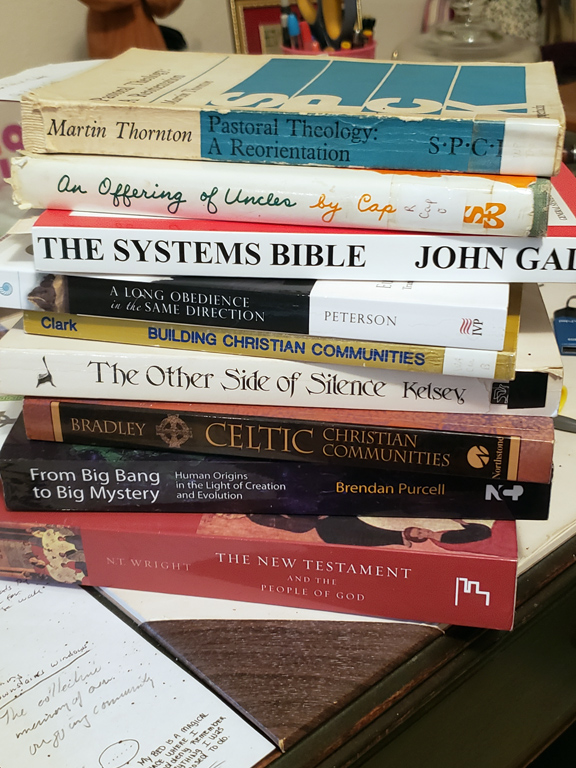
In the meantime, here’s the stack I’m working through for the book:




 The Apprentice Priest