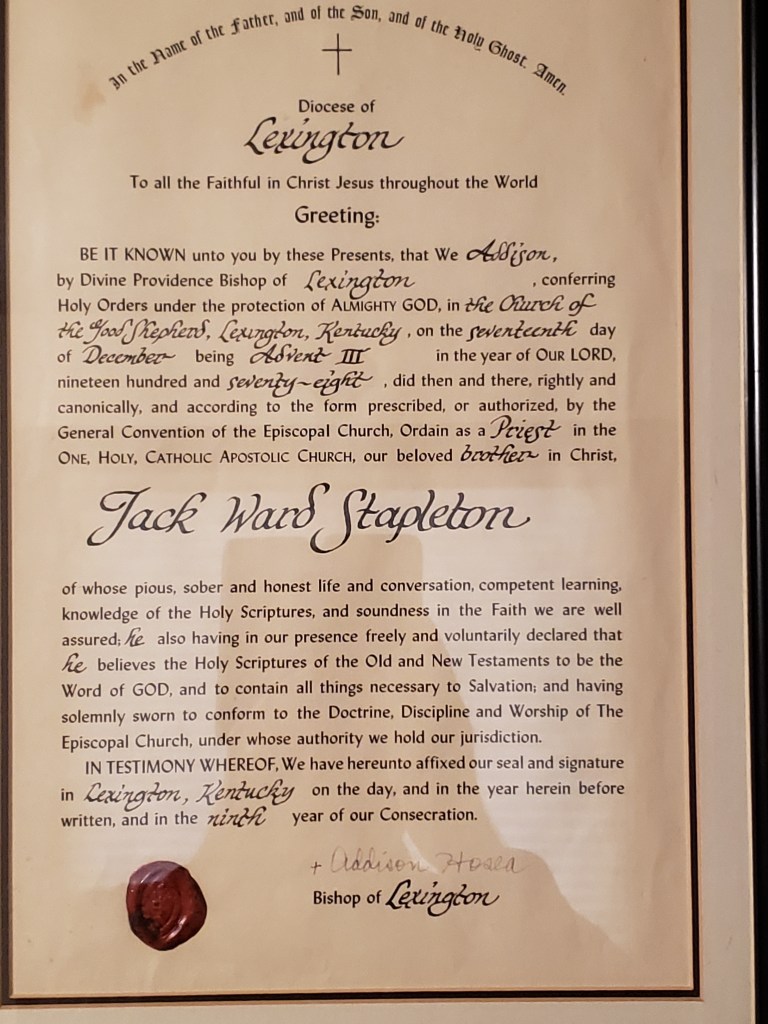
It isn’t my age. In fact, I can barely remember being 46. But it was on this day 46 years ago, in 1978, that I was ordained a priest in the “One, Holy, Catholic, Apostolic Church.” At least that’s what the ordination certificate says.
Although Evergreen, Colorado, has a number of excellent coffee shops and some remarkable brew pubs, I’m not expecting any anniversary discounts today. Being an Episcopal priest is not a particularly notable status in our culture – and it never was as important as we thought it was back in more religious times. That is NOT to say that being a priest is insignificant, only that its significance is not in the arena of national cultural life.
A person ordained a priest maintains two statuses. First is in the Holy Order of priesthood. That status is reflected in three functions: presiding at the Eucharist in the gathered Christian community, pronouncing blessings, and declaring absolution from sin. The second status is the ministry in which the ordained person participates. That can be in parish ministry, institutional chaplaincy, education, or any number of ministries that we can exercise over the years.
The arena in which I exercised Holy Orders has been exclusively the local congregation until I retired at the end of 2018. It was only in the last years of parish ministry that I finally stumbled on a connection between Orders and Ministry that changed the way in which I exercised ministry in the parish. (I have no doubt that many Episcopal priests have been aware of and functioning in that connection for most of their ordained life. I’ve always been a bit slow to catch on.)
The connection is the role of the parish priest in modeling the priesthood that the church members possess in Christ. In short, to teach others to bless, to teach others to pronounce forgiveness of sins, and to teach others to make common things holy (as in Holy Communion) by offering them to the God who transforms and transfigures. That is why this blog is called “The Apprentice Priest.” And that’s what I hope to explore in greater detail in the coming months and (maybe) years.
In an ongoing effort to render this old blog site habitable, a few items of furniture need to be brought into the sunlight again for a thorough cleaning. The first piece of furniture relates to the choice of its name: The Apprentice Priest.
Why Apprentice?
Today apprentice is not a synonym for disciple – but that’s because being an apprentice isn’t what it used to be. Unlike the reality show version of apprentice, modern apprenticeship is a step towards professional status in a trade. It does not involve living with one’s instructor or observing their lifestyle and character.
I picked up the practice describing myself as an apprentice from Dallas Willard. He well may be the source of the current adoption of apprentice as an alternative to disciple. But apprentice is probably popular because it is new. Human culture will undoubtedly be able to drain it of substantial meaning as we did with Christian and disciple. Christian and Christianity are terms that come loaded with a great deal of baggage that has little to do with what we read in the New Testament. While I am happy to be known as a follower of Jesus or an apprentice of Jesus, I prefer not to accept the term Christian until I understand what associations it has for the person with whom I am speaking.
Disciple has its own problems. Alison Morgan reports: “In 2011 the Anglican Diocese of Gloucester conducted a survey among its clergy, asking what they regarded as the most important elements of discipleship. The survey reported widespread agreement across the diocese: clergy from all contexts and traditions selected ‘Bible study’ as the foremost activity of a Christian disciple, followed by ‘prayer.’ There was no suggestion that discipleship should involve any element either of ministry or lifestyle; indeed, ‘personal morality’ was rated bottom of the seventeen options offered, along with ‘witness’ and ‘faith at work.’”[1]
Morgan later observes: “Jesus wasn’t training theologians; he was training practitioners, and the primary context of training was not the classroom but the community.’[2] This is consistent with Dallas Willard’s contention that “The term ‘discipleship’ has currently been ruined so far as any solid psychological and biblical content is concerned.”[3]
On the other hand, apprentice has an advantage over the other terms. Christian is rarely used to imply any relationship except that between Christ and the individual believer. However, to be an apprentice, you usually have to be apprenticed to someone. One can be a disciple of anyone, living or dead. But one can only apprentice oneself to a living person. Therefore, to be an apprentice of Jesus means a) that He is alive, b) He is accessible in relationship, and c) that relationship is capable of growing, evolving, and deepening.
Being an apprentice of Jesus the Christ is where I want to be. Sharing some of that journey’s failures and successes is one reason I’m resurrecting The Apprentice Priest. And the “priest” part of this? Maybe in a couple of weeks, I’ll have more to say.
[1] Alison Morgan, Following Jesus: The Plural of Disciple is Church, ReSource, c. 2015, p. 44
My vote for the most profound theologian of the past 50 years goes to an anonymous London taxi driver. N.T. Wright told his story back in 2010 when Wright served as the Anglican bishop of Durham. The story inspired Wright’s Easter sermon that year, and it is best to let the bishop tell it in his own words:
The taxi driver looked back at me in his mirror. His face was a mixture of amusement and sympathy. We were stuck in traffic and he’d asked me, as they do, what I did for a living.
‘Ah,’ he said, ‘you Church of England people’ (having told me he was a Roman Catholic himself). ‘You’re still having all that trouble about women bishops, aren’t you?’
I had to admit that that was indeed the case.
‘The way I look at it,’ he said, ‘is this: if God raised Jesus Christ from the dead, all the rest is basically rock’n’roll.’
Rock ‘n roll indeed. Yes, that probably is an over-simplification, but the hard truth behind it is that if God did not raise Jesus Christ from the dead, then as Paul told the Corinthians: “Your faith is futile.” Most of the things that self-identified Christians squabble about are of debateable importance. But if Jesus is not raised, then they are of no importance at all.
May I suggest that we take the Resurrection of Jesus as a pair of glasses, corrective lenses through which we look at Scripture, theology, history, the physical and social sciences, and, in fact, every human endeavor? Let us remember that resurrection is not resuscitation. The description of the risen Jesus’ physical actions in the Gospels indicate much more than restoration to the life Jesus lived before his crucifixion. This is something new.
To look at our lives through those Resurrection glasses is to invite ourselves to assess and reassess all else that we believe. Maybe how we see our world is more a product of the culture in which we were raised and less the product of Jesus’ Kingdom.
In previous postings (May 12, June 6, July 3) I looked at the problem of conversion when it is considered a singular event rather than an extended journey. I considered the problem in three contexts; first of an individual coming to faith from outside the covenant tradition of Israel: Simon the magician (Acts 8:9-24). Second, problem of conversion in a community, many of whom also came from outside the covenant tradition. In that case it was the church in Corinth, primarily looking at Paul’s First Letter to the Corinthians. In the third case it was the apostles themselves who served as an example of the problem of conversion; a problem even among those steeped in both the covenant tradition and the teaching of Jesus. Perhaps all these stories connected with our experience of people of faith or communities of faith. But whether we found a connection or not, all three of those postings only described situations. There was no mention of a way forward, of getting the process of conversion unstuck.
It reminds me of one of my mother’s favorite jokes (she was a medical secretary). A man visits his doctor and describes a whole host of symptoms. The doctor listens carefully and then he asks: “Have you had this condition before?” The man answers in the affirmative and the doctor then says: “Well, you’ve got it again. That will be fifty dollars. Next patient.” Fortunately, my postings are free of charge, but it’s still not helpful to leave us with a description we may already recognize.
Of course, the first step is to recognize that conversion is a journey and if we’re not making progress, we need to get unstuck. There are several tools available to us in getting moving on our journey. These tools, often called spiritual disciplines, are, or should be, quite familiar to us. Most Christian traditions include prayer, Bible study, and service. There are several other disciplines including fasting, giving, worship, penance, devotional reading and more. And these are not new. Their pedigree is older than the Church, for we learned them from the Jews.
These disciplines have indeed been around for centuries, but by themselves are not sufficient to start our journey into a fuller conversion. If they were, Christian history would read rather differently. At their best, they might awaken a hunger for closer connection with Jesus. At their worst they create a complacency that can produce legalistic self-righteousness. It is not that these disciplines are faulty. They are all good and several of them necessary to the journey of conversion. It is that there are two critical elements missing: understanding the context of the disciplines and understanding their purpose.
Most of what Jesus teaches about the values and priorities of the Jesus path assume it is lived in community. The late Canon David Watson once observed that “the meeting place is the learning place for the marketplace.” Many times, when I’ve quoted that in sermons and teachings, the only response I get is a blank look. Part of the problem is that Watson was speaking in British idiom and I’ve only ministered in the US. But the main problem is that we fail, on the whole, to appreciate the essential nature of community in following the Jesus path.
The meeting place, in Watson’s observation, is the regular gathering of Christ’s people in worship and fellowship. Yet even that can be misleading. Worship is an action directed God-ward. The community’s attention is directed towards those who are leading the worship. It is not a place of conversation or relation-building among those gathered. Worship, whether liturgical or non-liturgical, is not designed to create or build relationships. Those relationships are formed in smaller configurations where there is time to share and reflect and experiment with the Spirit filled life in Christ.
It is in these smaller groups, as well as in corporate worship, that the meeting place becomes the learning place. The learning can be factual – as in getting insight to Scripture through sharing understanding. It can be behavioral – as in sharing struggles and practices in prayer. It can be relational – as in dealing faithfully with others whose style of communication, values, and personalities are quite different than our own. When what we are learning becomes part of our own behavior, we carry that into the world outside our group and our congregation. And the meeting place has become the learning place for engaging in the marketplace – a Britishism that refers not to the large halls of commerce but to the town market where, in the midst of our personal commerce we connect with our local community.
That now leaves us with the final piece of the puzzle of getting conversion unstuck – the purpose. And that purpose is not what we often think it is. But that must wait for the next post.
That comment is showing up regularly throughout the world of social media. It could also be the longest. Our isolation is likely to continue through Easter Day and well beyond. Yet even in the midst of our current chaos, the Christian year moves through its own rhythms, whether we are allowed to gather or not. Each Sunday and major feast has its own prayer, its collect[1]. For many Episcopalians, Sunday will be the only time they hear or read the collect of the day. Those who follow the discipline of daily Morning and/or Evening Prayer may offer that collect each day throughout the week. Yet even then, the calendar moves on and we don’t use the collect until next year.
And then there’s the reality that very few Christians attend churches that use these particular collects, and fewer pause to reflect on what has just been prayed. Then there’s the new, current reality that we cannot, for the immediate future, gather for worship. Even those who join their congregations online seem to be about half of what we used to have when we could meet in a common place.
Because of this I suggest we might look back a couple of weeks and reflect on the collect for the Third Sunday of Lent:
Almighty God, you know that we have no power in ourselves to help ourselves: Keep us both outwardly in our bodies and inwardly in our souls, that we may be defended from all adversities which may happen to the body, and from all evil thoughts which may assault and hurt the soul; through Jesus Christ our Lord, who lives and reigns with you and the Holy Spirit, one God, for ever and ever. Amen.
Book of Common Prayer
That first declaration may seem inaccurate to us. After all, we are doing quite a lot to help ourselves. Whether it is increasing our capacity for testing or working on a vaccine for the COVID19 virus or issuing stay at home orders or practicing social distancing or thoroughly and regularly washing our hands or turning our manufacturing from normal consumer items to masks and PPE and ventilators, we seem to be charging through to a solution even in the face of political maneuvering, finger pointing, wishful thinking and short-sightedness. And yet. Our failure to comprehend the fundamental connectedness of creation led us to this point. Whatever we can accomplish to ameliorate the pandemic will not change that self-sabotaging flaw in human nature that prefers to narrow our vision to what results in our own benefit. Our inventiveness has changed a lot of things in this world and not all of them for the worse. And yet, we can’t seem to change our behavior even when our circumstances demand it. We have no power in ourselves to help ourselves.
So the prayer begins with an honest evaluation of human limits. From there the prayer moves on to our need from our Creator, “keep us both outwardly in our bodies and inwardly in our souls.” That distinction has echoes of a very unbiblical Platonism. In the Scriptures the body/soul distinction is very fuzzy. The Gospels tell the story of Incarnation, that God who is Spirit willingly embraces matter. Having already declared the material world “good” in Genesis 1, God now makes it holy in John 1:14: “and the Word became flesh and dwelt among us.” Because of that fundamental unity of soul and body that makes us human, things which cause harm to the body also assault and hurt the soul and those things which assault and hurt the soul affect the body adversely. Perhaps that is why the prayer uses “and” rather than “or.” The two conditions are inextricably interrelated.
The prayer then concludes with the common doxology: “through Jesus Christ our Lord, who lives and reigns with you and the Holy Spirit, one God, for ever and ever. Amen” It is through Jesus the Messiah that connection has been restored between creation and the Creator and so our prayers find their natural path through him. We are also reminded that this Jesus both lives and reigns. The unity described in the doxology is the model for the unity for which Jesus prayed we might be one as he and the Father are one. If a collect is a summary prayer, it certainly seems that the Collect for the Third Sunday in Lent summarizes our situation accurately. It might be worth our while to offer that prayer daily through this season of pandemic.
[1] A collect is a prayer that isused in “collecting” the community for worship and also several elements of prayer and praise into one.
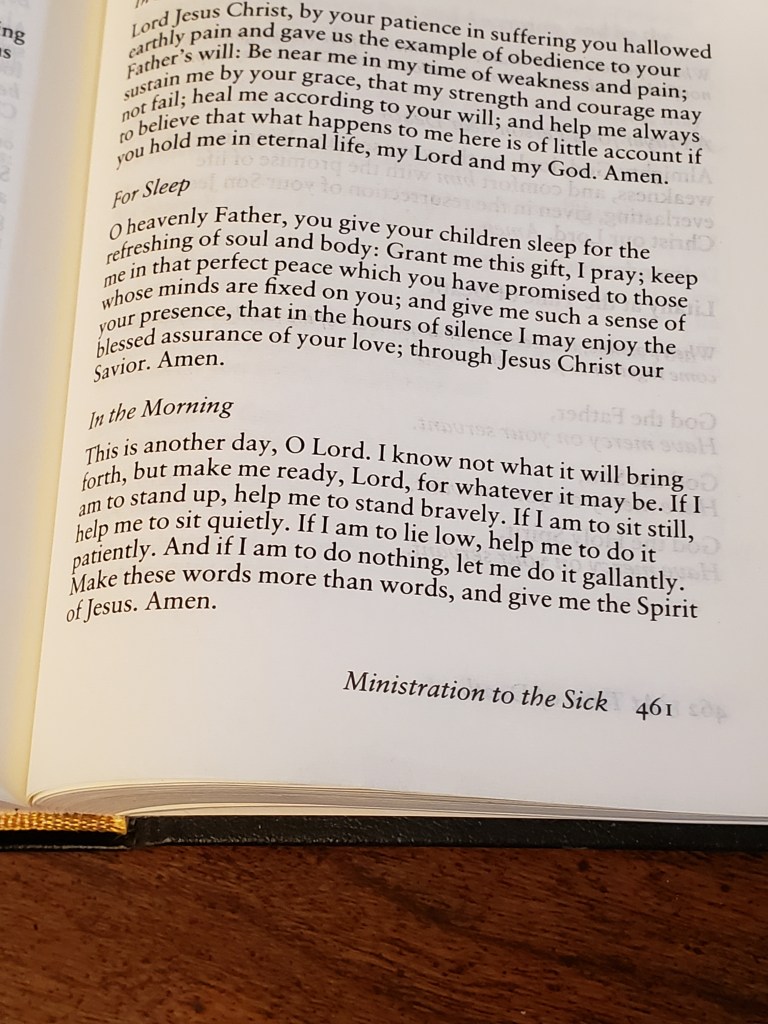
We called it “the Groundhog Book” to the probable consternation of the Standing Liturgical Commission. They had published The Draft Proposed Book of Common Prayer on February 2, 1976, the Feast of the Presentation. But that is also Groundhog Day and this was the 1970s so it became the Groundhog Book whether the powers that be liked it or not. Nonetheless, Episcopalians (particularly clergy and seminarians) pored over the 1,001 pages to see what glorious renewal of worship or what hideous manual of modern heresy we had been handed. Reviewing the pages with one of my mentors we discovered a new treasure deep inside the book, the last prayer in the section on Ministration to the Sick.
This is another day, O Lord. I know not what it will bring forth, but make me ready, Lord, for whatever it may be. If I am to stand up, help me to stand bravely. If I am to sit still, help me to sit quietly. If I am to lie low, help me to do it patiently. And if I am to do nothing, let me do it gallantly. Make these words more than words, and give me the Spirit of Jesus. Amen.
I’ve already seen this prayer posted in social media in relation to the current COVID19 crisis. With the increasing number of “stay in place” orders, the cancellations of events with over 50 in attendance (in some places over 10), many of us are experiencing the isolation of a recovering person regardless of our health. For those of us who tend towards introversion, this is not a great sacrifice. But for those who those who have lost their jobs, those who are more extroverted and have been told to work from home and struggle with the lack of human gatherings this is a dark and painful time.
How can those living with enforced cabin fever “do nothing gallantly?” I’d love to offer some “3 simple steps” or “four rules for prospering in crisis” but they would be as bogus as anything one might find on social media. There is, of course, one thing that all apprentices of Jesus can do no matter what their situation: pray.
OK, that’s neither original nor exciting. Most of those who read this are already praying. We may be praying for a number of things or a number of persons. But there are two things to keep in mind if we want our prayers to be more than just good thoughts. The first thing is to remember that when we pray we are also volunteering to be part of God’s answer to our prayers or to the prayers of others. Second, and related to that, the prayer of an apprentice also involves listening. In my former parish we called that “Paying Attention.” When we pay attention as an element of our praying we become open to God’s direction in both further prayer and continuing action.
Some nudge to call someone, to send a text or email or some other means of electronic communication or to follow the quiet prod to buy a gift card or take home a meal from a local eatery may be God’s timing to bring hope and courage to others trapped in fear. Doing nothing gallantly is to be content with the limitations imposed upon us in these days and turn our apparent helplessness into means by which others may be blessed, others may be encouraged, others may find hope rekindled, others find healing. To be able to do nothing (at least as our busy-ness loving world defines nothing) is not necessarily to be powerless – if we do nothing gallantly.
From Jack, a retired Episcopal priest and over 60 years of age (but in good health) in unofficial ecclesiastical quarantine because so many churches are in lockdown; to my beloved apprentices of Jesus in all the places where I’ve served (and a few that I haven’t): Grace and Peace to you from God our Father and the Lord Jesus Christ.
It feels odd not being able to “go to church” when we are in good health and we’re not on the road and the weather is clear. But “going to church” is a troublesome phrase because it can be read as going to a place or going to an event in which we are spectator/participants. A congregation in Brooklyn had t-shirts printed for their members. On the front it read “I don’t go to church.” On the back, “I AM the church!” It was clever and mostly true. I say “mostly” because to be completely true they’d have to change the “I am” to “We are.”
In the New Testament the English word church translates a Greek word ekklesia. Ekklesia (literally “called out”) had an important meaning in the ancient world before the New Testament was written. In the Greek city state of Athens, the ekklesia was the assembly of citizens that formed the first recorded attempt at democratic rule. Although citizens at that time only consisted of free males of 18 years old and above, they were called out on a regular basis to make significant decisions for the city of Athens.
Ekklesia is a gathering of a specific body, whether the body of the “citizens” of Athens or the Body of Christ. But what happens when the Body cannot gather? We’re facing that problem in many places both in the US and across the globe this weekend and probably longer. If church means an assembly then are we still church when we can’t assemble? The answer is certainly yes, but that yes has something to say about how we see ourselves as members of a church.
The citizens of Athens were part of the ekklesia whether the ekklesia was meeting or not. Indeed, members of the ekklesia could be fined for not attending the gathering (how’s that for a fund raising device for churches?). But the point is that the ekklesia existed even when it was not gathered. And if the existence of the church is not dependent on the gathering of the church, then how are we to model the interdependent life of the that Paul describes in 1 Corinthians 12?
For just as the body is one and has many members, and all the members of the body, though many, are one body, so it is with Christ. For in one Spirit we were all baptized into one body—Jews or Greeks, slaves or free—and all were made to drink of one Spirit. For the body does not consist of one member but of many. If the foot should say, “Because I am not a hand, I do not belong to the body,” that would not make it any less a part of the body. And if the ear should say, “Because I am not an eye, I do not belong to the body,” that would not make it any less a part of the body. If the whole body were an eye, where would be the sense of hearing? If the whole body were an ear, where would be the sense of smell? But as it is, God arranged the members in the body, each one of them, as he chose. If all were a single member, where would the body be? As it is, there are many parts, yet one body. The eye cannot say to the hand, “I have no need of you,” nor again the head to the feet, “I have no need of you.” On the contrary, the parts of the body that seem to be weaker are indispensable, and on those parts of the body that we think less honorable we bestow the greater honor, and our unpresentable parts are treated with greater modesty, which our more presentable parts do not require. But God has so composed the body, giving greater honor to the part that lacked it, that there may be no division in the body, but that the members may have the same care for one another. If one member suffers, all suffer together; if one member is honored, all rejoice together. Now you are the body of Christ and individually members of it. (1Cor 12:12-27)
Certainly we should pray for one another, for the members of our particular local Body and especially those of that Body who are most at risk in this crisis. At the same time we are the Body of a Christ who was himself Incarnate. As George Mcleod put it, “matter matters.” Thus, prayer in our isolation is vital, but it is not everything. Watching some form of worship via live streaming is helpful in maintaining a sense of connection, but it is not incarnational connection. And since we cannot gather in the same place at the same time during this time, how can we incarnate our community?
I’ve often taught that worship of an Incarnate Christ must be sensual worship, that is it should be engaging all the senses through which we interact with God’s creation. Vision and hearing may be engaged through live streaming, but that is not enough for it does nothing to establish the physical togetherness of the Body. Still, there are ways.
Calling one another to check in and encourage is far more valuable than we might believe. And though sending physical notes through the mail may not be wise (I’ll leave that one to the medical experts), an email that can be printed out and held in one’s hand is a physical representation of our connection in the Body of Christ.
This may seem rather trivial, but, to misquote Scripture, do not despise small things. The COVID19 virus has, for this time, apparently “dismembered” the Body of Christ. We can give lie to that appearance by using every appropriate resource of our sense to “re-member” who we are until that day when we can regather and receive that which we were given in re-membrance of Jesus. Maybe when we regather we will greet one another with gratitude and wonder, giving thanks for one another’s presence in one Body.
When I posted my entry on Practicing Blessing in the local church last Monday (12/23) I got one thing wrong. I mentioned a “conversation that was not caught on video.” In fact, it was. The incident involved a pastor who questioned whether he had authority to bless.
Although the questions about the pastor’s authority to bless seem to come mostly from churches in the evangelical tradition, when one casts a net over the question of whether ordinary Christians have that authority, then the doubt extends across most Christian traditions. Russ’s response to an earlier question on the content of blessing speaks to the doubts found about the authority of Christians to bless in our religious culture. The following excerpt (a bit more than 2 minutes) is worth the listen:
An example of blessing
The full videos of Russ’s four talks blessing run around an hour each. I know that few of us are so burdened with free time that watching an hour long video is a challenge. Nonetheless, I encourage all of you to find time to view – you won’t regret it. Again, you can find them here: https://www.trinitygreeley.org/russ-parker-videos/.
Of course, the practice of blessing by all Christians is nothing new, though it has certainly been lost for quite a while. Ian Bradley, in his book Celtic Christian Communities, makes note of the common practice in the Christian communities in Ireland, Scotland, Wales and other regions where “Celtic” Christianity thrived in the 4th – 9th centuries.
With this understanding of the power of the spoken word, pronouncing a blessing or benediction was no mere pleasantry or routine greeting to pass the time of day. Nor did it simply involve, as its Latin root benedicere suggests, speaking well of someone or something. Rather it conveyed to the recipient in an almost physical sense a portion of God’s goodness and grace… Although those delivered by saints and holy men [and women] were regarded as having a special force and efficacy, blessings were certainly not regarded as the exclusive province of priests and monks, and could come from the lips of any Christian. They were emphatically not confined to liturgical use but had a prominent place in the every day lives and conversation of laity and clergy alike, both inside and beyond the monastic vallum.
Ian Bradley, Celtic Christian Communities: Live the Tradition (Kelowna, BC, Canada: Northstone Publishing, 2000), 61
So if all Christians have the ministry of blessing, what is it that we should be teaching them to bless? Given the state of our society, it would seem obvious that we should teach husbands to bless their wives and wives their husbands. In fact, this would be a good discipline for couples preparing for Christian marriage. When the couple is together, their time should begin, or at least end, with blessing. When they are apart, they can bless one another, even from a distance, each night before sleep.
Parents need to be blessing their children, at night as they go to bed and in the morning before they leave for school. Both parents need to participate as a mother’s blessing is not the father’s, nor the father’s the mother’s. Children can be taught to bless their parents and one another.
These blessings can extend beyond the family and even beyond the life of the congregation. But wherever and to whomever the blessings are given, how do we bless. Again, I point you to Russ Parker’s video talks.
There is one other blessing I’ll close with, taken from Russ’s book, Rediscovering the Ministry of Blessing. It is a blessing for the communities in which we live.
Blessing for a town
We stand in the mighty name of Jesus and bless you [name of town], that you might prosper under the mighty hand of God.
We bless you that justice and righteousness might take their proper place within your boundaries. We bless you that the favour of the Lord might rest upon you and give you peace.
We bless you that the Father’s compassion might fall upon your people. We bless your poor that they might be lifted up.
We bless you that the knowledge of Jesus might come in among you like a flood.
We bless the people of God in [name of town] that they might rise up with servant authority and become a people of blessing.
We bless you that the joy of the Lord might be your strength. Amen. (Worldwide Mission Fellowship)
Parker, Russ. Rediscovering the Ministry of Blessing (pp. 125-126). SPCK. Kindle Edition.
After several months of blissful retirement, I went back to
work. I didn’t take a regular job, just three Sundays of supply work. The
location was the only problem, being in Aurora, and the far southeastern part
of that city as well. If you’re familiar with the Denver metro area, there is
simply no good way to get from Evergreen to that part of Aurora. Getting there
was no problem as they had an 8:00 am service and the traffic is light at that
hour of the morning. Going home after the 10:15a service was another matter.
However, the greatest demand on my time was sermon preparation. Having never
been to that church before, I could have just recycled a past sermon on those
lessons (aka, “cold canned tongue”). But that shortcut didn’t seem fair and
I’ve always enjoyed the work of sermon prep as much as delivering the result.
While the above paragraph does offer an excuse for my
absence from posting, it also brings me back to the issue of the Priesthood of
Christ and what it means to be in Christ.
At its best, sermon preparation involves not only study but
prayer. The people to whom the sermon is preached are not some random
collection of individuals but a Christian community with its own personality,
its own history and its own challenges. When the preacher has a long-standing
relationship with that congregation, he or she has a wealth of material to draw
upon in connecting the Scriptures with the community. However, the supply
priest rarely has that luxury. At best, we might know the circumstances that
brought us there, perhaps something about the priest we are filling in for (or
replacing!) and perhaps some stories we may have heard about the congregation over
the years.
In the case of my three sermons I had very little
information and therefore praying about the sermon took on some urgency. The
third sermon in particular took a bit of a twist at the end. The lessons
included a reading from Amos warning those in the northern kingdom about their
indifference to the corruption of their society while indulging in luxurious
living. The reading from Luke was the story Jesus tells of the rich man and the
poor beggar, Lazarus. While there were several elements of the story, in the
light of the Amos reading it wasn’t hard to make the connection between the indifference
of the wealthy of Israel and that of the rich man. The twist came because the
congregation’s dedication was to St. Martin of Tours.
The best known story of St. Martin comes during his time as
a catechumen, one being prepared for baptism. Here is the best known story of
St. Martin (with thanks to Wikipedia): “While Martin was a soldier in the Roman
army and stationed in Gaul (modern-day France), he experienced a vision, which
became the most-repeated story about his life. One day as he was approaching
the gates of the city of Amiens, he met a scantily clad beggar. He impulsively
cut his military cloak in half to share with the man. That night, Martin
dreamed of Jesus wearing the half-cloak he had given away. He heard Jesus say
to the angels: ‘Martin, who is still but a catechumen, clothed me with this
robe.’”
St. Martin of Tours
I included a retelling of that story to remind them that
their name dedication was to a person who was not indifferent to the needs of
the poor and was paying attention to the world surrounding him. This was not an
injunction to do something they weren’t already doing. Rather it was intended
to show them that their current practices were a fulfilling of divine purpose
they had received when taking on the name of St. Martin’s church.
One further twist in that sermon came after we’d arrived at
the church and I was reviewing the bulletin before the 8:00a service. In the
announcements there was a longish paragraph on being a “DIY” congregation.
Their rector had resigned early in September, thus the reason for supply
clergy. In the clergy-centric culture of the Episcopal Church, the departure of
the priest can leave a congregation feeling adrift and uncertain. The main
point of that article was to remind them that they have, in fact, always been a
congregation that took care of the things that made up Christian community and
that life would be “business as usual” as they started searching for a new
priest. When added to the lessons and the connection with St. Martin, this
provided an unexpected conclusion to the sermon for that morning.
One might ask how any of this story relates to the
priesthood of Christ and what it means to be “in Christ.” To answer that I need
to go back to the distinction made between the priest/presbyter and the
priest/hierus made in earlier posts on this subject. My status as a
priest/presbyter gave me a platform to speak to this congregation, but that’s
really all it gave me. If I were going to be for them a priest/hierus then I
would need to bring God’s word and God’s blessing to their life as a Christian
community. In order to do that I would need pray actively in seeking what God
wanted said and pray passively in paying attention to things around me that God
was orchestrating.
Those actions do not require ordination as a
priest/presbyter. For that period, and precisely because I did not know what to
say to that community, I was able to be “in Christ” for an extended period.
What the effect of what I spoke and on whom I do not know. I spoke priestly
(hierus) words of blessing and encouragement. That is, I believe, what I was
supposed to do. Everything else from there is God’s problem, not mine.
Now this may seem a rather trivial example in the light of
the acts of Adam’s priesthood to separate, abuse, wound and destroy. But even a
cursory review of stories from the Bible demonstrates that God’s plans are not
worked out as grandiose schemes but through ordinary people in ordinary places.
Whether it is Abraham, or the young Samuel or David, or the young Jeremiah or
Mary the mother of Jesus or the fishermen Jesus chose, we dare not despise the
small things that appear to be God’s favored way of working.
The priesthood of Christ, the antidote to the broken
priesthood of Adam, is the Christ-directed acts of common men and women who
take the time and effort to live “in Christ” and thus become agents for
Christ’s healing in unexpected ways.
[Jesus] also said, “The kingdom of God is as if someone would scatter seed on the ground, and would sleep and rise night and day, and the seed would sprout and grow, he does not know how. The earth produces of itself, first the stalk, then the head, then the full grain in the head. But when the grain is ripe, at once he goes in with his sickle, because the harvest has come.”






 The Apprentice Priest