
The Wrong Ask

I’ve noted that a few churches I’m familiar with have been struggling with income significantly below expectations. There could be several reasons behind that this year. The rise in the minimum standard deduction was predicted to have a negative effect on charitable giving for one. The economic uncertainties of the current trade wars could be another. And some of the reasons may have to do with local circumstances unrelated to national economy. But whatever the reason, I believe there is a fundamental flaw in our approach to giving which needs to be addressed in times of abundance or times of scarcity. It comes down to why we give and how we give. Once those are addressed, only then can we talk about where we give.

Considering the common complaint that all churches do is ask for money, it is remarkable how reluctant many clergy are to preach on the subject. One would think that is all we do. But all too often when we overcome our reluctance it is because our preaching on money is time-sensitive; i.e., it’s timed to coincide with our annual funding campaign. The primary exception seems to be those times when income is significantly below expectations. In our reluctance to address giving, save in those times of institutional need, we miss significant opportunities to engage our congregations in practices of spiritual formation whose benefits extend way beyond the exercise of financial stewardship.

Generous DNA?

Over a dozen years ago, a study on altruism linked certain variants of a gene called AVPR1a with altruistic practices. [WARNING: before we get too exercised about this, I offer my favorite maxim: For every study there is eventually an equal and opposite study.] The scientific press cautiously observed “Genes affecting generosity may be found.” A reductionist might see this as evidence that behaviors we regard as uniquely human are nothing more than the result of evolutionary biology. But anyone who believes that there is a creative intelligence behind our genetic makeup would see this as God “hard-wiring” generosity into humanity, perhaps even that this genetic connection to generosity is some element of the imago dei that still resides in us. When we invite people to give, we invite them to exercise that image of God in practical action.

The Roots of Generosity: Giving to God

The ancient world which the first books of the Bible describe was one mostly free of the illusion of self-sufficiency. The inhabitants understood, in ways we no longer do, the very chanciness of life and the miracles of provision. Our modern understanding of the mechanics of life have quietly robbed us of both wonder and gratitude. That ancient world in the pages of Genesis was sprinkled with acts of thanksgiving to God. Those occasional spontaneous acts of giving to God in Genesis (the offering of sacrifices and building of altars and pillars) gave way to a structured set of instructions on giving found in the rest of the Pentateuch. Those instructions are focused around giving in general gratitude (thank offerings), in gratitude for harvest and in gratitude for the increase of herds. Whether the giving was prescribed by law or offered spontaneously, they served to remind us of our contingency. Acts of generosity in thanksgiving still have the power to connect us to God.

Why First – Then How – Then Where

If giving is to be more than fund raising, it needs to start with why we give. First of all, it is in our divine makeup to give (the DNA part). Second, giving reminds us that all we have accomplished, all the wealth we have created, is possible only because of what God has provided for us. This includes not only our very lives, but our intelligence, our upbringing, our opportunities, our education. “Every generous act of giving, with every perfect gift, is from above, coming down from the Father of lights, with whom there is no variation or shadow due to change.” (James 1:17) This is our first message and it can be given any time of the year. When it is time to preach on giving from the perspective of church income, the why of giving in our preaching serves as a reminder of what has already been proclaimed and not a new concept to be wrestled with.

The how of giving is as important as the why. In order for generosity to become a spiritual discipline that draws us closer to God it needs to remind us of what God has given to us. The key to how is in proportional giving. Under the law, giving was tied to both the first fruits of produce and animals and the tithe – the tenth belonging to God – was the model. If we focus on the tenth rather than the return of a proportion we will find our teaching to be as ineffective as various denominational declarations of the tithe as the standard. If we have $10,000 of income, giving $100, one percent, is as effective a teaching method as giving $1,000, the tithe. In a former parish we called this “Give as we receive.”

Once the why and how have become part of a congregation’s ongoing narrative we can come to the where. While why and how can be challenging as they need to be addressed throughout the year, where is more challenging for the preacher as it involves both courage and risk. In order to underscore the why and how of generosity, we need to be able to let go of our desire to seek financial security for our congregation. Where gives permission to give outside of the congregation. This becomes a teaching point as we can examine those potential recipients whose work is overtly Kingdom related (feeding the hungry, giving shelter to the homeless, etc.) and those whose work may be beneficial to the community but doesn’t ’t come under that category.

When we do address the local church as the potential where of giving we are also required to give good reasons beyond “we need to support our church.” Key elements of this are transparency and accountability in the handling of finances and assuring that the values reflected in the allocation of funds align with the values of the Kingdom.

Obviously, this approach is not a quick fix for our balance sheets. It is, however, a long-term investment in the long-term health of a Christian community.

Serving God – in an advisory capacity

The title of this post does eventually connect with the content, but only at the end. If you’ve got the time – read on!

The relationship between the apprentice of Jesus and the civil authorities is a complicated one, particularly in our times of uncivil discourse and partisan rancor. Even in the Hebrew Scriptures, where we have a covenant kingdom defined by its relationship with the YHWH, the official business of the state religion is often condemned for maintaining the trappings of the Law and neglecting the lifestyle that the Law requires.

In the time of Jesus, there was no covenant kingdom, though there remained a covenant nation reduced to vassal status by the empire of Rome. The relationship between the Jewish community and Caesar is uneasy to say the least. When Jesus is confronted by a trick question on paying taxes, he responds with the enigmatic injunction, “Render to Caesar the things that are Caesar’s, and to God the things that are God’s.” (Mark 12:17). The competing interpretations of his statement by centuries of Christians indicates that we’ve no more solved his riddle than did the Herodians and Pharisees who first posed the issue.

The only recorded conversations between Jesus and Pilate – the local representative of imperial authority – give only a bit more clarity. The synoptic Gospels are sparse in their description, with Pilate asking Jesus if he is the king of the Jews and Jesus giving the non-answer, “You have said so.” John, on the other hand gives a great deal more substance to the exchange.

There are two brief encounters described in John’s story. In the first Jesus declares that his kingdom is not from this world, with the use of the word kosmos referring to the order of power and values represented by Pilate and the imperial system. After having Jesus flogged, Pilate again confronts Jesus, confused and perturbed by the fact that Jesus is not behaving the way Pilate would expect. He asks, “Do you not know that I have power to release you, and power to crucify you?” Jesus’ answer reflects a common understanding by many Jews, that the pagan kingdoms hold power only provisionally: “You would have no power over me unless it had been given you from above.”

That brings us to references to civil authority found elsewhere in the New Testament. We find references there both negative and positive to the civil authorities. The most obvious is in the Revelation to John where references to these worldly rulers are swathed in opaque apocalyptic imagery. A more debatable reference is in 1 Corinthians 2:6-8:

Yet among the mature we do speak wisdom, though it is not a wisdom of this age or of the rulers of this age, who are doomed to perish. But we speak God’s wisdom, secret and hidden, which God decreed before the ages for our glory. None of the rulers of this age understood this; for if they had, they would not have crucified the Lord of glory.

While there are some commentators who assert that the “rulers of this age” refer to spiritual powers, the context is more likely a reference to the civil authorities involved – directly and indirectly – in the condemnation of Jesus. In the broader context of Paul’s thoughts, contrasting human wisdom with God’s foolishness, he’s essentially noting that “you boys missed the boat on this one.”

Yet Paul is the source of two other references to the Christian’s relationship with civil authority. The better known is the first seven verses of the thirteenth chapter of Romans:

Let every person be subject to the governing authorities; for there is no authority except from God, and those authorities that exist have been instituted by God. Therefore whoever resists authority resists what God has appointed, and those who resist will incur judgment. For rulers are not a terror to good conduct, but to bad. Do you wish to have no fear of the authority? Then do what is good, and you will receive its approval; for it is God’s servant for your good. But if you do what is wrong, you should be afraid, for the authority does not bear the sword in vain! It is the servant of God to execute wrath on the wrongdoer. Therefore one must be subject, not only because of wrath but also because of conscience. For the same reason you also pay taxes, for the authorities are God’s servants, busy with this very thing. Pay to all what is due them–taxes to whom taxes are due, revenue to whom revenue is due, respect to whom respect is due, honor to whom honor is due.

(Romans 13:1-7)

While such a subservient attitude towards authority may offend our modern individualistic sensibilities, we often miss the irony of Paul’s injunction. It was those very authorities who beheaded Paul. Indeed, the emperor at the time of his writing was Nero, under whom Paul was executed. These verses have been cited by Christians in our country to rebuke those who protested against government leaders and government policies. They have also been conveniently ignored by Christians who opposed leaders and policies with which they disagreed. Oftentimes it has been the same Christians who cite or ignore depending on who is in power. Neither the left nor the right have been innocent of such convenient use of Paul’s teaching, which is an eloquent testimony to the superficiality of our Christianity.

There are two more references to civil authority that are found in the Letter to Titus and the First Letter to Timothy. The Titus reference echoes the injunction to submit to civil authority. The Timothy reference, on the other hand, begins with the command to hold those in authority in various kinds of prayer. But given the ambiguity of the scriptural references to civil authority, how are we to pray?

From time to time various religious leaders have issued calls to prayer for the president at the time. Oftentimes there is some urgency in the call. Most of the time these leaders have the good sense not to list specific things to be praying, but not always. The question that frequently comes to my mind is how regularly do individual Christians pray for those in authority? In my own denomination there is a section in our worship called “The Prayers of the People.” There are many forms these prayers can take but it is required that all varieties must include, among other topics, prayers for the nation and all in authority. The various versions offered in the Book of Common Prayer tend to be generic, only a couple of them offer the option to pray for the President by name.

There is a way to make our prayers more specific, but it requires a warning beforehand. The warning comes from an episode in intercession several years ago. I was praying for leadership in the denomination, and, as usual, I was giving God detailed instructions on what needed to be done with, for and to the person in question. While I can’t say I heard an audible voice, I did experience something profound that to this day I am certain was God speaking. It was a gentle voice with a gentle rebuke: “Jack, I really don’t need your advice.” That immediately brought to mind one of the cynical statements I’d heard – and made – about Christians: “I want to serve God — in an advisory capacity.”

So, if God didn’t need my suggestions, how was I to pray? What comes to mind is Jesus’ final instructions to his disciples in Matthew’s Gospel, commonly known as “The Great Commission.”

And Jesus came and said to them, “All authority in heaven and on earth has been given to me. Go therefore and make disciples of all nations, baptizing them in the name of the Father and of the Son and of the Holy Spirit, teaching them to observe all that I have commanded you; and lo, I am with you always, to the close of the age.”

(Matthew 28:18-20)

The all authority part is the key. It is reiterated in the Revelation to John:

“The kingdom of the world has become the kingdom of our Lord and of his Christ, and he shall reign for ever and ever.”

(Revelation 11:15).

This is, in turn, harkens back to Daniel’s vision:

“I saw in the night visions, and behold, with the clouds of heaven there came one like a son of man, and he came to the Ancient of Days and was presented before him. And to him was given dominion and glory and kingdom, that all peoples, nations, and languages should serve him; his dominion is an everlasting dominion, which shall not pass away, and his kingdom one that shall not be destroyed.”

(Daniel 7:13-14)

The earlier theme is reiterated, that God is the ultimate authority and all human authority derives from God. Now that authority has been focused in the Incarnate Son and Jesus, therefore, is the rightful ruler of the nations. All human ruling authority is derived from Jesus, but derivation does not equal endorsement. In fact, Jesus is painfully clear that simply claiming his Name while ignoring his commands leads to divine rejection (Matthew 7:21-23; Luke 6:46). The prayer to God for rulers and all in authority is a prayer that they would do what God requires. It doesn’t matter what our opinion is on the controversial issues of our day. God needs neither our advice nor our instruction. Rulers who rule unjustly, whether tyrants or duly elected officials, will face judgment. But it is God’s judgment they will face, not ours. Therefore, pray daily for rulers and all in authority. And let God sort all.

The Priesthood of Christ in the details

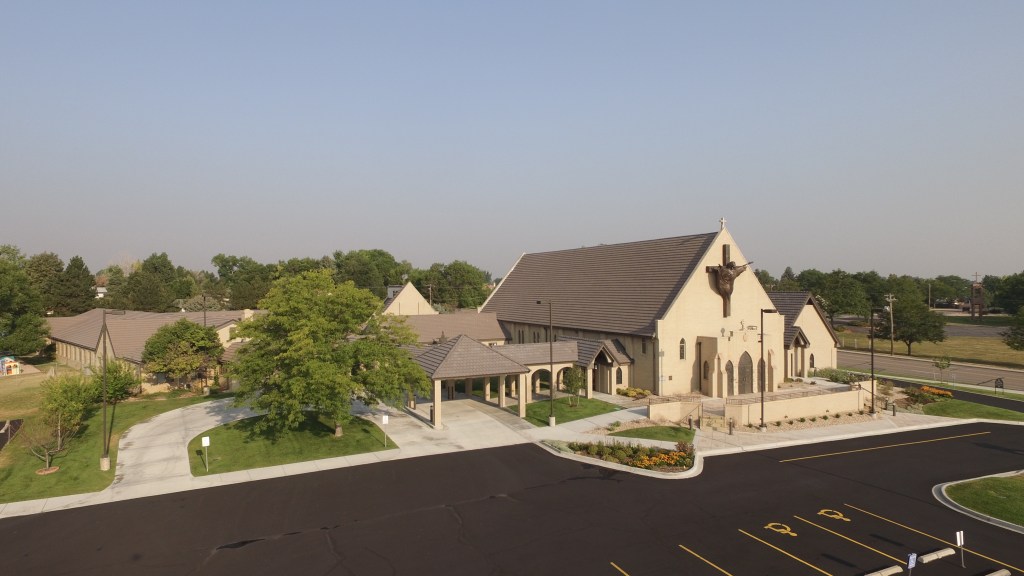
Trinity Parish, Greeley – my former parish

After several months of blissful retirement, I went back to work. I didn’t take a regular job, just three Sundays of supply work. The location was the only problem, being in Aurora, and the far southeastern part of that city as well. If you’re familiar with the Denver metro area, there is simply no good way to get from Evergreen to that part of Aurora. Getting there was no problem as they had an 8:00 am service and the traffic is light at that hour of the morning. Going home after the 10:15a service was another matter. However, the greatest demand on my time was sermon preparation. Having never been to that church before, I could have just recycled a past sermon on those lessons (aka, “cold canned tongue”). But that shortcut didn’t seem fair and I’ve always enjoyed the work of sermon prep as much as delivering the result.

While the above paragraph does offer an excuse for my absence from posting, it also brings me back to the issue of the Priesthood of Christ and what it means to be in Christ.

At its best, sermon preparation involves not only study but prayer. The people to whom the sermon is preached are not some random collection of individuals but a Christian community with its own personality, its own history and its own challenges. When the preacher has a long-standing relationship with that congregation, he or she has a wealth of material to draw upon in connecting the Scriptures with the community. However, the supply priest rarely has that luxury. At best, we might know the circumstances that brought us there, perhaps something about the priest we are filling in for (or replacing!) and perhaps some stories we may have heard about the congregation over the years.

In the case of my three sermons I had very little information and therefore praying about the sermon took on some urgency. The third sermon in particular took a bit of a twist at the end. The lessons included a reading from Amos warning those in the northern kingdom about their indifference to the corruption of their society while indulging in luxurious living. The reading from Luke was the story Jesus tells of the rich man and the poor beggar, Lazarus. While there were several elements of the story, in the light of the Amos reading it wasn’t hard to make the connection between the indifference of the wealthy of Israel and that of the rich man. The twist came because the congregation’s dedication was to St. Martin of Tours.

The best known story of St. Martin comes during his time as a catechumen, one being prepared for baptism. Here is the best known story of St. Martin (with thanks to Wikipedia): “While Martin was a soldier in the Roman army and stationed in Gaul (modern-day France), he experienced a vision, which became the most-repeated story about his life. One day as he was approaching the gates of the city of Amiens, he met a scantily clad beggar. He impulsively cut his military cloak in half to share with the man. That night, Martin dreamed of Jesus wearing the half-cloak he had given away. He heard Jesus say to the angels: ‘Martin, who is still but a catechumen, clothed me with this robe.’”

St. Martin of Tours

I included a retelling of that story to remind them that their name dedication was to a person who was not indifferent to the needs of the poor and was paying attention to the world surrounding him. This was not an injunction to do something they weren’t already doing. Rather it was intended to show them that their current practices were a fulfilling of divine purpose they had received when taking on the name of St. Martin’s church.

One further twist in that sermon came after we’d arrived at the church and I was reviewing the bulletin before the 8:00a service. In the announcements there was a longish paragraph on being a “DIY” congregation. Their rector had resigned early in September, thus the reason for supply clergy. In the clergy-centric culture of the Episcopal Church, the departure of the priest can leave a congregation feeling adrift and uncertain. The main point of that article was to remind them that they have, in fact, always been a congregation that took care of the things that made up Christian community and that life would be “business as usual” as they started searching for a new priest. When added to the lessons and the connection with St. Martin, this provided an unexpected conclusion to the sermon for that morning.

One might ask how any of this story relates to the priesthood of Christ and what it means to be “in Christ.” To answer that I need to go back to the distinction made between the priest/presbyter and the priest/hierus made in earlier posts on this subject. My status as a priest/presbyter gave me a platform to speak to this congregation, but that’s really all it gave me. If I were going to be for them a priest/hierus then I would need to bring God’s word and God’s blessing to their life as a Christian community. In order to do that I would need pray actively in seeking what God wanted said and pray passively in paying attention to things around me that God was orchestrating.

Those actions do not require ordination as a priest/presbyter. For that period, and precisely because I did not know what to say to that community, I was able to be “in Christ” for an extended period. What the effect of what I spoke and on whom I do not know. I spoke priestly (hierus) words of blessing and encouragement. That is, I believe, what I was supposed to do. Everything else from there is God’s problem, not mine.

Now this may seem a rather trivial example in the light of the acts of Adam’s priesthood to separate, abuse, wound and destroy. But even a cursory review of stories from the Bible demonstrates that God’s plans are not worked out as grandiose schemes but through ordinary people in ordinary places. Whether it is Abraham, or the young Samuel or David, or the young Jeremiah or Mary the mother of Jesus or the fishermen Jesus chose, we dare not despise the small things that appear to be God’s favored way of working.

The priesthood of Christ, the antidote to the broken priesthood of Adam, is the Christ-directed acts of common men and women who take the time and effort to live “in Christ” and thus become agents for Christ’s healing in unexpected ways.

[Jesus] also said, “The kingdom of God is as if someone would scatter seed on the ground, and would sleep and rise night and day, and the seed would sprout and grow, he does not know how. The earth produces of itself, first the stalk, then the head, then the full grain in the head. But when the grain is ripe, at once he goes in with his sickle, because the harvest has come.”

(Mark 4:26-29)

A New and Different Priesthood

An Episcopal priest writing about priesthood is no big deal. And even when the distinction is made between the priest/elder (prebyteros) which is what I am, and the priest/hieros which describes both the Levitical priesthood and the priesthood of Christ, it seems an esoteric topic with little relevance to most Christians, much less most human beings. However, as asserted in my earlier posts on the priesthood of Adam, the priestliness of our humanity is something we cannot renounce for it is at the very core of our identity and purpose. The topic is relevant to all human beings regardless of faith or lack of faith.


If human beings are intended to be priestly creatures then the history of humanity in the world is evidence that there is a problem with our priesthood. We exercise our priesthood the way our encounters with the world give meaning in building and blessing. We also exercise our priesthood the way our encounters with the world rob meaning by destroying and cursing. What we build we find easy to destroy. But what we destroy is hard to heal or rebuild and sometimes beyond our best efforts. It appears our priesthood is powerless against the reality of Sin. Can there be an alternative?


This is obviously a rhetorical question. The short answer is that Jesus has inaugurated a new priesthood. It is a priesthood in which the priest takes on the consequences of our damaged Adamic priesthood, offers himself, and then surviving that offering transfigures our damaged priesthood as part of a new creation. That sounds quite lovely and very hopeful but tells us little about how we are to live in this broken and benighted world. If there is substance to be found in this new priesthood that can be accessed and deployed by ordinary apprentices of Jesus then we need to understand what that new priesthood is and what it is not.


It is much easier to address the negative than the positive. The priesthood of Jesus is neither a magic bullet nor a magic wand. Even the in world of Harry Potter, magic is unable to address the fundamental illness in the heart of our Adamic priesthood. One of my favorite themes from N.T. Wright asserts that when God wants to bring justice to our human mess He doesn’t send in the tanks – He sends in the poor in spirit, the meek, the ones whose hunger for righteousness is a burning ache and a desperate thirst for the healing of the world. But that’s not it either.
The priesthood of Christ is not a status conferred or a gift given. Rather it is what St. Paul struggles to articulate in much of his writing – it is being “in Christ.” The priesthood of Christ is Christ’s alone. If we are to wield that priesthood in our world it is only because we are in Christ and Christ, therefore, is in us.


How that works is the topic I’ll be taking up next.

The Priesthood of Adam and the Shaping of History

Every interaction with things and persons outside of our selves has the potential to be a building block of history. However, this is not the sort of history that we study in texts or even read for our pleasure. Robert Capon, in his An Offering of Uncles uses the distinction for two words in Greek that must make do with one word in English for translation. The English word is time, the Greek have both chronos and kairos. Chronos is time in the abstract. As I sit writing I hear the tick of the clock above my desk. It shows me that it is now a 11:19 in the morning. That tells us precisely nothing. To give meaning to that bit of chronos I need to know what it is time for. Chronos by itself gives us only chronology. Kairos gives us meaning and meaning creates history. When one person says of another “we have a history together,” they are referring to encounters that took place in high time, kairos time. Those encounters could leave the persons encouraged or healed or discouraged or wounded but they were real history filled with meaning that will echo far beyond the encounters themselves.

In the late Douglas Adam’s series, The Hitchhikers Guide to the Universe, the ultimate supercomputer, Deep Thought, runs a 7,500,000 year program to discover the answer to the ultimate question of “life, the universe and everything.” The answer is 42. When Deep Thought’s programmers protest, the computer replies that they’ve never really understood what the question was. In the ASCII (American Standard Code for Information Interchange) 42 is the code for the asterisk (*). Computing frequently uses the * as a “wildcard” that can represent any number of characters in a search or filter. Some folks assert that in giving the answer to the question of the meaning of existence as 42, Adams was declaring the meaning is anything you want it to be.

As an apprentice of Jesus, I can’t buy that theory. There is meaning shot through creation. There is ultimate meaning in the Creator’s purpose in creation. But the assertion attributed to Adams is a great deal more true than many Christians would accept. Our actions in kairos time create meaning within the greater meaning of God’s purposes. In that sense we build into a structure that God has already designed. This approach adds meaning to Paul’s injunction to the Christian community in Corinth:

For no one can lay a foundation other than that which is laid, which is Jesus Christ. Now if anyone builds on the foundation with gold, silver, precious stones, wood, hay, straw— each one’s work will become manifest, for the Day will disclose it, because it will be revealed by fire, and the fire will test what sort of work each one has done. If the work that anyone has built on the foundation survives, he will receive a reward. If anyone’s work is burned up, he will suffer loss, though he himself will be saved, but only as through fire. Do you not know that you are God’s temple and that God’s Spirit dwells in you?

(1 Corinthians 3:11-16)

Those actions that are represented by the more permanent elements can be seen as actions in kairos time that build into God’s temple. And what of the less permanent elements? Those could represent the lost opportunities, our failure to pay attention to the kairos time and the actions invited or required at those moments of meaning. It is a deeply flawed analogy, but it is useful nonetheless.

What the analogy fails to address is our capacity to undo meaning. Our actions in kairos time that give meaning are priestly acts and fully human acts as well. But the story of the Fall in the garden in Eden is the story of a priestly act that destroys meaning. There are four pieces of brokenness that result from that failure, all interconnected. The connection between the human creatures and the Creator is broken (they were afraid and hid). The connections of inner human integrity is broken (they were ashamed of their own creaturely vulnerability). The connections of the shared imago dei of man and woman is broken (Adam blamed both Eve and the Creator). The connection of humanity with the earth of which they are a part is broken (the earth is cursed). That last one requires some clarification. God did not curse the earth, but rather observed that the earth is now cursed because of humanity. Even the briefest perusal of human impact on our planet is an eloquent testimony to the Earth’s suffering at our hands.

The Priesthood of Adam has been ever since then both the agent of building meaning and of destroying it. We can still do good. So far it seems that the black masses of unmeaning can undermine our masses of meaning in the briefest moment.

Can the priesthood of Adam be healed? Or must we look to a different priesthood to heal the wounds we inflict? I’ll take up that idea in my next posting.

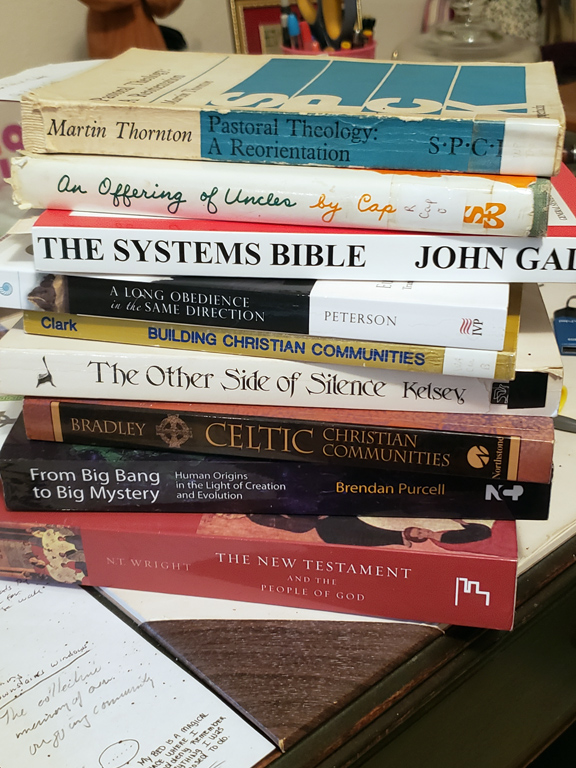
In the meantime, here’s the stack I’m working through for the book:

The Priesthood of Adam and the Shape of the World

I’ve used the subtitle from An Offering of Uncles to give a hint of this post. When I first read Capon’s book I made no connection between the priesthood of Adam and the hiereus/priest. Over the years I’ve lent the book out twice and lost it twice and I’m holding on to this one (thanks to one of the online book sites specializing in out of print books) for dear life. Even after many years and a couple of re-readings, the penny hadn’t dropped. According to Capon’s assumption, Adam’s special role in creation was to be a priest. And though that priesthood has been marred through the Fall, it still remains an inescapable part of what it means to be human. To be a human is to be a priest. Which then begs the question – just what is a priest?

In my previous post I noted that: “The role of the hiereus/priest is adequately described in various encyclopedias both print and online. I was looking for more than a bit of religious anthropology.” However, we cannot escape that bit of religious anthropology if we’re to make sense of Capon’s assertion. According to Wikipedia (the source of all knowledge accurate or wildly inaccurate)

“A priest or priestess is a religious leader authorized to perform the sacred rituals of a religion, especially as a mediatory agent between humans and one or more deities. They also have the authority or power to administer religious rites; in particular, rites of sacrifice to, and propitiation of, a deity or deities.”

In other words, the work of the priest is to act as a connector between humanity and divinity, or better, between the common and the holy. This definition faintly echoes N.T. Wright’s understanding of the image of God in humanity at creation:

“This is what is meant by humans being made in God’s image: not that we simply are like God in this or that respect, but that as angled mirrors we are called to sum up the praises of creation, on the one hand, and to rule as wise stewards over the world, on the other. This is the vocation known as the ‘royal priesthood’, kings and priests.”

(“Mind, Spirit, Soul and Body: All for One and One for All Reflections on Paul’s Anthropology in his Complex Contexts” N.T. Wright, Paper give at the Society of Christian Philosophers: Regional Meeting, Fordham University; March 18, 2011)

The parallel between Capon’s theme and Wright’s definition of the imago dei hints that we may be onto something in the context of biblical anthropology. That something, the function of the priesthood of Adam, must wait until the next posting. In the meantime, here follows an update on the book in progress.

Of the Making of Many Books There Is No End

“And much study is a weariness of the flesh.” So speaks the author of Ecclesiastes. And the writing of books means the reading of books and each new development of a chapter prompts another look at a book that wasn’t already on the reading list. I’ve just finished a re-read of Leading Christians to Christ by Fr. Rob Smith. I looked up an old favorite, Systemantics by John Gall only to find he’d published a third, expanded, edition called The Systems Bible. (Yes, I ordered it and it’s on the growing stack. Damn you, Amazon.) Gall’s book isn’t a theological tome. But it is an amusing look at how systems don’t work. One of my favorite maxims is “Systems tend to oppose their own proper function.” If that isn’t a description of the Church I don’t know what is.

More word games: priesthood

This continues my posting from June 15, beginning with a recap of the word games around priesthood. At the end I will throw in a couple of tidbits about the book I’m writing.

The English word priest is misleading. It is derived from the Greek word prebyteros, but it is never used to represent that word in English. We use the word elder, which is fair enough as that is what presbyteros means. Instead, we use the word priest to translate a different Greek word altogether: hiereus. The hiereus is one who has the role of mediator between human beings and gods or God. It is used of the Temple hierarchy and of Jesus as mediator between God and humanity. In other words, regardless of etymology, a hiereus is a priest. Confused yet? But wait! There’s more! In order to continue with my chaotic thinking (and also to muddy the waters further) I’ll be using the terms hiereus/priest and presbyteros/priest to distinguish these two roles.

A long time ago, in a town far, far away, in 1978 to be exact, the world was young, the mountains green, no stain yet on the hills were seen. No, wait. That a Star Wars rip off and a poem from The Hobbit. Let’s begin again. In 1978 I was ordained a presbyteros/priest. I was already a hierus/priest though I didn’t know it at the time. In fact, I thought the two were the same thing. More than a decade after that event I was invited to join some fellow Episcopal clergy in a seminar on the theology of priesthood. It actually went nowhere. One of my classmates, a wonderful priest by the name of Sara Balcombe, observed that instead of a theology of priesthood we were actually examining a sociology of religion. But though the seminar went nowhere, it did start me thinking about priesthood and the difference between the priesthood of the church and the priesthood of Jesus in which all Christians participated. I understood a good bit about the role of the presbyteros/priest. I soon realized that I didn’t really know that much about the role and function of the hiereus/priest.

The role of the hiereus/priest is adequately described in various encyclopedias both print and online. I was looking for more than a bit of religious anthropology. Fortunately, I recalled a book I’d read in college called An Offering of Uncles. The part that made the book relevant was the subtitle: The Priesthood of Adam and the Shape of the World. The author, the late Fr. Robert Capon, was a very funny writer. So much so that sometimes the creative insights were lost in the wit. My last rereading also reminded me that, in terms of cultural reference points, the book is very dated. Something like goldenrod appliances left over from the 1970s. The key phrase that makes the book worthwhile and worth exploring is The Priesthood of Adam.

That’s where I’ll wrap up today. We’re off to volunteer at the Wild Animal Sanctuary and as it is an hour’s drive away, we leave early and get back late. However, I did promise some comment on the book in progress. Its working title is Converting the Church, which I suspect, in the long run, won’t work. It explores the idea of conversion with several examples, the problem of communal life and the fact that being a disciple of Jesus, in the Gospels, was an invitation, never a command.

I’ve been rather busy

Most of my energy has been directed towards completing an outline. The outline is for a book I’ve been planning to write for the last three years. For two of those three I was still Rector of Trinity Parish in Greeley. Now that I’m retired, I thought I could finally get to work, and I have. The book has (so far) 14 chapters plus an introduction and an appendix. Mind you, it’s only an outline. The actual work of writing is very hard work. It will not be some classic work of theology or ecclesiology or ascetical theology though it embraces all three.

Of course, the idea of writing a book in retirement is a bit of a cliché. Even if I finish it, finding a publisher is another matter. Even if it is published, I do not expect a wide readership for it is not written for a wide audience. Nonetheless, the topic is important to me and the experiences of four decades of ministry, particularly the last 15 in Greeley, gives me some substantial basis from which to write.

There are, however, other things on my mind than would be covered in this book. That’s the reason I started blogging as The Apprentice Priest. While being apprentices of Jesus is much of what my possible book is about, priesthood doesn’t really come into it. And yet, priesthood is something that has consumed my praying, my thinking and my living since 1972 when I first went to talk to my bishop about ordination.

At the same time, the priesthood I’m concerned with is not, for the most part, about holy orders. In fact, referring to the Order to which I belong as the “priesthood” is a major stumbling block to comprehending both that Order of ministry and the concept of priesthood in general. In order to sort that out I need to dive into the murky waters of etymology – the study of the origin and development of words.

Our word, priest, comes into English via a very circuitous route from a Greek word, presbyteros. While presbyteros occurs frequently in the Greek New Testament, the word priest is used to translate a different word entirely: heireus. That term is used for the Temple priesthood and also for the priesthood of Jesus Christ in the epistle to the Hebrews. Presbyteros, on the other hand, means elder. Where the word is used in the New Testament it almost always refers to someone who has responsibility for governing the life of the local church. Thus, regardless of the vagaries of language, the Christian priest is actually an elder.

Of course, there is much more to the problem of priesthood than that. The much more will have to wait until my next posting. Until then, I’ll leave you with three pieces of Scripture that give a hint of where I’m going and why.

Exodus 19:4-6 ‘You yourselves have seen what I did to the Egyptians, and how I bore you on eagles’ wings and brought you to myself. Now therefore, if you will indeed obey my voice and keep my covenant, you shall be my treasured possession among all peoples, for all the earth is mine; and you shall be to me a kingdom of priests and a holy nation.’ These are the words that you shall speak to the people of Israel.”

1 Peter 2:9-10 But you are a chosen race, a royal priesthood, a holy nation, a people for his own possession, that you may proclaim the excellencies of him who called you out of darkness into his marvelous light. Once you were not a people, but now you are God’s people; once you had not received mercy, but now you have received mercy.

Revelation 5:9-10 And they sang a new song, saying, “Worthy are you to take the scroll and to open its seals, for you were slain, and by your blood you ransomed people for God from every tribe and language and people and nation, and you have made them a kingdom and priests to our God, and they shall reign on the earth.”

Plugged In

A couple of decades ago I was doing some freelancing computer troubleshooting. One small consulting company had run into trouble when a relative had tried to upgrade the memory in one of their PCs. After the “upgrade” it no longer worked. A memory error. It turned out to be an incompatible DIMM as apparently the helpful relative assumed all DIMMs worked in all PCs. I found the correct match, opened the PC, switched out the memory and fired it up. The power light came on, the beeps from the POST (power on self test) were audible as was the whirring of the hard drive. Unfortunately, the screen was still black. Nothing. I pulled the plug to shut the PC down (not recommended practice) and opened it up again in case I’d unseated the video card, but all was well. Fired it up and again the screen was black though all else seemed functioning. And yes, the monitor was showing power. Repeat shut down and restart and then I noted that in putting the case back together I had neglected to plug the monitor cable back into the PC. Fortunately, none of the employees were around to witness my embarrassment.

The memory of that absent-minded moment comes freshly to mind each time I encounter Jesus statement: “I am the true vine.” The monitor was in perfect working order, but without the connection to the PC it was just an overpriced door stop. Jesus said: “Abide in me, and I in you. As the branch cannot bear fruit by itself, unless it abides in the vine, neither can you, unless you abide in me. I am the vine; you are the branches. Whoever abides in me and I in him, he it is that bears much fruit, for apart from me you can do nothing.” (John 15:4-5) It is an imperfect analogy as the unplugged monitor was indeed useless; apart from Jesus, human beings can do quite a lot of things.

What then did Jesus mean by that sweeping statement, “apart from me you can do nothing.”? Was this another case of exaggeration for effect like the camel going through the eye of a needle? I think it may relate to part of his opening statement in this passage: “I am the true vine, and my Father is the vinedresser. Every branch in me that does not bear fruit he takes away, and every branch that does bear fruit he prunes, that it may bear more fruit.” (John 15:1-2) The issue comes down to what “fruit” the Father is expecting. For nearly 20 centuries Christian community in some form or another has been let loose in the world. In those centuries that community has blessed our world in countless ways. In those centuries that community has harmed our world as well. We can safely assume that the acts of the Christian community that have caused harm are not the “fruits” the Father expects. The more difficult question is whether the good done by the Christian community represents those fruits.

After all, good can be done and blessings given by all sorts of human beings of any faith or of none. Human communities and organizations, regardless of belief or lack of belief, have accomplished much that is good in our world. If the fruit of which Jesus speaks is simply doing good works, then the statement “apart from me you can do nothing” makes little sense. Perhaps the fruits, i.e. the lifestyle and efforts of those connected with Jesus, are different from other human good works in that they are part of a greater understanding from God’s point of view.

Great chess players have the ability to “see” the possible consequences of each move several moves ahead. But no human being can truly grasp how our actions will reverberate in the lives of others. If we had that ability there would be no such thing as the “law of unintended consequences.” By abiding in Jesus, Christians are intimately connected to the Creator’s universal vision and understanding. Our deeds in Christ therefore serve a divine strategy that we cannot grasp.

However, that then raises the question of what it means to “abide” in Jesus. Going back to my adventures with the computer monitor, that monitor had power flowing through it from the electrical outlet. But without the video cable attached to the PC it could show nothing as there was no channel of communication. Abiding in Jesus is our means of clear communication with the Father and therefore with the Father’s purposes, projects and directions. If that is the case, then Jesus’ words about abiding in him are a challenge to several common concepts of Christian discipleship.

Instead of discipleship as a personal improvement regimen where our behavior looks more and more like what the New Testament expects, discipleship becomes the daily exercise of abiding, being connected to, Jesus moment by moment. The measure of our success therefore is not how much more patient and loving and generally nicer we become, but of how many seconds of each minute and minutes of each hour and hours of each day we are consciously connected with Jesus.

That may sound suspiciously like abandoning Christian engagement with the world and focusing entirely on my own spiritual condition. But if I am connected with Jesus, do we really think he will be content to let me rest in my “me and Jesus” cocoon? In contrast, abiding in Jesus may propel us out into the world in actions of blessing and building in places comfortable and uncomfortable. It may even propel us to giving rebuke to the greed and abuse and neglect that haunt human life.

At my former parish we had a set of spiritual disciplines we called the Trinity Way of Life. The first of those disciplines was Pay Attention where we were encouraged to spend brief moments throughout our day giving our whole attention to God. One thing we discovered was that when we got our attention focused, God frequently directed our attention to people and situations around us. It seems anti-intuitive in our culture, but according to Jesus’ image of the vine and branches the way to healing engagement with our world may be to turn all our energy to connecting with, and staying connected to, Jesus.

Day One

“Modern attempts to get away from the sheer historical facts of the Resurrection are, at best, based on a total misunderstanding. The whole Bible proclaims the need for, and the achievement of, a salvation that will remake creation (not one that will ignore it or escape from it), and it is just such a salvation, at once supernatural and historical, that was won on Easter Day. If the Resurrection narratives are [merely] a subtle way of convincing us that God still loves us, or that there is a life (albeit, a non-material one) beyond death, they must be reckoned among the oddest and most ill-conceived stories ever written.”

[Michael Sadgrove (b. 1950) & N. T. Wright (b. 1948), “Jesus Christ the Only Saviour”, in The Lord Christ [1980], John Stott, ed., vol. 1 of Obeying Christ in a Changing World, John Stott, gen. ed., 3 vol.,    London: Fountain, 1977, p. 73]

The above selection from Christian Quote of the Day came through on Easter morning. It addresses the very issue I plan to raise in this post and flows from the previous post on the meaning of the cross. Before I get to that there is this odd thought that came to mind this morning while reading the Daily Office relating to the Gospel of John.

All four of the Jesus stories (Gospels) assert that the discovery of the Resurrection occurred on the first day of the week. If all one reads are Matthew, Mark and Luke then that assertion just seems like a bit of historical grounding. But what, in the mode of multiple layers of meaning, if there is more significance to that Sunday timing than historical grounding? John wrote his Gospel quite some time after the first three were in circulation. An ancient document which may be the earliest to describe the books of the New Testament (the Muratonian Fragment) has this to say about the fourth Gospel: “to his fellow disciples and bishops, who had been urging him [to write], he said, ‘Fast with me from today to three days, and what will be revealed to each one let us tell it to one another.’ In the same night it was revealed to Andrew, [one] of the apostles, that John should write down all things in his own name while all of them should review it.”

John included several episodes not found in the earlier Gospels: the wedding at Cana, the Samaritan woman and the raising of Lazarus being some of the best known. He also gave greater significance to the Resurrection being on the first day of the week, though in a roundabout manner.

John opens his Gospel echoing the opening verses of Genesis. But that is not the only Genesis reference. If he opens with the first day of creation, he reaches a climax when Pilate brings Jesus, beaten bloody, before the crowds, with the words Ecce Homo, “behold the man.” This event occurs on Friday, the sixth day of the week. In Genesis 1, the sixth day of creation concludes with the creation of humankind. We move from the beginning of the glory of humanity bearing the Imago Dei, to the brutalized Incarnate God whose scarred body illustrates the rage and loathing of a broken humanity who has failed its attempt at self-deification. Ecce Homo indeed. In the waning hours of that Friday, Jesus is crucified. In his dying he takes on himself the full weight of our fallen nature, the very nature that had nailed him to the cross. Taking on that burden, he dies. And there was evening and there was morning, the sixth day.

And on the seventh day God finished his work that he had done, and he rested on the seventh day from all his work that he had done. (Gen 2:2) On the seventh day our crucified humanity lays in a tomb. John’s Genesis pattern may seem completed at this point. Certainly, the Genesis creation story linked to the Jesus story seems to bookend the whole story of God’s creation.

Yet there is still a Genesis link to come. On the first day of the week, in Genesis the beginning of creation, Jesus rises from death. It is not a resuscitation of a corpse. This Risen Jesus is quite corporeal, eating with his disciples, inviting Thomas’ touch. But he has also appeared in a locked room. In Luke’s story he vanishes after blessing and breaking bread with two disciples in the village of Emmaus. This embodiment seems something altogether new. And that is it, the significance of the Resurrection on the first day of the week is the announcement of a new creation. It is a theme picked up by Paul in his writings, a theme which has echoes in the prophetic writings. The Resurrection is a vindication to be sure, but it is more. The Resurrection is the defeat of death to be sure, but it is more. The forgiveness of sins, which Paul ties inextricably to the Resurrection (And if Christ has not been raised, your faith is futile and you are still in your sins. 1 Corinthians 15:17) frees us from the chains of our past sins to be sure, but it is more. The Resurrection is the inauguration of the new creation. And in Christ we participate as part of that new creation. To leave that out, to confine the Resurrection to vindication or victory over death or forgiveness is to miss the ultimate consummation of the work of Jesus. For Christ is risen, the new creation has begun, and this is a life worth exploring. Alleluia.