


The Lentiest Lent We’ve Ever Lented

That comment is showing up regularly throughout the world of social media. It could also be the longest. Our isolation is likely to continue through Easter Day and well beyond. Yet even in the midst of our current chaos, the Christian year moves through its own rhythms, whether we are allowed to gather or not. Each Sunday and major feast has its own prayer, its collect[1]. For many Episcopalians, Sunday will be the only time they hear or read the collect of the day. Those who follow the discipline of daily Morning and/or Evening Prayer may offer that collect each day throughout the week. Yet even then, the calendar moves on and we don’t use the collect until next year.

And then there’s the reality that very few Christians attend churches that use these particular collects, and fewer pause to reflect on what has just been prayed. Then there’s the new, current reality that we cannot, for the immediate future, gather for worship. Even those who join their congregations online seem to be about half of what we used to have when we could meet in a common place.

Because of this I suggest we might look back a couple of weeks and reflect on the collect for the Third Sunday of Lent:

Almighty God, you know that we have no power in ourselves to help ourselves: Keep us both outwardly in our bodies and inwardly in our souls, that we may be defended from all adversities which may happen to the body, and from all evil thoughts which may assault and hurt the soul; through Jesus Christ our Lord, who lives and reigns with you and the Holy Spirit, one God, for ever and ever. Amen.

Book of Common Prayer

That first declaration may seem inaccurate to us. After all, we are doing quite a lot to help ourselves. Whether it is increasing our capacity for testing or working on a vaccine for the COVID19 virus or issuing stay at home orders or practicing social distancing or thoroughly and regularly washing our hands or turning our manufacturing from normal consumer items to masks and PPE and ventilators, we seem to be charging through to a solution even in the face of political maneuvering, finger pointing, wishful thinking and short-sightedness. And yet. Our failure to comprehend the fundamental connectedness of creation led us to this point. Whatever we can accomplish to ameliorate the pandemic will not change that self-sabotaging flaw in human nature that prefers to narrow our vision to what results in our own benefit. Our inventiveness has changed a lot of things in this world and not all of them for the worse. And yet, we can’t seem to change our behavior even when our circumstances demand it. We have no power in ourselves to help ourselves.

So the prayer begins with an honest evaluation of human limits. From there the prayer moves on to our need from our Creator, “keep us both outwardly in our bodies and inwardly in our souls.” That distinction has echoes of a very unbiblical Platonism. In the Scriptures the body/soul distinction is very fuzzy. The Gospels tell the story of Incarnation, that God who is Spirit willingly embraces matter. Having already declared the material world “good” in Genesis 1, God now makes it holy in John 1:14: “and the Word became flesh and dwelt among us.” Because of that fundamental unity of soul and body that makes us human, things which cause harm to the body also assault and hurt the soul and those things which assault and hurt the soul affect the body adversely. Perhaps that is why the prayer uses “and” rather than “or.” The two conditions are inextricably interrelated.

The prayer then concludes with the common doxology: “through Jesus Christ our Lord, who lives and reigns with you and the Holy Spirit, one God, for ever and ever. Amen” It is through Jesus the Messiah that connection has been restored between creation and the Creator and so our prayers find their natural path through him. We are also reminded that this Jesus both lives and reigns. The unity described in the doxology is the model for the unity for which Jesus prayed we might be one as he and the Father are one. If a collect is a summary prayer, it certainly seems that the Collect for the Third Sunday in Lent summarizes our situation accurately. It might be worth our while to offer that prayer daily through this season of pandemic.


[1] A collect is a prayer that isused in “collecting” the community for worship and also several elements of prayer and praise into one.

Doing Nothing Gallantly

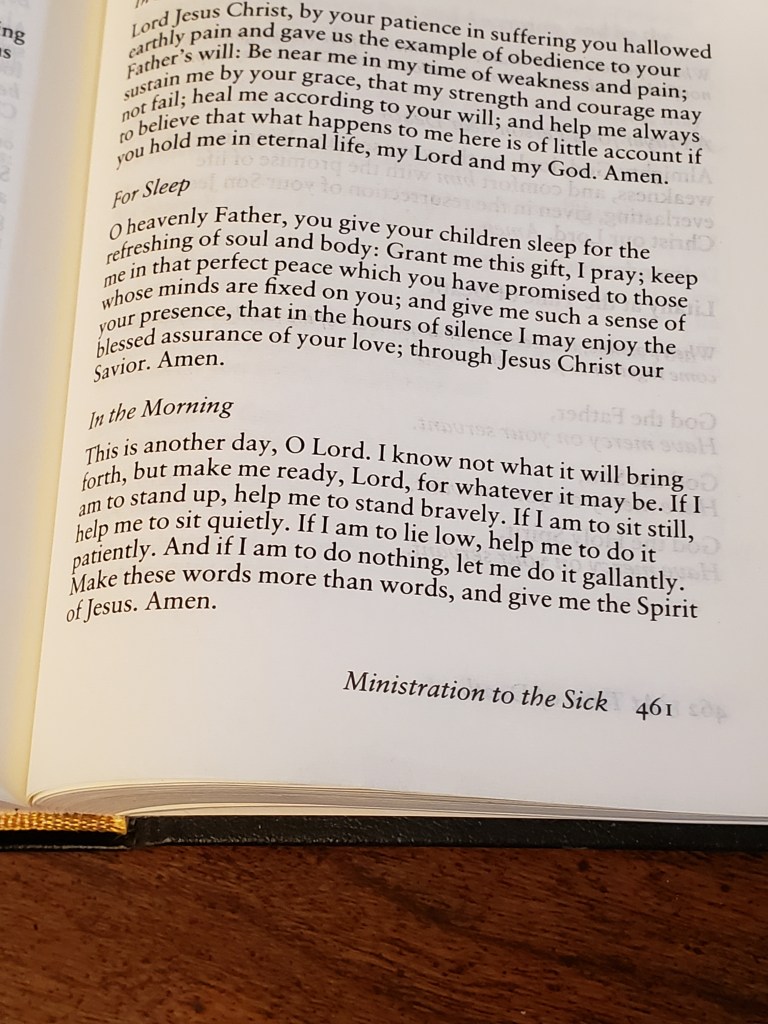
We called it “the Groundhog Book” to the probable consternation of the Standing Liturgical Commission. They had published The Draft Proposed Book of Common Prayer on February 2, 1976, the Feast of the Presentation. But that is also Groundhog Day and this was the 1970s so it became the Groundhog Book whether the powers that be liked it or not. Nonetheless, Episcopalians (particularly clergy and seminarians) pored over the 1,001 pages to see what glorious renewal of worship or what hideous manual of modern heresy we had been handed. Reviewing the pages with one of my mentors we discovered a new treasure deep inside the book, the last prayer in the section on Ministration to the Sick.

This is another day, O Lord. I know not what it will bring forth, but make me ready, Lord, for whatever it may be. If I am to stand up, help me to stand bravely. If I am to sit still, help me to sit quietly. If I am to lie low, help me to do it patiently. And if I am to do nothing, let me do it gallantly. Make these words more than words, and give me the Spirit of Jesus. Amen.

I’ve already seen this prayer posted in social media in relation to the current COVID19 crisis. With the increasing number of “stay in place” orders, the cancellations of events with over 50 in attendance (in some places over 10), many of us are experiencing the isolation of a recovering person regardless of our health. For those of us who tend towards introversion, this is not a great sacrifice. But for those who those who have lost their jobs, those who are more extroverted and have been told to work from home and struggle with the lack of human gatherings this is a dark and painful time.

How can those living with enforced cabin fever “do nothing gallantly?” I’d love to offer some “3 simple steps” or “four rules for prospering in crisis” but they would be as bogus as anything one might find on social media. There is, of course, one thing that all apprentices of Jesus can do no matter what their situation: pray.

OK, that’s neither original nor exciting. Most of those who read this are already praying. We may be praying for a number of things or a number of persons. But there are two things to keep in mind if we want our prayers to be more than just good thoughts. The first thing is to remember that when we pray we are also volunteering to be part of God’s answer to our prayers or to the prayers of others. Second, and related to that, the prayer of an apprentice also involves listening. In my former parish we called that “Paying Attention.” When we pay attention as an element of our praying we become open to God’s direction in both further prayer and continuing action.

Some nudge to call someone, to send a text or email or some other means of electronic communication or to follow the quiet prod to buy a gift card or take home a meal from a local eatery may be God’s timing to bring hope and courage to others trapped in fear. Doing nothing gallantly is to be content with the limitations imposed upon us in these days and turn our apparent helplessness into means by which others may be blessed, others may be encouraged, others may find hope rekindled, others find healing. To be able to do nothing (at least as our busy-ness loving world defines nothing) is not necessarily to be powerless – if we do nothing gallantly.

What quarantine can tell us about church

From Jack, a retired Episcopal priest and over 60 years of age (but in good health) in unofficial ecclesiastical quarantine because so many churches are in lockdown; to my beloved apprentices of Jesus in all the places where I’ve served (and a few that I haven’t): Grace and Peace to you from God our Father and the Lord Jesus Christ.

It feels odd not being able to “go to church” when we are in good health and we’re not on the road and the weather is clear. But “going to church” is a troublesome phrase because it can be read as going to a place or going to an event in which we are spectator/participants. A congregation in Brooklyn had t-shirts printed for their members. On the front it read “I don’t go to church.” On the back, “I AM the church!” It was clever and mostly true. I say “mostly” because to be completely true they’d have to change the “I am” to “We are.”

In the New Testament the English word church translates a Greek word ekklesia. Ekklesia (literally “called out”) had an important meaning in the ancient world before the New Testament was written. In the Greek city state of Athens, the ekklesia was the assembly of citizens that formed the first recorded attempt at democratic rule. Although citizens at that time only consisted of free males of 18 years old and above, they were called out on a regular basis to make significant decisions for the city of Athens.

Ekklesia is a gathering of a specific body, whether the body of the “citizens” of Athens or the Body of Christ. But what happens when the Body cannot gather? We’re facing that problem in many places both in the US and across the globe this weekend and probably longer. If church means an assembly then are we still church when we can’t assemble? The answer is certainly yes, but that yes has something to say about how we see ourselves as members of a church.

The citizens of Athens were part of the ekklesia whether the ekklesia was meeting or not. Indeed, members of the ekklesia could be fined for not attending the gathering (how’s that for a fund raising device for churches?). But the point is that the ekklesia existed even when it was not gathered. And if the existence of the church is not dependent on the gathering of the church, then how are we to model the interdependent life of the that Paul describes in 1 Corinthians 12?

For just as the body is one and has many members, and all the members of the body, though many, are one body, so it is with Christ. For in one Spirit we were all baptized into one body—Jews or Greeks, slaves or free—and all were made to drink of one Spirit. For the body does not consist of one member but of many. If the foot should say, “Because I am not a hand, I do not belong to the body,” that would not make it any less a part of the body. And if the ear should say, “Because I am not an eye, I do not belong to the body,” that would not make it any less a part of the body. If the whole body were an eye, where would be the sense of hearing? If the whole body were an ear, where would be the sense of smell? But as it is, God arranged the members in the body, each one of them, as he chose. If all were a single member, where would the body be? As it is, there are many parts, yet one body. The eye cannot say to the hand, “I have no need of you,” nor again the head to the feet, “I have no need of you.” On the contrary, the parts of the body that seem to be weaker are indispensable, and on those parts of the body that we think less honorable we bestow the greater honor, and our unpresentable parts are treated with greater modesty, which our more presentable parts do not require. But God has so composed the body, giving greater honor to the part that lacked it, that there may be no division in the body, but that the members may have the same care for one another. If one member suffers, all suffer together; if one member is honored, all rejoice together. Now you are the body of Christ and individually members of it. (1Cor 12:12-27)

Certainly we should pray for one another, for the members of our particular local Body and especially those of that Body who are most at risk in this crisis. At the same time we are the Body of a Christ who was himself Incarnate. As George Mcleod put it, “matter matters.” Thus, prayer in our isolation is vital, but it is not everything. Watching some form of worship via live streaming is helpful in maintaining a sense of connection, but it is not incarnational connection. And since we cannot gather in the same place at the same time during this time, how can we incarnate our community?

I’ve often taught that worship of an Incarnate Christ must be sensual worship, that is it should be engaging all the senses through which we interact with God’s creation. Vision and hearing may be engaged through live streaming, but that is not enough for it does nothing to establish the physical togetherness of the Body. Still, there are ways.

Calling one another to check in and encourage is far more valuable than we might believe. And though sending physical notes through the mail may not be wise (I’ll leave that one to the medical experts), an email that can be printed out and held in one’s hand is a physical representation of our connection in the Body of Christ.

This may seem rather trivial, but, to misquote Scripture, do not despise small things. The COVID19 virus has, for this time, apparently “dismembered” the Body of Christ. We can give lie to that appearance by using every appropriate resource of our sense to “re-member” who we are until that day when we can regather and receive that which we were given in re-membrance of Jesus. Maybe when we regather we will greet one another with gratitude and wonder, giving thanks for one another’s presence in one Body.