Every interaction with things and persons outside of our selves has the potential to be a building block of history. However, this is not the sort of history that we study in texts or even read for our pleasure. Robert Capon, in his An Offering of Uncles uses the distinction for two words in Greek that must make do with one word in English for translation. The English word is time, the Greek have both chronos and kairos. Chronos is time in the abstract. As I sit writing I hear the tick of the clock above my desk. It shows me that it is now a 11:19 in the morning. That tells us precisely nothing. To give meaning to that bit of chronos I need to know what it is time for. Chronos by itself gives us only chronology. Kairos gives us meaning and meaning creates history. When one person says of another “we have a history together,” they are referring to encounters that took place in high time, kairos time. Those encounters could leave the persons encouraged or healed or discouraged or wounded but they were real history filled with meaning that will echo far beyond the encounters themselves.
In the late Douglas Adam’s series, The Hitchhikers Guide to the Universe, the ultimate supercomputer, Deep Thought, runs a 7,500,000 year program to discover the answer to the ultimate question of “life, the universe and everything.” The answer is 42. When Deep Thought’s programmers protest, the computer replies that they’ve never really understood what the question was. In the ASCII (American Standard Code for Information Interchange) 42 is the code for the asterisk (*). Computing frequently uses the * as a “wildcard” that can represent any number of characters in a search or filter. Some folks assert that in giving the answer to the question of the meaning of existence as 42, Adams was declaring the meaning is anything you want it to be.
As an apprentice of Jesus, I can’t buy that theory. There is meaning shot through creation. There is ultimate meaning in the Creator’s purpose in creation. But the assertion attributed to Adams is a great deal more true than many Christians would accept. Our actions in kairos time create meaning within the greater meaning of God’s purposes. In that sense we build into a structure that God has already designed. This approach adds meaning to Paul’s injunction to the Christian community in Corinth:
For no one can lay a foundation other than that which is laid, which is Jesus Christ. Now if anyone builds on the foundation with gold, silver, precious stones, wood, hay, straw— each one’s work will become manifest, for the Day will disclose it, because it will be revealed by fire, and the fire will test what sort of work each one has done. If the work that anyone has built on the foundation survives, he will receive a reward. If anyone’s work is burned up, he will suffer loss, though he himself will be saved, but only as through fire. Do you not know that you are God’s temple and that God’s Spirit dwells in you?
(1 Corinthians 3:11-16)
Those actions that are represented by the more permanent elements can be seen as actions in kairos time that build into God’s temple. And what of the less permanent elements? Those could represent the lost opportunities, our failure to pay attention to the kairos time and the actions invited or required at those moments of meaning. It is a deeply flawed analogy, but it is useful nonetheless.
What the analogy fails to address is our capacity to undo meaning. Our actions in kairos time that give meaning are priestly acts and fully human acts as well. But the story of the Fall in the garden in Eden is the story of a priestly act that destroys meaning. There are four pieces of brokenness that result from that failure, all interconnected. The connection between the human creatures and the Creator is broken (they were afraid and hid). The connections of inner human integrity is broken (they were ashamed of their own creaturely vulnerability). The connections of the shared imago dei of man and woman is broken (Adam blamed both Eve and the Creator). The connection of humanity with the earth of which they are a part is broken (the earth is cursed). That last one requires some clarification. God did not curse the earth, but rather observed that the earth is now cursed because of humanity. Even the briefest perusal of human impact on our planet is an eloquent testimony to the Earth’s suffering at our hands.
The Priesthood of Adam has been ever since then both the agent of building meaning and of destroying it. We can still do good. So far it seems that the black masses of unmeaning can undermine our masses of meaning in the briefest moment.
Can the priesthood of Adam be healed? Or must we look to a different priesthood to heal the wounds we inflict? I’ll take up that idea in my next posting.
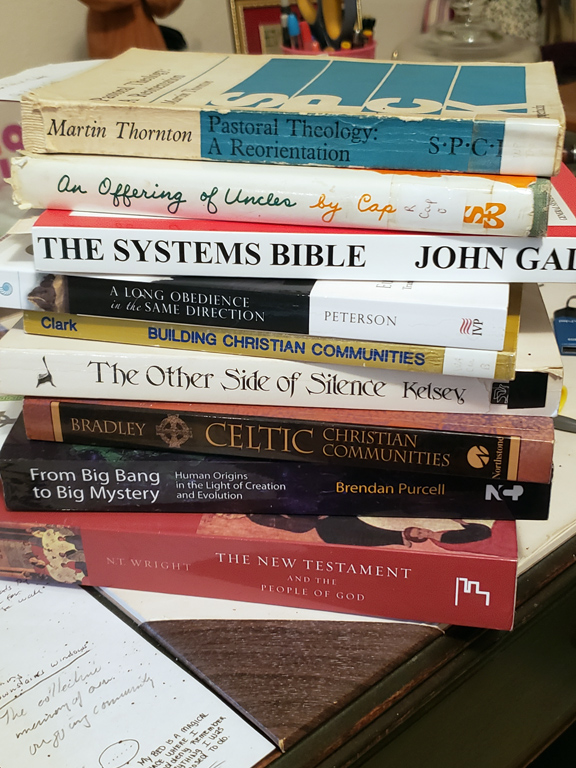
In the meantime, here’s the stack I’m working through for the book:
 The Apprentice Priest