
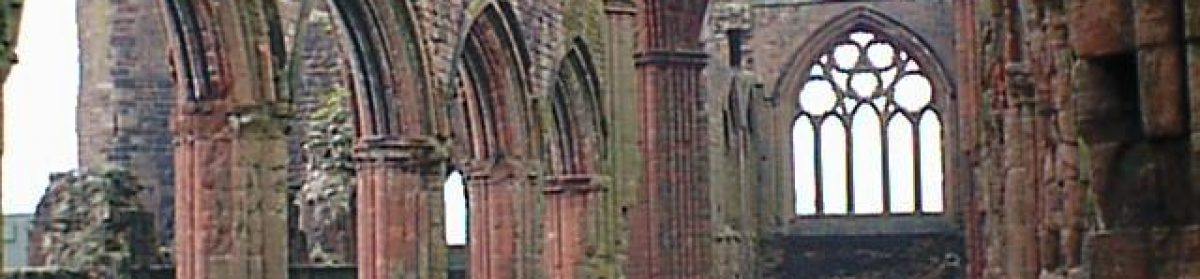
The first Sunday in October, fourteen years ago, I preached a sermon series on foundations. It was topical at the time. We were in a difficult transition in the parish. The denomination and its overseas partners were in turmoil. We were, to say the least, unsettled. It seemed a good time to look at what shape our foundation was in as a Christian community. Those of us who were at Trinity in those days may tell you they remember the series because of an illustration that stretched over four weeks. It had to do with the near collapse of Winchester Cathedral and how a deep sea diver helped save the cathedral. It’s a great story, but I won’t retell it here. If you’re interested just search for “Diver Bill” on the Internet.
The issue of foundations has been an unexpected theme in my sabbatical reading. Though Scripture tells us “For no one can lay any foundation other than the one already laid, which is Jesus Christ.” (1Corinthians 3:11); in fact, a building has foundations built on the central foundation. When we were beginning our narthex expansion in 2012, we did soil sampling of the ground where we would build. That soil was found to be fill dirt and no matter how solid a foundation of concrete and rebar we could pour; the ground underneath was too unstable to build on. The ultimate foundation of any building is the solid earth itself, and that equates to the Jesus foundation of the Body of Christ.
Even though the ground was unstable we built there anyhow, but not in foolishness. Rather, the builders drove a number of “helical piers” into the bedrock below the unstable soil. Thus a second “foundation” was set into the ultimate foundation of bedrock. This leads to another use of the image of foundation in Scripture: “… the foundation of the apostles and prophets, with Christ Jesus himself as the chief cornerstone.” (Ephesians 2:20) This secondary foundation’s reference to a cornerstone has real significance in the life of a Christian community. Today, cornerstones are more decorative than functional. In the past, the cornerstone was essential to constructing a stable building. From this stone all other stones will be set in reference. That’s an excellent guideline for a church whether speaking of local congregations or denominations. As the culture in which we exist changes the practices and language of the church must adapt, but only within limits. All changes must be in reference to the cornerstone of Christ Jesus or what we build will not stand for long.

Of course, once the helical piers were in place, the foundation of the addition was next. Steel beams were placed along the piers and with rebar and steel sheets the foundation of the addition was poured in concrete. Once that was in place, the building could rise. There is one other foundation image in Scripture: “… you will know how people ought to conduct themselves in God’s household, which is the church of the living God, the pillar and foundation of the truth.” (1Timothy 3:15) This rather ambitious description of the church makes more sense if we see it as a third foundation dependent on the first two.
A community, founded on the life, death, resurrection and ascension (enthronement) of Jesus is founded on a reality that does not change no matter how cultures and systems and theories evolve. A community building itself with constant reference to the cornerstone of Jesus can adapt to a changing world without compromising its foundation or losing its integrity. If both of those foundations hold, then Paul’s assertion about the nature of the church is quite reasonable.
It is this third foundation that has caught my attention in my sabbatical reading. I think it is important because until we grasp what it is and what it means for us I don’t think we’ll be able to fully realize our destiny in Christ as Trinity Parish.
That’s all I have for today. It will take some time to organize my thoughts. It will take a great deal of prayer to get a glimmer of what I believe God may be saying to us at this time. Don’t expect a quick follow up. But for those few who read this, I ask that you encourage others to read and reflect as well. Blogs are essentially monologues. Even the option for comments doesn’t take us very far. If this time away is to bear the fruit it should, we’ll have to move this from monologue to dialogue.

 The Apprentice Priest